
Recallab › Question bank › Gynaecology › #50583
Human papillomavirus vaccination
A 14-year-old girl is to be vaccinated against human papillomavirus. Which types matter most for cervical cancer, and how does the schedule differ by age at the first dose?
- correctA. Types 16 and 18; two doses if started before 15 years, three doses if started at 15 or later
- B. Types 6 and 11; three doses at any age
- C. Types 6 and 11; a single dose is sufficient at any age
- D. Types 16 and 18; three doses at any age, with a booster every five years
Explanation
Key fact
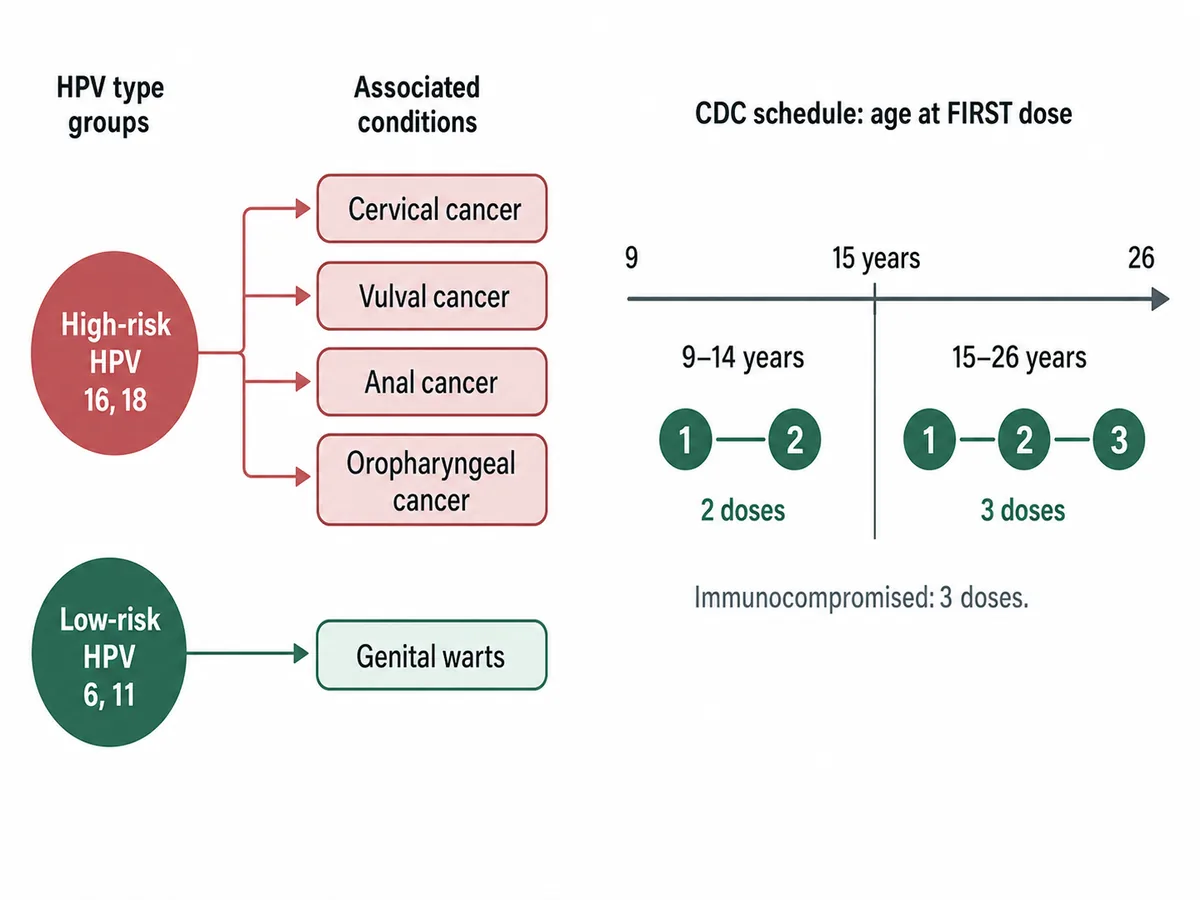
Sixteen and eighteen cause the cancer; six and eleven cause the warts. The younger the start, the fewer the doses needed.
Types 16 and 18, with two doses before 15 years and three from 15 onwards. Younger immune responses are stronger.
Why
Types 16 and 18 cause about 70 per cent of cervical cancers.
Types 6 and 11 cause genital warts and are covered by the quadrivalent vaccine.
Antibody responses in younger adolescents are higher, so two doses suffice.
From 15 years, or with immunocompromise, three doses are given.
It works best before exposure, hence vaccination before sexual debut.
Which types, and how many doses
Why not the others
- B. Types 6 and 11; three doses at any age — names the wart-causing types rather than the oncogenic ones.
- C. Types 6 and 11; a single dose is sufficient at any age — names the wrong types; single-dose schedules are being adopted in some programmes but not as stated here.
- D. Types 16 and 18; three doses at any age, with a booster every five years — names the right types but no booster is recommended, and two doses suffice in the young.
Remember
Sixteen and eighteen for cancer. Two doses if under fifteen.
Go deeper
Vaccination does not replace screening, because the vaccine does not cover every oncogenic type and many women were vaccinated after exposure.
The nonavalent vaccine adds five further oncogenic types, raising coverage to about 90 per cent of cervical cancers.
Boys benefit too, through reduced anal and oropharyngeal cancer and herd protection, which is why several countries vaccinate both sexes.
Park K. Park's Textbook of Preventive and Social Medicine, 28th ed. (Bhanot, 2025); Williams Gynecology, 4th ed. (McGraw Hill, 2020).