
Recallab › Question bank › Paediatrics › #50592
Congenital adrenal hyperplasia
A newborn with ambiguous genitalia and a 46,XX karyotype collapses on day 10 with vomiting, hyponatraemia and hyperkalaemia. Which enzyme is deficient, and why do virilisation and salt loss occur together?
- A. 17-alpha-hydroxylase; the block raises androgens and causes salt retention
- B. 11-beta-hydroxylase; the block causes salt loss and hypotension
- C. 5-alpha-reductase; the block prevents virilisation and causes salt loss
- correctD. 21-hydroxylase; the block diverts precursors into androgens while cortisol and aldosterone both fail
Explanation
Key fact
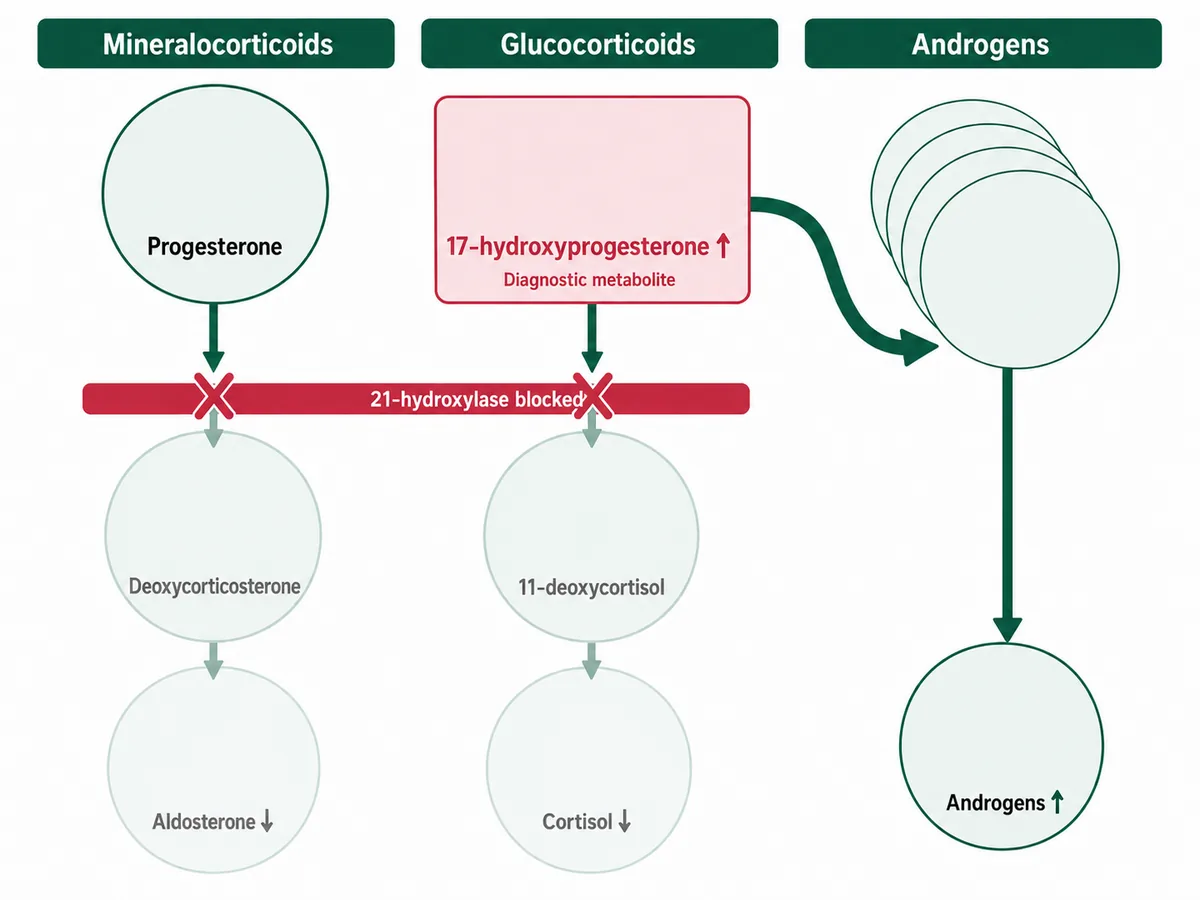
One blocked enzyme, two hormones lost and one overproduced. Everything upstream is pushed down the only open path.
21-hydroxylase, diverting precursors to androgens while cortisol and aldosterone both fail. It accounts for over 90 per cent of cases.
Why
21-hydroxylase is needed for both cortisol and aldosterone.
Losing cortisol removes negative feedback, so ACTH rises and the gland hyperplases.
Accumulated 17-hydroxyprogesterone is diverted into the androgen pathway.
A 46,XX fetus is therefore virilised in utero.
Losing aldosterone causes the salt-wasting crisis in the second week.
One block, three consequences
Why not the others
- A. 17-alpha-hydroxylase; the block raises androgens and causes salt retention — is wrong on androgens. That block reduces androgens and causes hypertension from mineralocorticoid excess.
- B. 11-beta-hydroxylase; the block causes salt loss and hypotension — also virilises but causes hypertension, because deoxycorticosterone accumulates.
- C. 5-alpha-reductase; the block prevents virilisation and causes salt loss — is a peripheral conversion defect in 46,XY individuals, with normal adrenal function and no salt loss.
Remember
Cortisol down, aldosterone down, androgens up. Ambiguous genitalia then a salt-losing crisis.
Go deeper
Raised 17-hydroxyprogesterone is the diagnostic marker and the basis of newborn screening where it is done.
A virilised 46,XX infant is the commonest cause of ambiguous genitalia, and the crisis is what kills - so electrolytes are checked in any such newborn.
Treatment replaces both hormones: hydrocortisone and, in salt-losers, fludrocortisone, with stress dosing during illness.
Nelson Textbook of Pediatrics, 22nd ed. (Elsevier, 2024); Ghai Essential Pediatrics, 10th ed. (CBS Publishers, 2025).