
Recallab › Blog › Psychiatry for NEET PG: six diagnostic clues in thoughts, time and function
Psychiatry for NEET PG: six diagnostic clues in thoughts, time and function
A psychiatry vignette becomes easier when you identify the feature that separates the nearest alternatives. Ask how the person experiences a thought, how much time it occupies and what happens to everyday function.
Register to practise NEET PG psychiatry questions →Free account, no card needed.
These six Recallab questions use illustrated profiles, checklists and charts to make those distinctions visible. They build from describing a symptom to deciding whether a diagnostic threshold is met. Try each before opening its worked answer.
Before you name the diagnosis: three questions
- How does the person experience it? Compare conviction, resistance and whether the thought fits the person's own wishes.
- What is its effect on daily life? Read time occupied, disrupted activities and consequences such as faltering growth.
- Which extra or absent feature changes the diagnosis? Check the whole symptom pattern, episode duration and severity before choosing a label.
Beliefs, obsessions and the daily threshold
Recallab example 1 · a belief that dominates the week
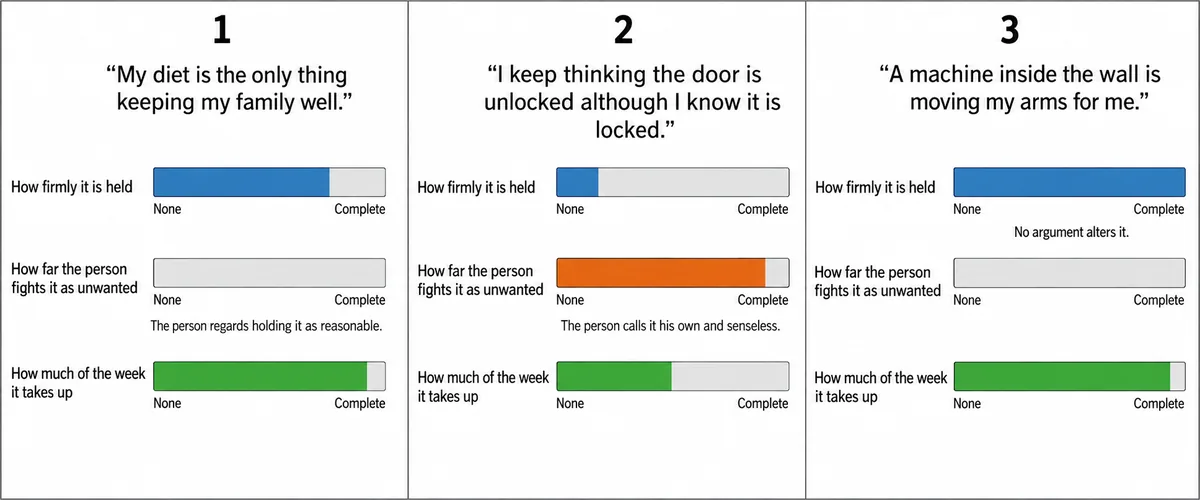
Three outpatients each hold a belief that has taken over much of their week. Each belief has been profiled in the figure on three measures taken at interview. What does patient 1 hold? Three patients, each with a short quoted belief and a three bar profile.
Look first: compare conviction, resistance and the share of the week occupied by the belief.
 View larger ↗⤢ Tap to enlarge
- AAn overvalued idea
- BAn obsession
- CAn ordinary preoccupation
- DA delusion
Show the answer and explanation
Answer: A. An overvalued idea
A. An overvalued idea. Patient 1 regards the belief as reasonable and does not resist it. It dominates the week, yet conviction stops short of absolute certainty. That combination fits an overvalued idea: a comprehensible belief that has gained disproportionate importance. Read all three bars together; time occupied alone does not distinguish these experiences.
Why the other options lose: an obsession (B) is unwanted and resisted in the profile shown for patient 2; patient 1 accepts the belief. An ordinary preoccupation (C) does not dominate most of the week in this way. A delusion (D) is held with fixed certainty despite contrary argument, as in patient 3; patient 1's conviction falls short of that.
Recallab question 58339 · Psychiatry › Basics & Classification · reference: Kaplan & Sadock's Synopsis of Psychiatry
Recallab example 2 · an unwanted thought or an everyday worry
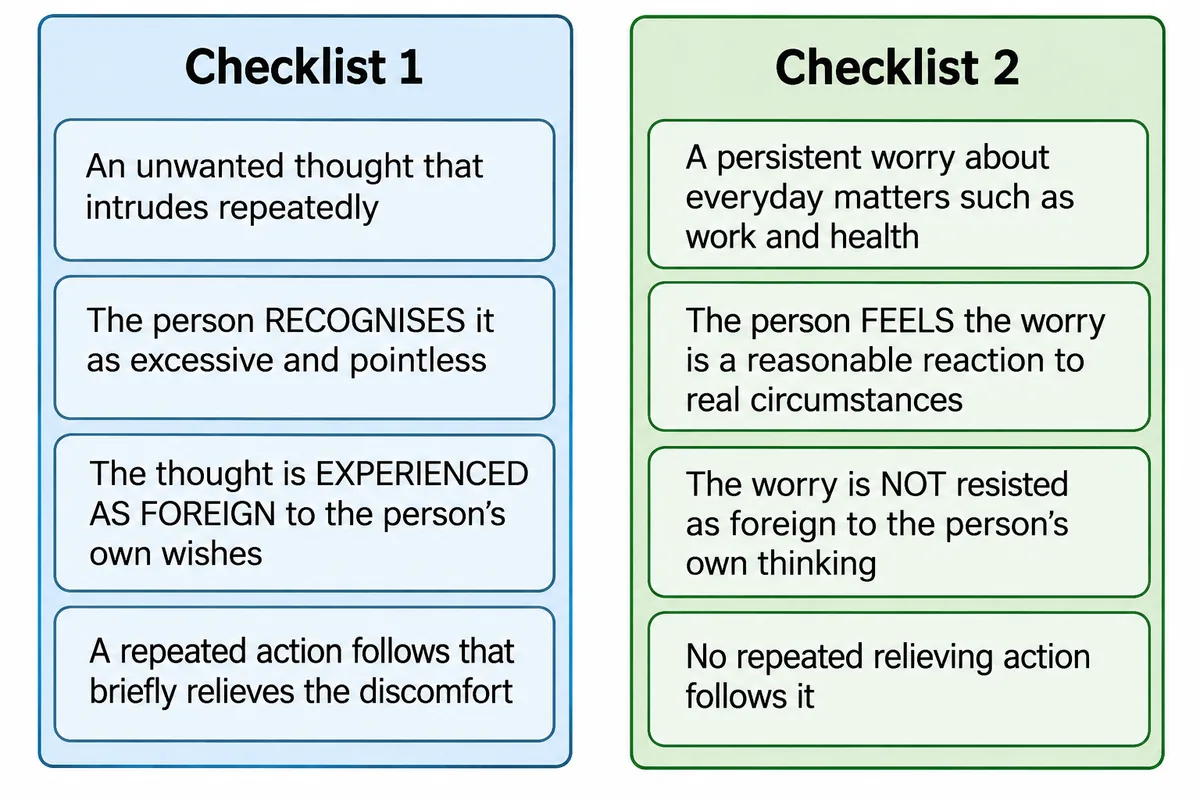
Two symptom checklists, taken from two different patients who each complain of distressing repetitive thoughts, are drawn in the figure side by side, numbered and with no diagnosis named on either. Checklist 1 describes an obsession rather than the worry of generalised anxiety. What single feature of it decides that? Two symptom checklists side by side, one an intrusive resisted thought, one an accepted everyday worry.
Look first: read how each person relates to the thought, rather than counting how often it returns.
 View larger ↗⤢ Tap to enlarge
- AIt is felt to be reasonable
- BIt concerns everyday matters
- CIt recurs many times a day
- DIt is resisted as foreign to the self
Show the answer and explanation
Answer: D. It is resisted as foreign to the self
D. It is resisted as foreign to the self. In checklist 1, the person recognises the thought as excessive and unwanted, and resists it because it conflicts with their wishes. This is an obsession. Here, foreign means unwelcome to the person, not inserted by an outside force: it remains their own thought. The associated ritual briefly relieves the discomfort. Checklist 2 instead describes worry accepted as a reasonable response to everyday circumstances.
Why the other options lose: feeling that the thought is reasonable (A) describes checklist 2, rather than the unwanted experience in checklist 1. Concern about everyday matters (B) describes the content of a worry, but content alone cannot settle the distinction. Recurring many times a day (C) can occur in either pattern. The decisive feature in this comparison is the person's recognition and resistance.
Recallab question 56538 · Psychiatry › Obsessive Compulsive Disorder · reference: Kaplan & Sadock's Synopsis of Psychiatry
Recallab example 3 · when checking takes over the day
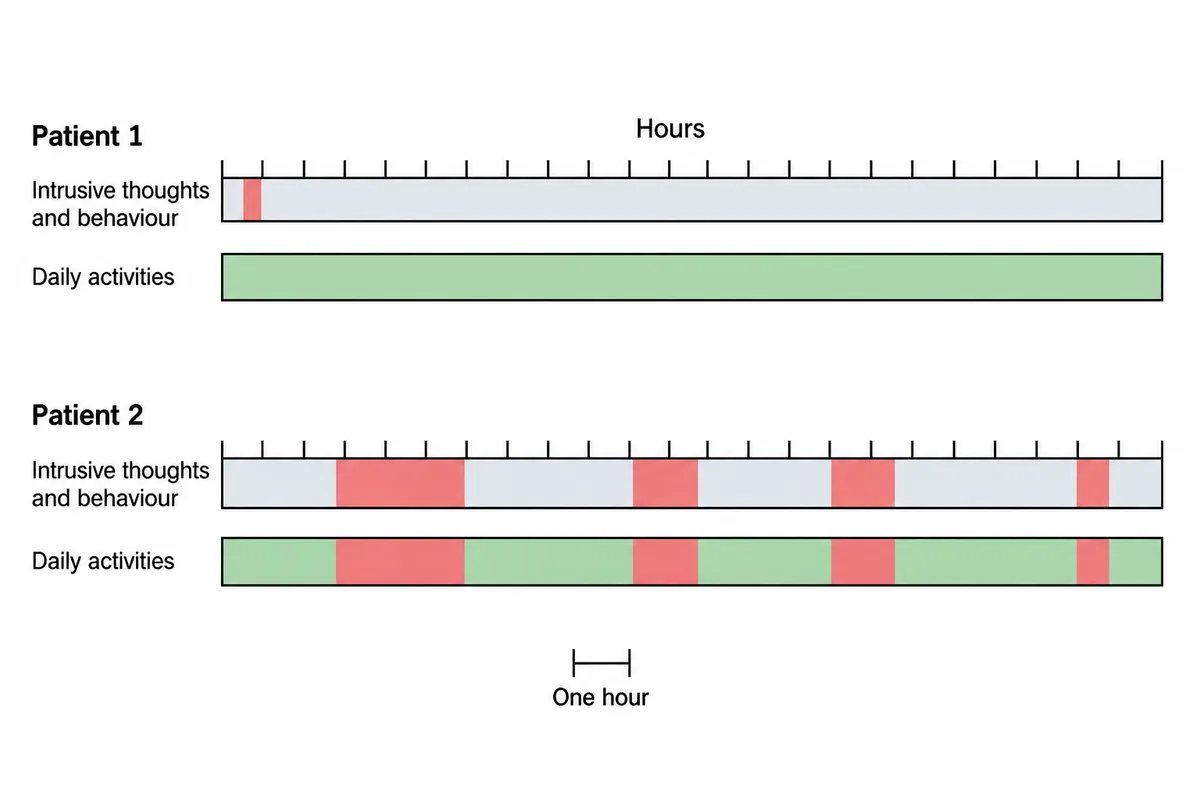
Two patients' daily time-use charts are drawn in the figure, each shading the hours spent on intrusive thoughts and repeated checking or washing across a twenty-four hour bar, with a second bar showing whether daily activities were interrupted. Patient 2's chart crosses the diagnostic time threshold and patient 1's does not. What in the chart decides it? Two patients' twenty-four hour time-use bars, shading time spent on intrusive thoughts and related behaviour.
Look first: measure the total shaded time against the one-hour mark, then read the daily-activities bar.
 View larger ↗⤢ Tap to enlarge
- AThe presence of any intrusive thoughts
- BShaded time exceeding one hour
- CInterruption of daily activities alone
- DMore than one day of charting
Show the answer and explanation
Answer: B. Shaded time exceeding one hour
B. Shaded time exceeding one hour. Patient 2 spends more than an hour a day on intrusive thoughts and associated behaviour. This crosses the time threshold shown in the question; interrupted daily activities provide further support. Patient 1 has less than an hour of shading and no interruption. More generally, OCD requires time-consuming symptoms, or clinically significant distress or impairment; exceeding an hour is not compulsory when the other criterion is met.
Why the other options lose: the presence of any intrusive thoughts (A) is insufficient, since patient 1 has them too. Interruption of daily activities alone (C) can be diagnostically significant, but it is not the sole deciding feature here: the shaded time already crosses the threshold. More than one day of charting (D) does not explain the difference between these two daily bars.
Recallab question 56640 · Psychiatry › Obsessive Compulsive Disorder · reference: Kaplan & Sadock's Synopsis of Psychiatry
Eating, trauma and mood: the deciding feature
Recallab example 4 · restricted eating and falling weight
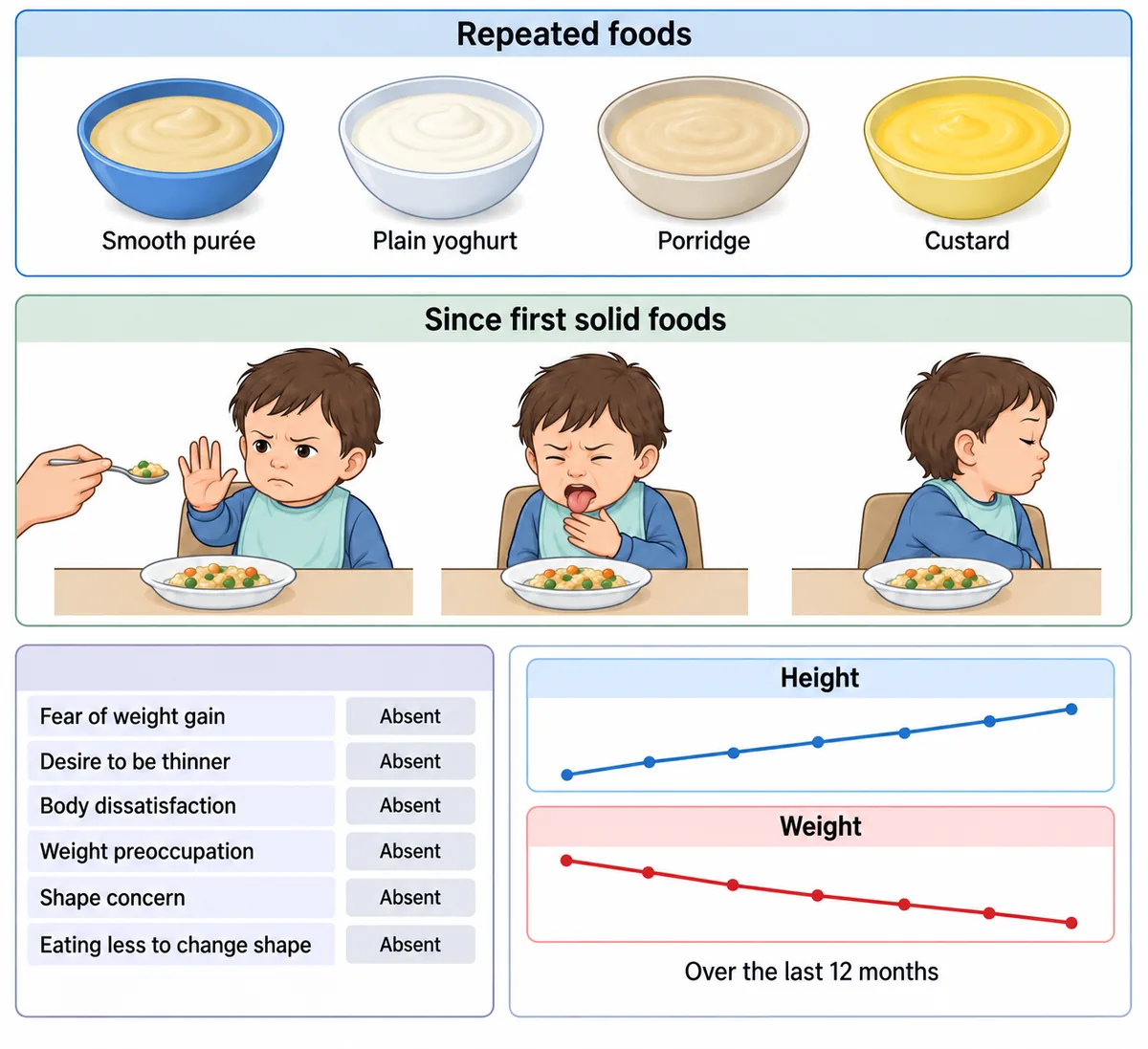
An eight-year-old boy has crossed two weight centiles downwards over a year. What he ate in one week, what happens when a new food is offered, and his answers about his own shape and weight are drawn in the figure. Which drawn finding separates his disorder from anorexia nervosa? A week of a boy's intake, what happens when a new food is offered, and his answers about his own shape and weight.
Look first: compare the food grid and growth chart with the answers about shape and weight.
 View larger ↗⤢ Tap to enlarge
- ANo concern about shape or weight
- BThe fall of two centiles
- CHis age of eight years
- DA very narrow range of foods
Show the answer and explanation
Answer: A. No concern about shape or weight
A. No concern about shape or weight. The questionnaire supplies the discriminator in this case. His intake is narrow, he rejects unfamiliar textures and his weight has crossed two centiles downwards. This supports avoidant restrictive food intake disorder, or ARFID, with a meaningful nutritional consequence. The restriction is not driven by a disturbed experience of body shape or weight, which separates this presentation from anorexia nervosa.
Why the other options lose: a fall of two centiles (B) shows the effect on growth, but weight can also fall in anorexia nervosa. His age of eight years (C) cannot exclude anorexia nervosa, which can begin before puberty. A very narrow range of foods (D) describes restriction that can occur in either condition. The reason for restriction, rather than the short food list alone, settles this comparison.
Recallab question 58438 · Psychiatry › Eating Disorders · reference: Kaplan & Sadock's Synopsis of Psychiatry
Recallab example 5 · reading the whole trauma checklist
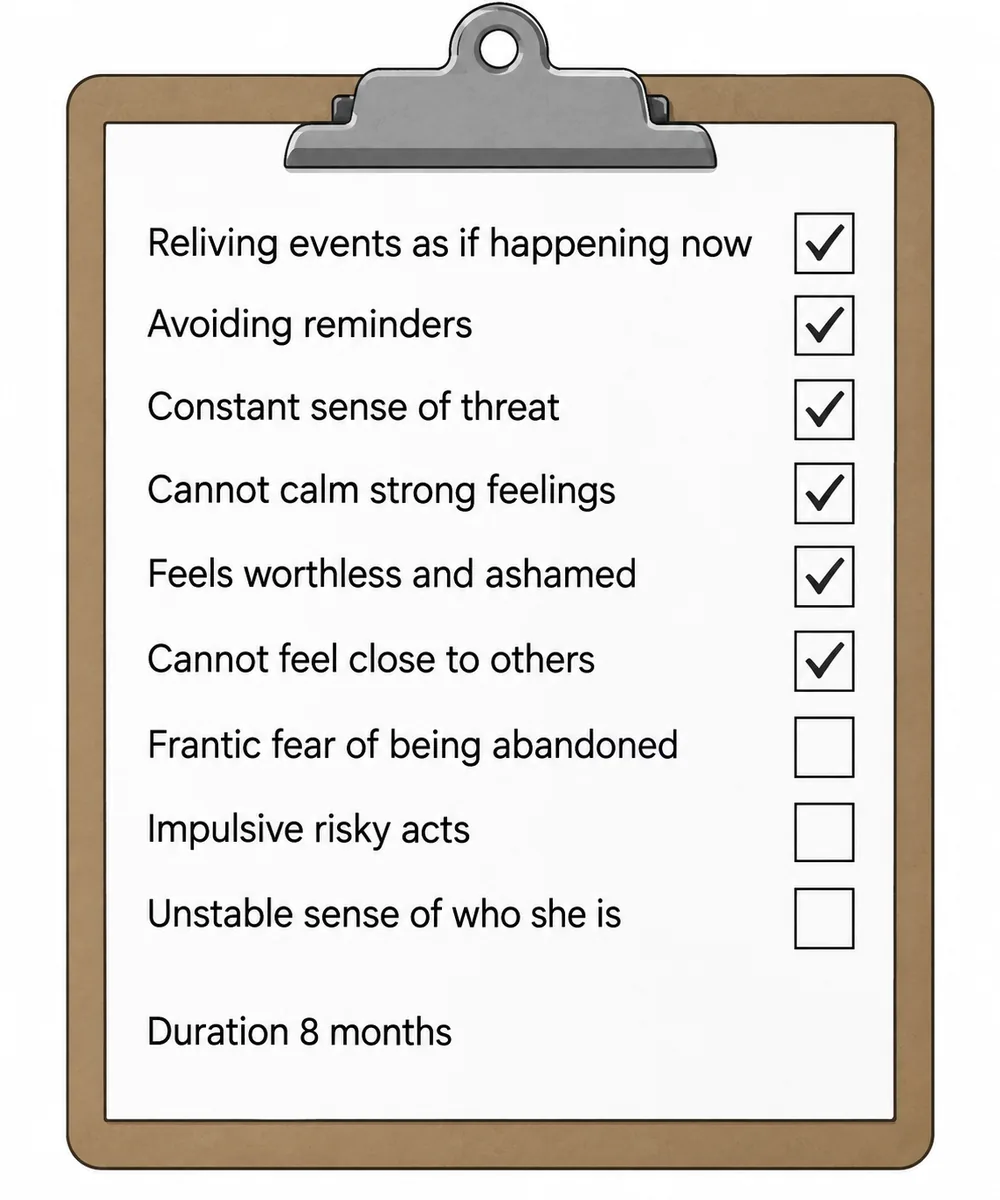
A woman of 32 was held and repeatedly abused by her partner for six years before she escaped. Eight months later she is assessed, and her completed ICD-11 symptom checklist is shown in the figure. What is the most likely diagnosis? Her completed symptom checklist, one row per symptom.
Look first: read every tick and blank box, and separate the trauma symptoms from changes in emotion, self-image and relationships.
 View larger ↗⤢ Tap to enlarge
- AComplex PTSD
- BAdjustment disorder
- CPTSD
- DBorderline personality disorder
Show the answer and explanation
Answer: A. Complex PTSD
A. Complex PTSD. The ICD-11 checklist shows all three core PTSD features: reliving events in the present, avoidance and a persistent sense of threat. It also shows difficulty regulating emotion, a negative view of herself and difficulty feeling close to others. These are the three disturbances in self-organisation that distinguish complex PTSD from PTSD. The prolonged abuse supports the context, but the symptom pattern decides the answer.
Why the other options lose: adjustment disorder (B) does not account for the full trauma-related pattern and is not the diagnosis when PTSD requirements are met. PTSD (C) accounts for the first three ticks but misses the additional disturbances in self-organisation. Borderline personality disorder (D) would be supported by features such as fear of abandonment, impulsivity and an unstable identity; those rows are unticked in this comparison.
Recallab question 60439 · Psychiatry › Anxiety, Stress & Somatoform · reference: Kaplan & Sadock's Synopsis of Psychiatry
Recallab example 6 · a short elevated episode with admission
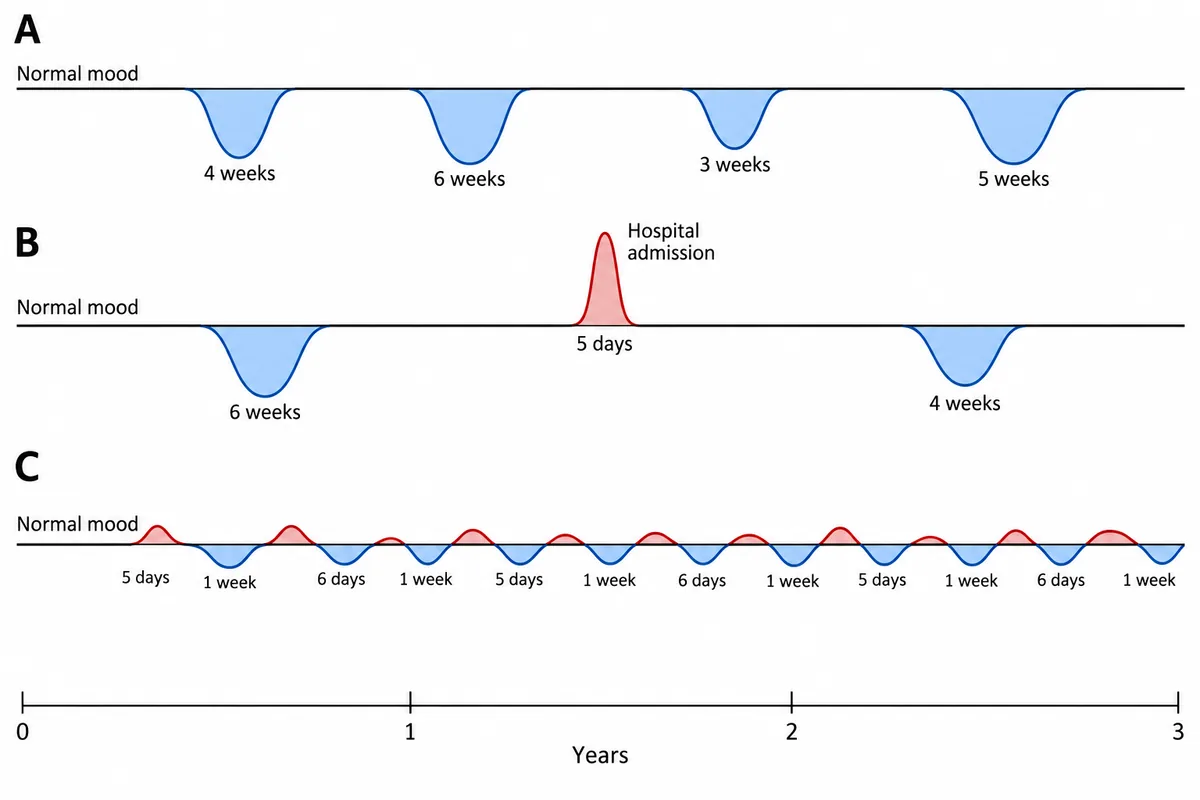
Three patients' moods are charted in the figure over three years, with the duration of each episode marked. Which diagnosis does chart B support? Three mood charts over three years, with the duration of each episode marked.
Look first: read the duration labels together with the note beside the elevated episode in chart B.
 View larger ↗⤢ Tap to enlarge
- ACyclothymia
- BSchizoaffective disorder
- CBipolar affective disorder
- DRecurrent depressive disorder
Show the answer and explanation
Answer: C. Bipolar affective disorder
C. Bipolar affective disorder. Chart B contains depressive episodes and an elevated episode lasting five days that required hospital admission. The need for admission because of the elevated episode makes it mania rather than hypomania; a manic episode can be shorter than a week when admission is necessary. A manic episode supports bipolar I disorder even without a depressive episode. In this chart, both poles of mood are visible.
Why the other options lose: cyclothymia (A) fits the persistent smaller fluctuations in chart C, without full mood episodes. Schizoaffective disorder (B) requires a psychotic illness pattern that this mood chart does not establish; no psychotic symptoms independent of mood episodes are shown. Recurrent depressive disorder (D) fits chart A's depressive episodes without elevation. The admission note prevents the five-day duration from being mistaken for hypomania.
Recallab question 55083 · Psychiatry › Mood Disorders · reference: Kaplan & Sadock's Synopsis of Psychiatry
The one-minute routine
| If the figure gives | Ask first | It settles |
|---|---|---|
| A belief profile | Is it resisted, dominant or held with fixed certainty? | Obsession, overvalued idea or delusion |
| Two repetitive-thought checklists | Is the thought unwanted and resisted, or accepted as a reasonable worry? | Obsession versus anxious worry |
| A daily checking or washing chart | Does shaded time exceed an hour, or is there significant distress or impairment? | The diagnostic threshold for OCD |
| Restricted eating with falling weight | Is restriction driven by concerns about shape or weight? | ARFID versus anorexia nervosa in this case |
| An ICD-11 trauma checklist | Are emotion, self-image and relationships affected alongside the core PTSD symptoms? | Complex PTSD versus PTSD |
| A short elevated mood episode | Was admission necessary because of the episode? | Mania despite a duration under one week |
Practise more psychiatry questions and compare other figures in ten NEET PG image questions. For the diagnostic distinction between mania and hypomania, see the MSD Manual's bipolar disorders guide.
Why candidates use Recallab
- Built towards 22,000 — a batch at a time
- Illustrations drawn for the question
- Every option explained, not just the right one
- AI study tools that are live today
- Start free, today
Or see the plans, or try a timed mock section.
Register to practise NEET PG psychiatry questionsFree account, no card needed. Practise with every option explained and a reference on every question.Drawn from questions #58339, #56538, #56640, #58438, #60439, #55083 in the Recallab bank, each with its own verified answer and current-edition reference. Last reviewed 14 October 2026.