
Recallab › Question bank › Pharmacology › #50006
Amiodarone
A 64-year-old man has taken amiodarone for ten months for recurrent ventricular tachycardia after a myocardial infarction. He now reports fatigue, a 4 kg weight gain and cold intolerance. TSH is 14 mIU/L and free T4 is low. His arrhythmia has been well controlled and no alternative agent is considered safe for him. What is the most appropriate management?
- correctA. Continue amiodarone and start levothyroxine
- B. Stop amiodarone and observe for spontaneous recovery
- C. Stop amiodarone and start carbimazole
- D. Continue amiodarone and start oral prednisolone
Explanation
Key fact
Amiodarone-induced hypothyroidism does not require stopping the drug - add levothyroxine and carry on.
Continue amiodarone and start levothyroxine. The hypothyroid form is easily replaced, so an effective antiarrhythmic need not be sacrificed.
Why
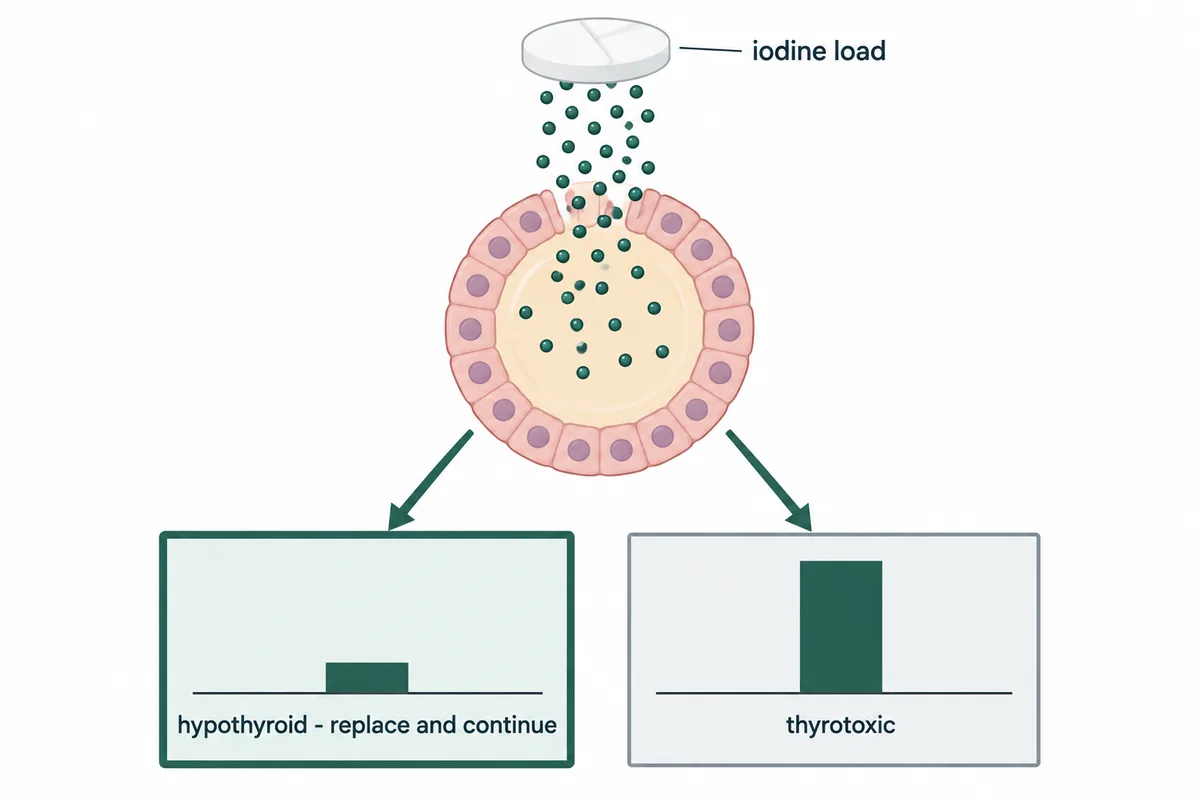
Each 200 mg tablet releases roughly 75 mg of iodine, far above the daily requirement.
That iodine load causes a Wolff-Chaikoff block that some thyroids fail to escape from.
The result is a straightforward primary hypothyroidism: high TSH, low free T4.
Levothyroxine corrects it directly and the dose is titrated on TSH.
Amiodarone has a half-life of weeks to months, so stopping it would not help quickly anyway.
The two directions of amiodarone thyroid disease
| Hypothyroidism | Thyrotoxicosis type 1 | Thyrotoxicosis type 2 | |
|---|---|---|---|
| Mechanism | Failure to escape Wolff-Chaikoff | Iodine-induced excess synthesis | Destructive thyroiditis |
| Gland | Often pre-existing autoimmunity | Nodular or latent Graves | Normal |
| Vascularity on Doppler | - | Increased | Absent |
| Treatment | Levothyroxine | Thionamide | Glucocorticoid |
| Stop amiodarone? | Not necessary | Usually | Often can continue |
Two ways an iodine load can go
Why not the others
- B. Stop amiodarone and observe for spontaneous recovery — gives up arrhythmia control in a man with post-infarct VT, and the long half-life means the iodine load persists for months.
- C. Stop amiodarone and start carbimazole — treats thyrotoxicosis. Giving it to a hypothyroid patient deepens the hypothyroidism.
- D. Continue amiodarone and start oral prednisolone — is the treatment for the destructive type 2 thyrotoxicosis, not for hypothyroidism.
Remember
Hypo: replace and continue. Hyper: think which type first. Only the thyrotoxic side forces a decision about the drug.
Go deeper
Baseline thyroid, liver and lung function plus a chest radiograph are checked before starting, then thyroid and liver function about six-monthly.
Other amiodarone toxicities to know: pulmonary fibrosis, corneal microdeposits, slate-grey photosensitive skin, hepatitis and optic neuropathy.
Its antiarrhythmic action is class III - potassium channel block prolonging phase 3 repolarisation - but it also has class I, II and IV activity.
Tripathi KD. Essentials of Medical Pharmacology, 9th ed. (Jaypee, 2024); Katzung's Basic & Clinical Pharmacology, 16th ed. (McGraw Hill, 2024).