
Recallab › Question bank › Medicine › Endocrinology › #50052
SGLT2 inhibitors in type 2 diabetes
A 58-year-old man with type 2 diabetes has an HbA1c of 8.2% on metformin. He also has heart failure with an ejection fraction of 35% and an eGFR of 44 mL/min/1.73m2 with a urine albumin-creatinine ratio of 320 mg/g. Which additional agent has the strongest evidence for reducing both heart failure hospitalisation and progression of his kidney disease?
- correctA. An SGLT2 inhibitor
- B. A sulfonylurea
- C. Pioglitazone
- D. A dipeptidyl peptidase-4 inhibitor
Explanation
Key fact
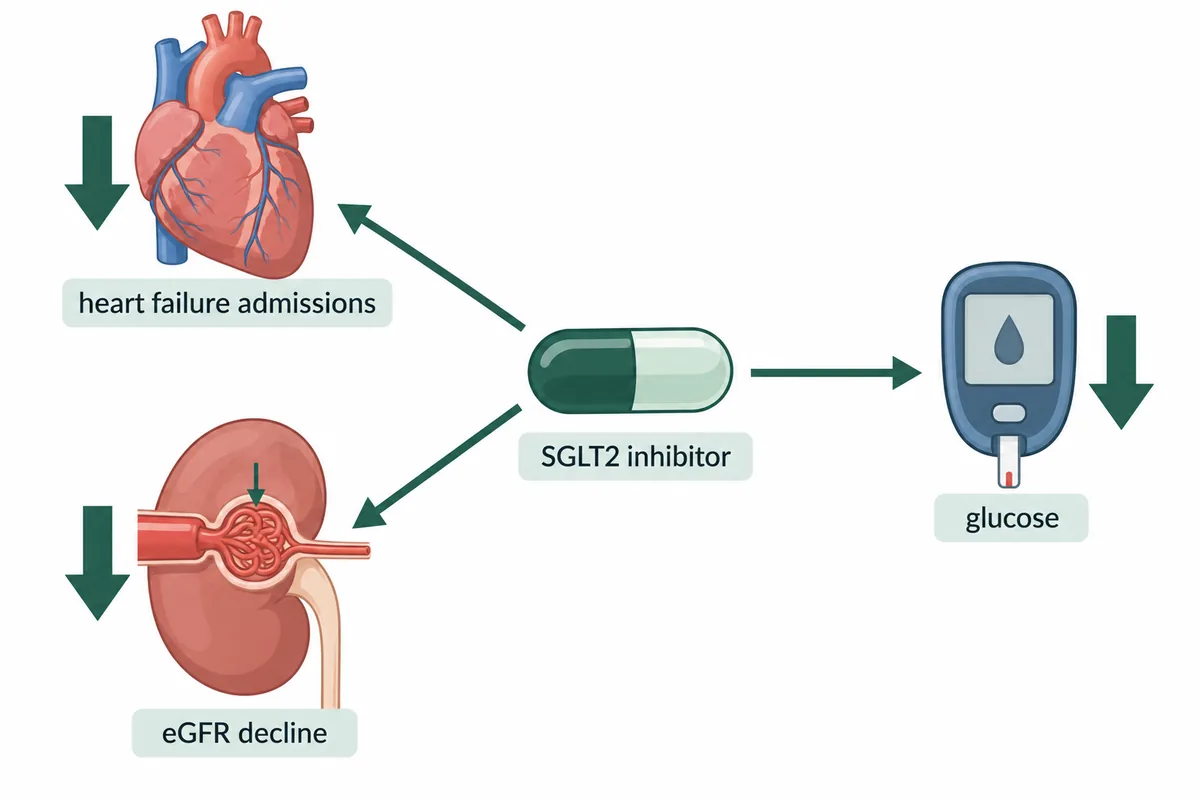
SGLT2 inhibitors protect the heart and the kidney independently of glucose control - which is why they are chosen when both are involved.
An SGLT2 inhibitor. It is the only class here with trial evidence for both heart failure hospitalisation and slowing kidney disease.
Why
He has three problems: hyperglycaemia, heart failure and albuminuric kidney disease.
SGLT2 inhibitors reduce heart failure hospitalisation whether or not the patient is diabetic.
They slow the fall in eGFR and reduce albuminuria.
The mechanism is largely haemodynamic - restoring tubuloglomerular feedback and reducing intraglomerular pressure.
An eGFR of 44 is no barrier; they are started well below that for kidney protection.
One drug, three problems
Why not the others
- B. A sulfonylurea — lowers glucose but offers no cardiac or renal protection, and causes hypoglycaemia and weight gain.
- C. Pioglitazone — causes fluid retention and is contraindicated in heart failure. It would make him worse.
- D. A dipeptidyl peptidase-4 inhibitor — is glucose-neutral for outcomes; saxagliptin actually increased heart failure hospitalisation in one trial.
Remember
Heart failure or kidney disease with diabetes? Reach for the flozin. The glucose lowering is almost incidental.
Go deeper
Expect a small early dip in eGFR after starting. It is haemodynamic, it stabilises, and it is not a reason to stop.
Warn about genital mycotic infection, volume depletion, and euglycaemic ketoacidosis during illness or fasting - hold the drug before surgery.
A GLP-1 receptor agonist is the alternative when atherosclerotic disease and obesity dominate rather than heart failure.
Harrison's Principles of Internal Medicine, 22nd ed. (McGraw Hill, 2025).