
Recallab › Question bank › Pharmacology › #50225
Warfarin reversal
A 71-year-old man on warfarin for atrial fibrillation is admitted with a large intracerebral haemorrhage. His INR is 6.2. Which is the most appropriate agent for immediate reversal?
- A. Protamine sulfate
- B. Fresh frozen plasma alone
- correctC. Four-factor prothrombin complex concentrate with intravenous vitamin K
- D. Intravenous vitamin K alone
Explanation
Key fact
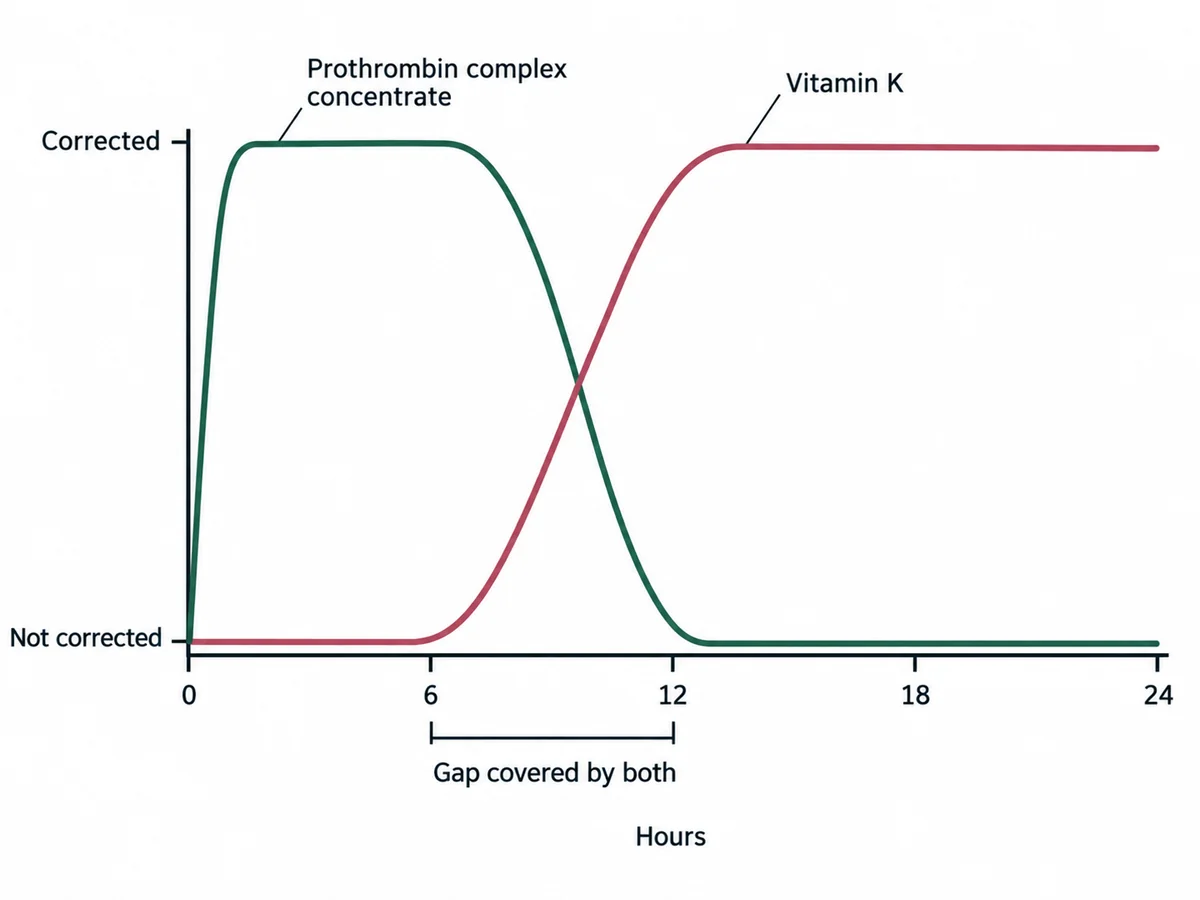
Prothrombin complex concentrate reverses warfarin in minutes; vitamin K takes hours. In life-threatening bleeding you need both.
Four-factor prothrombin complex concentrate with intravenous vitamin K. The concentrate replaces the factors now, and vitamin K keeps them replaced.
Why
Warfarin blocks vitamin K epoxide reductase, so factors II, VII, IX and X are not carboxylated.
Reversal needs those factors back in the blood immediately.
Prothrombin complex concentrate contains all four in small volume, and works within 10 to 15 minutes.
Vitamin K restores the liver's own synthesis, but takes 6 to 24 hours.
Given alone, the concentrate would wear off before the liver caught up - hence both.
Two clocks: why both agents are given
Why not the others
- A. Protamine sulfate — reverses heparin, not warfarin. It has no effect on vitamin K-dependent factor deficiency.
- B. Fresh frozen plasma alone — does work but needs large volumes, takes time to thaw and cross-match, and risks fluid overload. It is the fallback where concentrate is unavailable.
- D. Intravenous vitamin K alone — is essential but far too slow on its own for an intracerebral bleed. The haematoma expands while you wait.
Remember
Concentrate for now, vitamin K for later. Neither alone is adequate in major bleeding.
Go deeper
Warfarin skin necrosis appears in the first days of treatment, because protein C has a shorter half-life than the procoagulant factors and falls first, creating a transient prothrombotic state. Heparin cover prevents it.
For a raised INR without bleeding, omitting doses with or without oral vitamin K is usually enough.
Warfarin has innumerable interactions through CYP2C9 and through displacement from albumin; benzodiazepines are one of the few classes that do not interact.
Tripathi KD. Essentials of Medical Pharmacology, 9th ed. (Jaypee, 2024); Katzung's Basic & Clinical Pharmacology, 16th ed. (McGraw Hill, 2024).