
Recallab › Question bank › Medicine › Endocrinology › #50262
Addison disease
A 38-year-old woman has six months of fatigue, weight loss and dizziness on standing. She has darkening of the palmar creases, buccal mucosa and old scars. Sodium is 126 mEq/L, potassium 5.8 mEq/L and 9 am cortisol is low. Why is she pigmented, and what does that tell you about the level of the lesion?
- A. ACTH is low, so the lesion is in the pituitary
- correctB. ACTH is high and its precursor drives melanocytes, so the lesion is in the adrenal gland
- C. Aldosterone excess causes the pigmentation, so the lesion is in the zona glomerulosa
- D. Cortisol itself stimulates melanocytes, so the lesion could be at either level
Explanation
Key fact
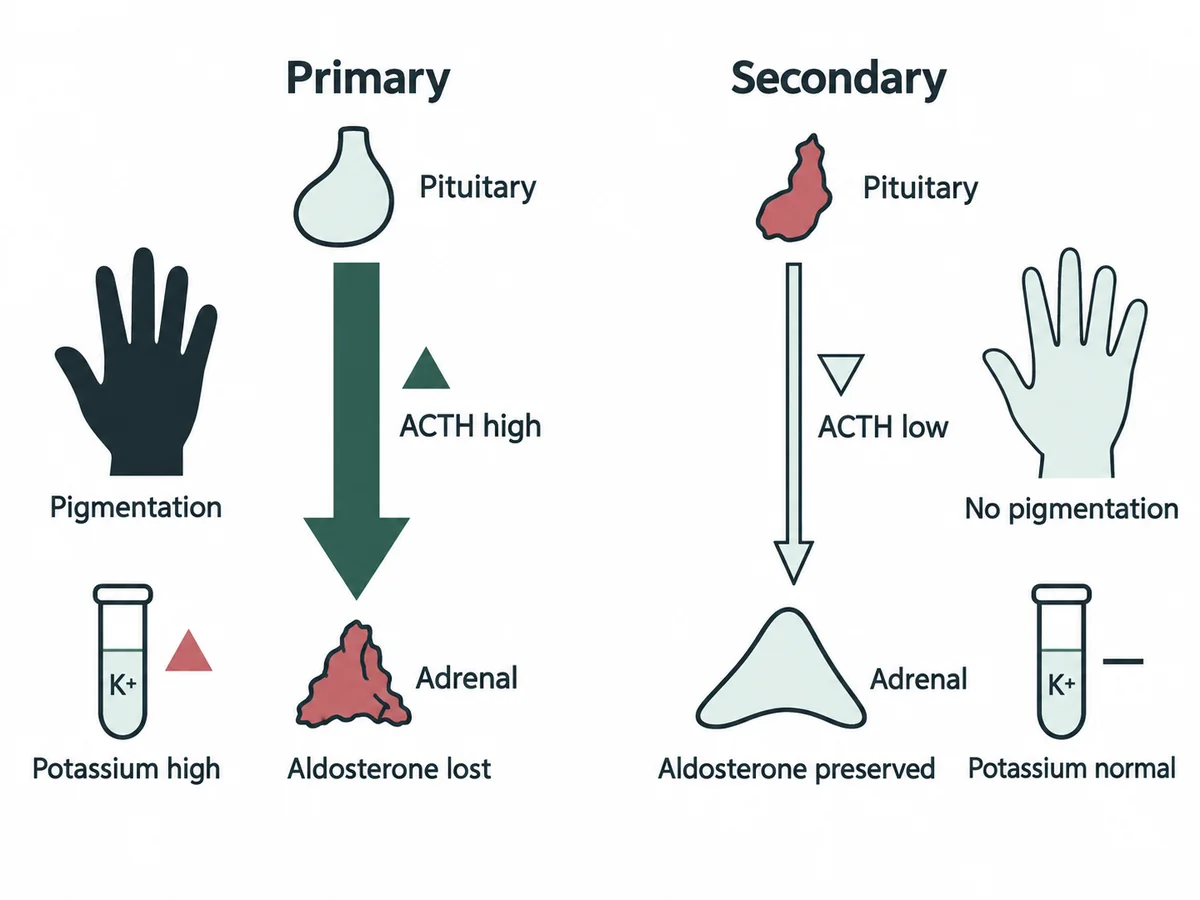
Pigmentation means the problem is in the adrenal, not the pituitary. Only primary failure raises ACTH, and it is ACTH that pigments.
ACTH is high and drives melanocytes, so the lesion is adrenal. Secondary adrenal failure has a low ACTH and no pigmentation.
How it happens
- Cortisol is low, so there is adrenal insufficiency.
- The question is whether the failure is primary or secondary.
- In primary failure the adrenal cannot respond, so negative feedback is lost and ACTH rises.
- ACTH is cleaved from pro-opiomelanocortin, which also yields melanocyte-stimulating hormone.
- High concentrations act on melanocortin-1 receptors and darken skin and mucosa.
- Hyperkalaemia also localises it: aldosterone is lost only in primary failure, because the renin-angiotensin system, not ACTH, controls it.
Primary against secondary adrenal insufficiency
Why not the others
- A. ACTH is low, so the lesion is in the pituitary — would mean no pigmentation and a normal potassium, because aldosterone is not ACTH-dependent.
- C. Aldosterone excess causes the pigmentation, so the lesion is in the zona glomerulosa — reverses the physiology. Aldosterone is deficient here, which is why the potassium is high.
- D. Cortisol itself stimulates melanocytes, so the lesion could be at either level — is wrong. Cortisol has no melanocyte action; it is the ACTH precursor peptide that does.
Remember
Pigmented and hyperkalaemic means primary; pale and normokalaemic means secondary. Two signs settle the level.
Go deeper
Confirm with a short synacthen test: an inadequate cortisol rise 30 minutes after synthetic ACTH. Plasma ACTH then separates primary from secondary.
In an adrenal crisis, treat first and test later: fluids and hydrocortisone immediately, taking the cortisol and ACTH sample before the first dose if possible.
Worldwide the commonest cause of primary failure is autoimmune adrenalitis, but tuberculosis remains a major cause in India, often with adrenal calcification.
Patients need a steroid card, a doubled dose during illness, and parenteral hydrocortisone for vomiting - sick day rules.
Harrison's Principles of Internal Medicine, 22nd ed. (McGraw Hill, 2025).