
Recallab › Question bank › Pharmacology › Antimicrobial Drugs › #50525
Surgical antibiotic prophylaxis
A 50-year-old man with stable angina is listed for elective coronary artery bypass grafting. He has no drug allergies and is not known to be colonised with resistant organisms. Which antibiotic should be used for prophylaxis, and when should it be given relative to the skin incision?
- A. Vancomycin for every patient, 24 hours before surgery
- B. Ciprofloxacin, immediately after the incision is made
- C. Benzylpenicillin, at induction of anaesthesia and for five days afterwards
- correctD. Cefazolin, within 60 minutes before incision
Explanation
Key fact
Prophylaxis must be in the tissue before the knife goes in. A first- or second-generation cephalosporin covers the skin organisms that matter.
Cefazolin within 60 minutes before incision. Staphylococci from the skin are the target.
Why
Surgical site infection comes mainly from the patient's own skin flora.
Staphylococcus aureus and coagulase-negative staphylococci dominate.
Cefazolin covers both and has a suitable half-life.
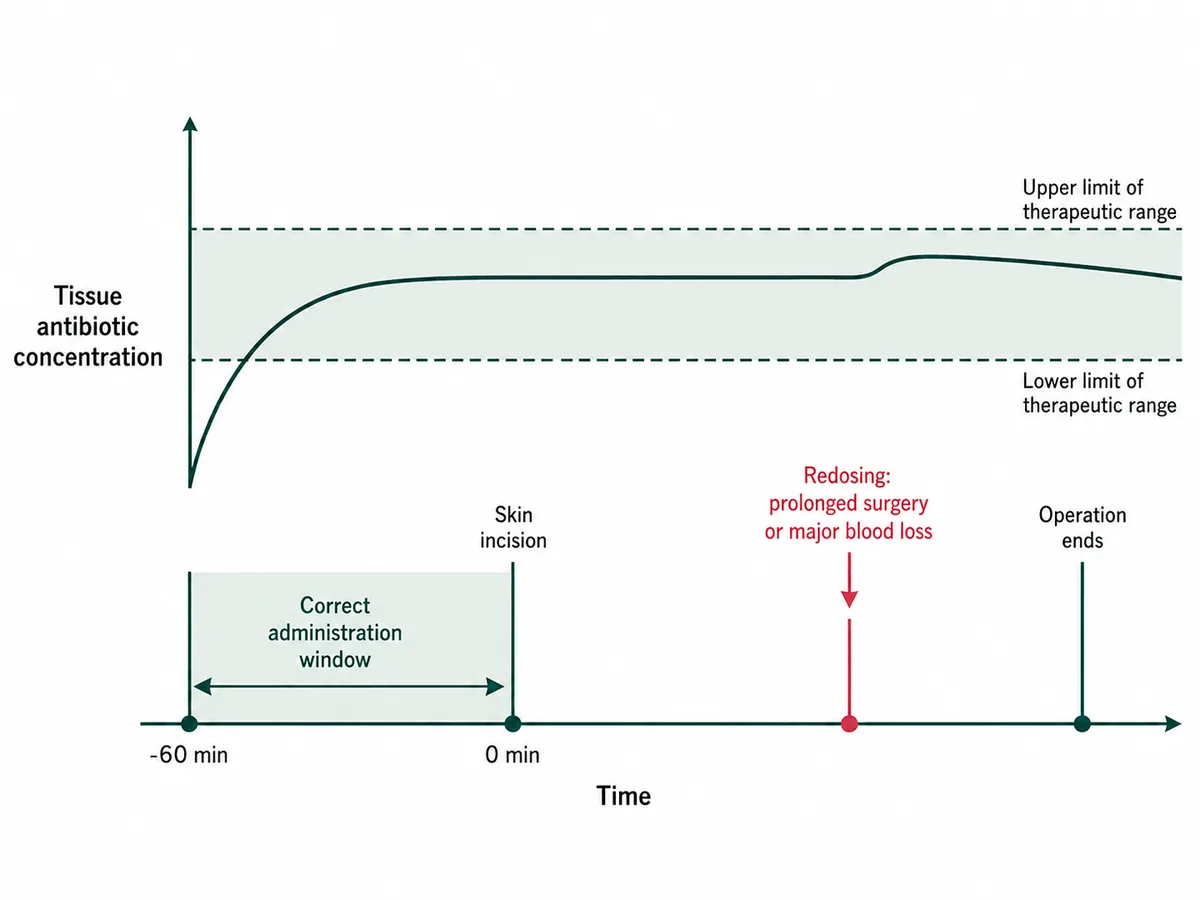
Tissue concentration must be adequate at the moment of incision.
A dose is repeated if surgery is prolonged or blood loss is heavy.
Timing surgical antibiotic prophylaxis
Why not the others
- A. Vancomycin for every patient, 24 hours before surgery — is reserved for known colonisation with resistant staphylococci or true beta-lactam allergy, and 24 hours ahead is far too early.
- B. Ciprofloxacin, immediately after the incision is made — is given too late to protect the wound, and a quinolone is the wrong spectrum for skin flora.
- C. Benzylpenicillin, at induction of anaesthesia and for five days afterwards — has too narrow a spectrum for skin staphylococci, and prolonged postoperative courses increase resistance without reducing infection.
Remember
One dose, within the hour before the knife. Not after, and not for days.
Go deeper
Vancomycin needs a longer infusion, so it is started 60 to 120 minutes before incision when it is genuinely indicated.
Continuing prophylaxis beyond 24 hours does not reduce surgical site infection and does select resistant organisms - one of the clearest findings in the field.
The diphtheria carrier state is treated with erythromycin or penicillin, which is the other half of this seed and a separate question.
Bailey & Love's Short Practice of Surgery, 28th ed. (CRC Press, 2023); Goodman & Gilman's The Pharmacological Basis of Therapeutics, 14th ed. (McGraw Hill, 2023).