
What a MentorQ is
A MentorQ is a Recallab question that comes with its own Mentor. The Mentor has time for you: ask it to put the question more simply, compare the options or take it step by step, as often as you need. When you want a specialist, the Professor gives one considered reading of your answer — the verdict, the reasoning, the trap you fell into and the pearls to keep. Both teach only from that question’s approved explanation. The question underneath is written to teach too: the answer verified against a named current edition, every option explained, and a figure drawn for the point it turns on. Here is a real one, with its Mentor and Professor, exactly as the app shows it.
1 · The question, as a learner answered it
✕ This learner chose A. The answer is D.
The explanation
Answer: D. All of the above
Key fact
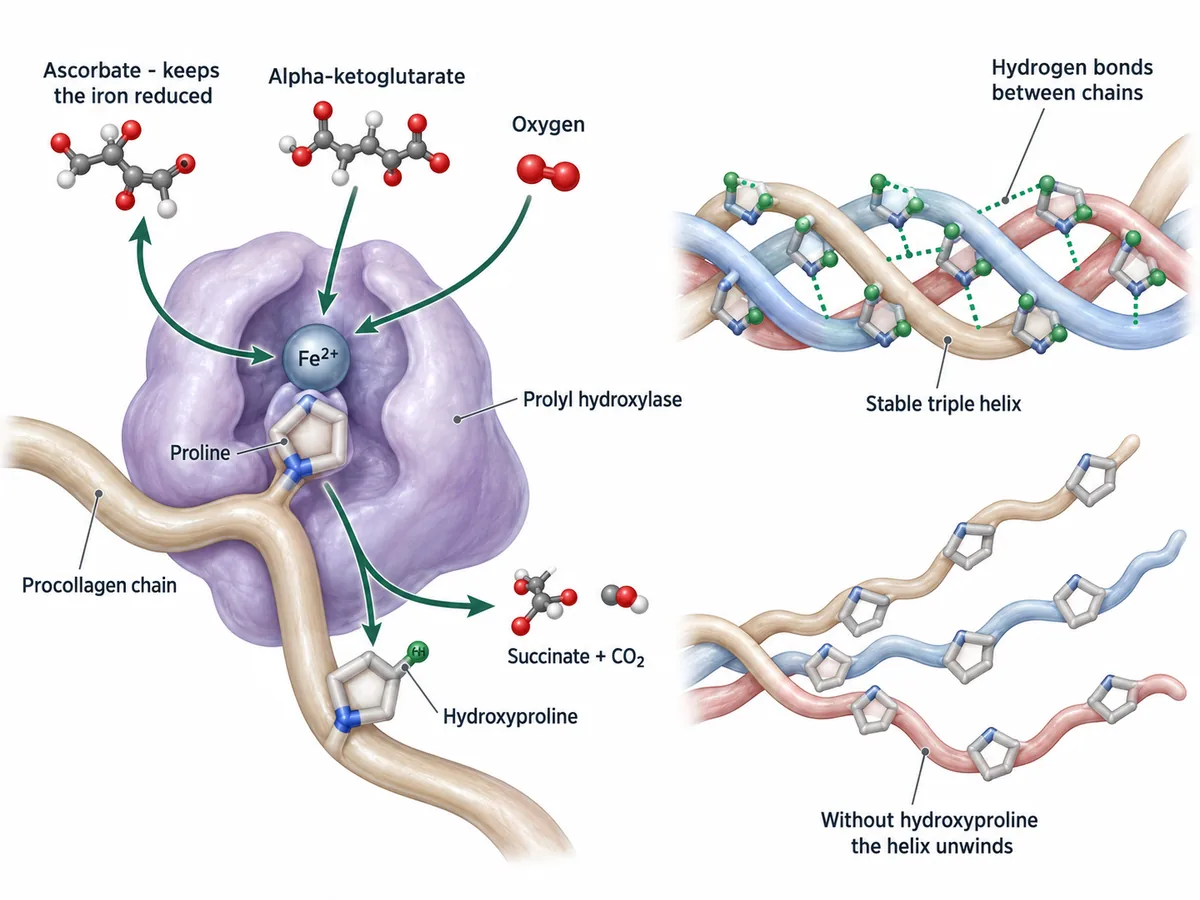
Prolyl hydroxylase needs four things at once: ascorbate, alpha-ketoglutarate, molecular oxygen and ferrous iron. Without hydroxyproline the collagen triple helix cannot form.
All of the above. Ascorbate, alpha-ketoglutarate and oxygen are all required, along with ferrous iron in the active site.
Why
Prolyl hydroxylase is a dioxygenase: it splits molecular oxygen between two substrates.
One oxygen atom hydroxylates the proline residue; the other converts alpha-ketoglutarate to succinate and carbon dioxide.
Ferrous iron sits in the active site and is essential for catalysis.
Iron is slowly oxidised during turnover, and ascorbate reduces it back to Fe2+.
Hydroxyproline then forms interchain hydrogen bonds that hold the triple helix together.
Four requirements at one active site
Why not the others
- A. Ascorbate — is required, but it is only one of the four; alone it is an incomplete answer.
- B. Alpha-ketoglutarate — is required as co-substrate, but again it is not the whole requirement.
- C. Oxygen — is required as the source of the hydroxyl group, and is likewise incomplete on its own.
Remember
Scurvy is a hydroxylation failure, not a collagen synthesis failure - the chains are made, they simply will not hold together.
Go deeper
The same chemistry explains why wound healing fails and old scars break down in scurvy: newly made collagen is unstable while existing collagen keeps turning over.
Prolyl hydroxylase of the HIF pathway uses identical cofactors, which is how cells sense hypoxia.
Harper's Illustrated Biochemistry, 33rd ed. (McGraw Hill, 2025); Lippincott Illustrated Reviews: Biochemistry, 9th ed. (Wolters Kluwer, 2025).
2 · Its Mentor, then the Professor, on the same question
Real replies from Recallab’s AI Mentor and Professor, recorded on 19 September 2026 for a learner who answered A. Both teach only from this question’s approved explanation and figure.
Explain this with simpler words.
The correct answer is D. All of the above.
To modify proline in collagen, the enzyme prolyl hydroxylase needs several ingredients:
- Ascorbate (vitamin C)
- α-ketoglutarate
- Oxygen
- Ferrous iron (Fe²⁺)
Each is necessary, so choosing only ascorbate is incomplete. Vitamin C helps keep the enzyme’s iron in the active Fe²⁺ form. The reaction adds a hydroxyl group to proline, producing hydroxyproline, which helps collagen chains hold their triple-helix shape.
In vitamin C deficiency (scurvy), collagen chains are still produced, but they are unstable because hydroxylation is impaired.
Check yourself: Which vitamin deficiency impairs collagen proline hydroxylation?
Verdict
You chose A, which is genuinely required, but the stem asks for the full set of listed requirements of peptidyl prolyl hydroxylation. Therefore D is correct: each of A, B, and C is necessary.
Reasoning
First, read the wording precisely: this is not asking which vitamin is associated with collagen, but what the hydroxylation reaction requires. The explanation identifies prolyl hydroxylase as a dioxygenase with several simultaneous requirements. Oxygen supplies one oxygen atom to the prolyl residue, while alpha-ketoglutarate is the coupled cosubstrate converted to succinate and carbon dioxide. Ferrous iron is required at the active site, and ascorbate maintains that iron in its reduced, catalytically active state. Since A, B, and C are each required, D is the only complete option.
The teaching figure makes this explicit: arrows from ascorbate, alpha-ketoglutarate, and oxygen converge on prolyl hydroxylase around Fe2+, with hydroxyproline produced from proline. The right-hand panels then show the consequence: hydroxyproline supports interchain hydrogen bonds and a stable triple helix; without it, the helix unwinds. This is why vitamin C deficiency impairs collagen stability rather than preventing peptide-chain synthesis altogether.
Why not the others
- A. Ascorbate is required to keep active-site iron reduced, but it is only one requirement and therefore is incomplete alone.
- B. Alpha-ketoglutarate is required as a cosubstrate, but it is not the sole requirement.
- C. Oxygen is required as the source of the hydroxyl group, but it is likewise incomplete on its own.
The pitfall
Anchoring on the classic association of vitamin C with collagen and overlooking that the question asks about the enzyme reaction rather than the deficiency disease.
Pearls
- When a biochemistry stem asks what an enzyme “requires,” distinguish a vitamin-derived helper from the complete catalytic system: substrate, cosubstrate, electron donor or reductant, metal, and oxygen may all matter.
- Collagen hydroxylation is a post-translational modification of an already synthesised procollagen chain; it is not the same as collagen peptide synthesis.
- A useful functional chain is: impaired proline hydroxylation leads to reduced hydroxyproline, weaker interchain hydrogen bonding, and an unstable collagen triple helix.
- The nearby mimic is defective collagen cross-linking: both weaken connective tissue, but hydroxylation primarily stabilises triple-helix formation, whereas cross-linking strengthens mature extracellular collagen fibrils.
Next question: Why does ascorbate deficiency cause a continuing collagen defect even though ferrous iron is present in the prolyl hydroxylase active site?
The enzyme's active-site iron can become oxidised during catalytic turnover and then cannot support the reaction effectively. Ascorbate reduces it back to the ferrous state, allowing further hydroxylation of prolyl residues. Without this recycling, newly produced collagen remains insufficiently stabilised.
What every MentorQ gives you
- Its own Mentor, and a Professor on call
The Mentor has time for you: simpler, compared or step by step, as often as you need. The Professor is the specialist: one considered reading of your answer.
- The answer is verified
Checked against a named current-edition textbook, cited under every explanation.
- Every option is explained
Why the right one is right, and why each of the other three is wrong.
- A figure drawn for it
Diagrams, comparison tables and labelled drawings made for that question.
Practise every MentorQ free until 1 January 2027.
A free account, an email and a password. No card.
How they are written
MentorQs are written and reviewed in batches. A batch is checked before it goes live: the key verified against the reference, the distractors explained, the figure drawn and checked against the anatomy it claims. You can see every batch, with the date it landed and how the bank grew, on the what’s new page.
The goal
22,000 NEET PG MentorQs, every one illustrated, by 1 January 2027
MentorQs are added in reviewed batches, so the bank grows while you use it.