
Recallab › Blog › How to review a wrong answer: a five-step routine for NEET PG practice
How to review a wrong answer: a five-step routine for NEET PG practice
A wrong answer is the most useful thing a practice session gives you. Most candidates spend ten seconds on it: read the right option, nod, move on.
Register to practise NEET PG questions →Free account, no card needed.
The explanation tells you what the answer is. It rarely tells you why you went the other way, and that is what decides whether you make the same mistake next week. The routine below takes about two minutes a question. It is shown on three real Recallab MentorQs, each one easy to miss for a different reason. Try each question first, then read the review under it.
The five-step review
- Before you read anything, say why you chose your option. One sentence: "I picked D because…". This is the step most people skip, and it is the only one that shows your actual error.
- Read why your option is wrong before why the key is right. A good explanation refutes every wrong option; start with the one you chose.
- Name the kind of error. A misread question, a fact the wrong way round, two similar facts confused, or a fact you did not have. The table below says what each one needs.
- Write the fix in one line, in your own words. Not the key fact copied out, but the correction to your sentence from step 1.
- Answer it again later, not now. Straight after the explanation you will get it right from memory of the answer. A few days later, that attempt is the real test.
| Kind of error | What it sounds like | What fixes it |
|---|---|---|
| A misread question | "I knew it; I answered something else" | A reading habit: say the last line of the stem back before the options |
| A fact the wrong way round | "I knew they were linked, not which way" | Learn the link with its direction |
| Two similar facts confused | "I mixed it up with the other one" | Learn the two side by side, with the feature that separates them |
| A fact you did not have | "I had never seen this" | Learn it, then test it again in a few days |
Example 1: answering a different question
Recallab example 1 · a misread question
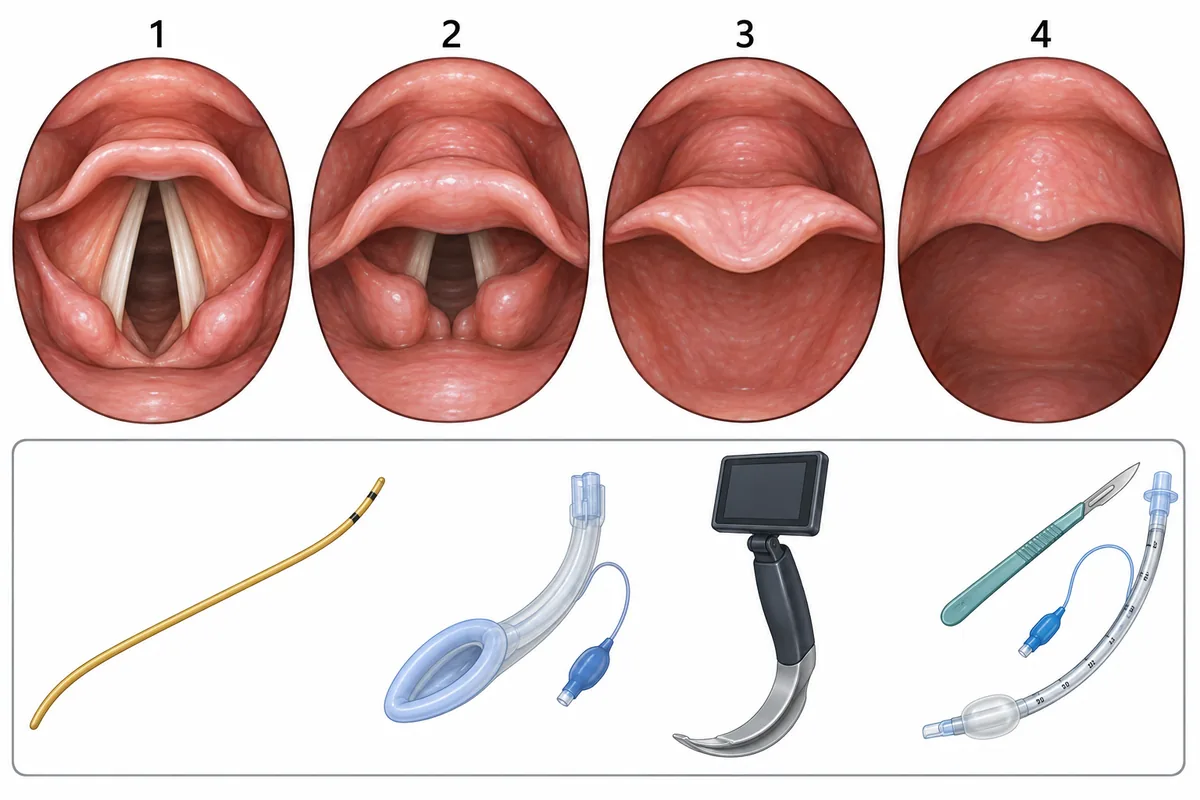
Four views at laryngoscopy are drawn in the figure. Which view is the first at which a tracheal tube cannot ordinarily be passed under direct vision?
 View larger ↗⤢ Tap to enlarge
- AView 3
- BView 2
- CView 1
- DView 4
Show the answer and explanation
Answer: A. View 3
View 3, where the epiglottis is seen and nothing beneath it. The tube cannot be watched into the cords, so a bougie or a videolaryngoscope is reached for. In view 2 the arytenoids are still visible, so a tube can usually be steered between them.
Why view 4 (D) is wrong: it is worse still, but it is not the first view at which direct intubation fails. View 1 (C) is a full view, the easiest of the four.
Recallab question 55080 · Anaesthesia › General Anaesthetics · reference: Morgan & Mikhail's Clinical Anesthesiology
The review. Suppose you chose view 4. Step 1: "I picked view 4 because nothing at all can be seen." That is true, and it is the trouble: the question asked for the first view at which a tube cannot be passed, not the worst. Step 3 names it a misread question, and no fact needs learning. The one-line fix is: "I answered worst when it asked first." The habit that prevents it is to say the last line of the stem back to yourself before looking at the options. For management questions, where one word in the last line decides the answer, see next best step.
Example 2: a fact the wrong way round
Recallab example 2 · a fact the wrong way round
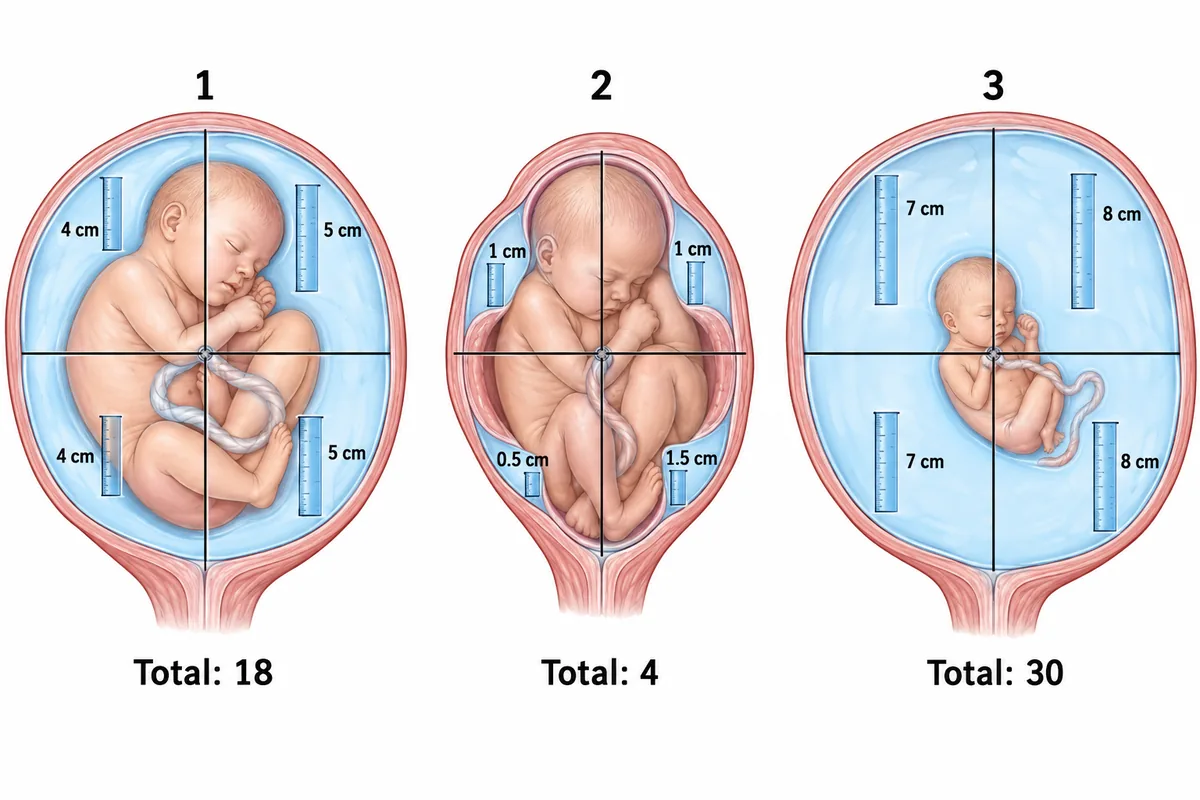
Three scans at thirty four weeks are drawn in the figure with the uterus divided into four quadrants and the deepest pocket measured in each. Scan 2 shows oligohydramnios. Which cause should be looked for first?
 View larger ↗⤢ Tap to enlarge
- AMaternal hyperglycaemia
- BImpaired fetal swallowing
- CRupture of the membranes
- DFetal anaemia
Show the answer and explanation
Answer: C. Rupture of the membranes
Rupture of the membranes. After the first half of pregnancy, amniotic fluid is fetal urine, so too little means it is either leaking out or not being made. Ruptured membranes are the commonest cause and are sought first; if the membranes are intact, the fetal kidneys and bladder are checked next.
Why impaired swallowing (B) is wrong: a fetus that cannot swallow cannot clear the fluid, so it builds up: polyhydramnios, the opposite problem. Maternal hyperglycaemia (A) also causes too much fluid, and fetal anaemia (D) leads to hydrops, often with polyhydramnios.
Recallab question 55091 · Obstetrics › Antenatal Care & Diagnosis · reference: DC Dutta's Textbook of Obstetrics
The review. Suppose you chose impaired swallowing. Step 1: "Swallowing changes the amount of fluid, so I picked it." The link is real; the direction is wrong. Step 3 names it a fact the wrong way round, which is the easiest kind to fix, because you already hold the fact. The one-line fix keeps the direction: "Too little fluid: leaking or not made. A fetus that cannot swallow gives too much."
Example 3: two similar facts confused
Recallab example 3 · two similar facts confused
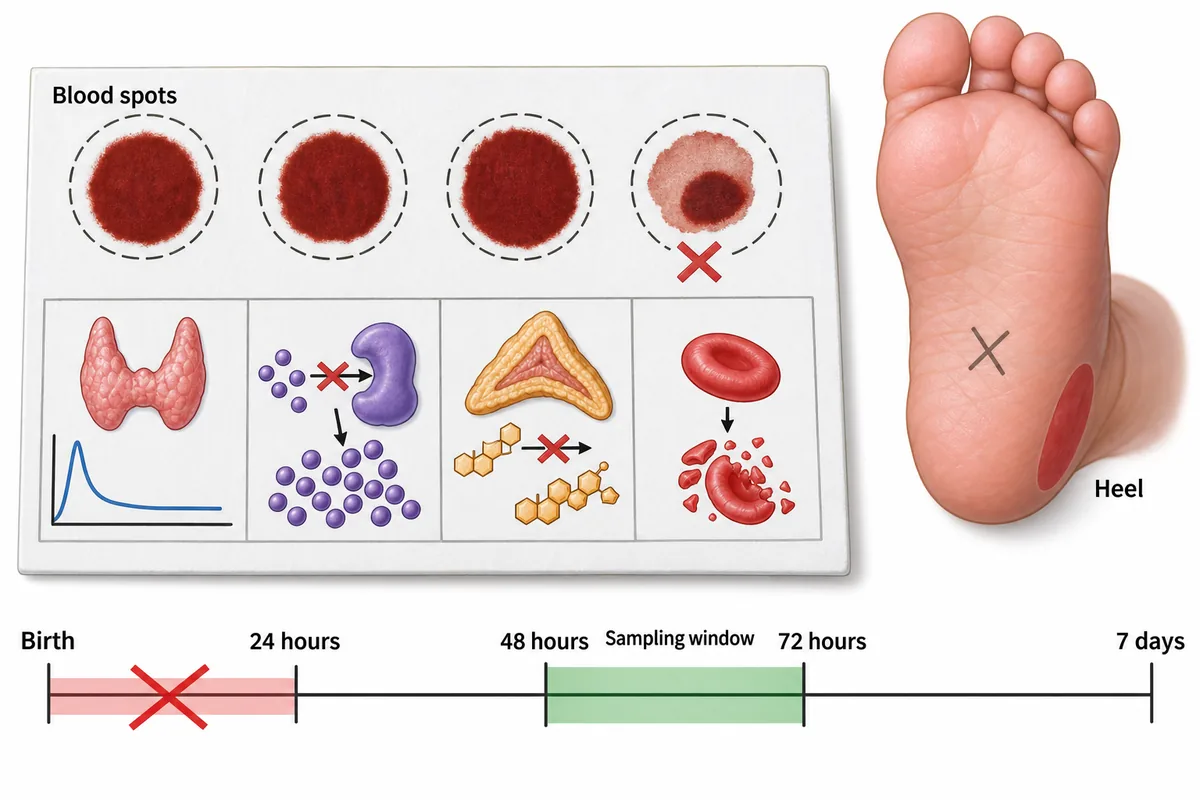
Which condition's marker surges in every healthy baby in response to the cold after birth, so that a sample in the first twenty four hours gives a false positive?
- AThe thyroid condition
- BThe amino acid condition
- CThe adrenal condition
- DThe red cell condition
Show the answer and explanation
Answer: A. The thyroid condition
 View larger ↗⤢ Tap to enlarge
The thyroid condition. Thyroid stimulating hormone surges in every newborn in the hours after birth, a normal response to the cold. A sample taken too early flags a healthy baby, so the window opens at 48 hours, once the surge has passed.
Why the adrenal condition (C) is wrong: its marker, 17-hydroxyprogesterone, is also high in the first days, but from the stress of birth, not the cold surge. The amino acid condition (B) is the reason to wait until feeding is established, which does not create a false positive; the red cell condition (D) has nothing to do with the timing.
Recallab question 55148 · Paediatrics › Neonatology · reference: Ghai Essential Pediatrics
The review. Suppose you chose the adrenal condition. Step 1: "Its marker is high in the first days, so an early sample would flag it." That is true, and it is exactly why the option is tempting. But the stem asks for the marker that surges in response to the cold. Step 3 names it two similar facts confused, and the fix is to learn them as a pair: "Early sample: TSH rises with the cold, 17-OHP with the stress of birth."
Right answers need reviewing too
A correct answer you guessed is a wrong answer that has not cost you anything yet. Rate your confidence as you answer (sure, think so or guess) and put every guess through the same review. The costliest error is the other way round: a wrong answer you were sure of. See lucky guesses and false certainty.
When to answer it again
Answer a missed question again after a few days, not the same evening. If you get it right, leave a longer gap before the next try; if you miss it again, bring it back sooner. Recallab's Due Today brings missed questions back on this kind of schedule, graded by whether you were right and how sure you were.
For more on telling reading errors from knowledge errors, see reading the answer you actually gave. For what each wrong option is built to test, see why is option B wrong?. For recognising what a question asks before you answer, see NEET PG question types.
Why candidates use Recallab
- Built towards 22,000 — a batch at a time
- Illustrations drawn for the question
- Every option explained, not just the right one
- AI study tools that are live today
- Start free, today
Or see the plans, or try a timed mock section.
Register to practise NEET PG questionsFree account, no card needed. Practise with every option explained and a reference on every question.Drawn from questions #55080, #55091, #55148 in the Recallab bank, each with its own verified answer and current-edition reference. Last reviewed 28 September 2026.