
Recallab › Blog › Next best step: how to answer NEET PG management questions
Next best step: how to answer NEET PG management questions
Most wrong answers to a management question come from a candidate who knew the diagnosis. The mistake is the moment: the right treatment, chosen one step too early or one step too late.
Register to practise NEET PG clinical questions →Free account, no card needed.
A clinical question that ends "what is the next step?" is asking about a sequence. Every option is usually something a doctor would do for this patient at some point; only one belongs now. Before you choose, run four checks, in order. Below are six real Recallab MentorQs from six clinical subjects, each turning on one check or one trap. Try each before you open the answer.
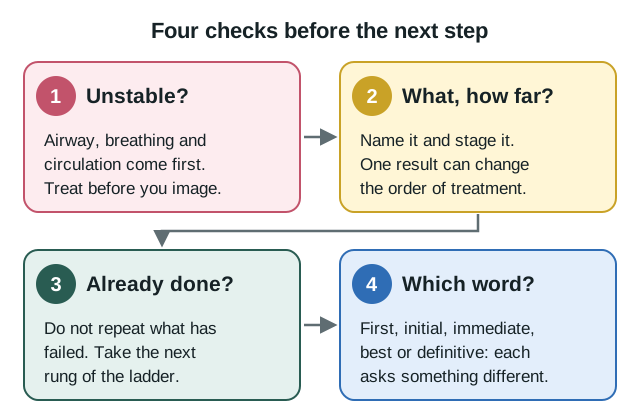
Four checks before you choose
- Is the patient unstable? If airway, breathing or circulation is failing, the answer is whatever fixes that, even before the test that would confirm the diagnosis.
- What is it, and how far has it gone? Name the condition and its stage. One result in the stem can change the order of treatment.
- What has already been done? A stem that lists what has failed is telling you to take the next rung, not to repeat a step.
- Which word does the question use? First, initial, immediate, best and definitive each ask for something different.
 View larger ↗⤢ Tap to enlarge
Check 1: is the patient unstable?
Recallab example 1 · trauma
A man of 20 arrives after a road crash with severe breathlessness, blood pressure 78/50, distended neck veins, subcutaneous emphysema and no air entry on the right, where the chest is hyper-resonant. What should be done first?
Look first: is there time for a test? Look at the blood pressure before the options.
- AUrgent portable chest radiograph
- BIntubation and positive pressure ventilation
- CImmediate chest decompression
- DRapid fluid resuscitation
Show the answer and explanation
Answer: C. Immediate chest decompression
Rule: an unstable patient is treated before the diagnosis is confirmed. Shock, distended neck veins and a silent, hyper-resonant chest make this a tension pneumothorax, and that is a clinical diagnosis. Releasing the air restores venous return within seconds; a formal chest drain follows.
Why the closest rival loses: the chest radiograph (A) is the test that would confirm it, and waiting for it delays the only treatment that works. Positive pressure ventilation (B) forces more air into the pleural space, and fluids (D) treat the shock as blood loss when the cause is obstruction.
Recallab question 50952 · Medicine › Emergency & Critical Care · reference: Bailey & Love's Short Practice of Surgery
Check 2: what is it, and how far has it gone?
Recallab example 2 · diabetic ketoacidosis
A 17-year-old with type 1 diabetes has vomiting, Kussmaul breathing, glucose 480 mg/dL, pH 7.08, bicarbonate 8 mEq/L and potassium 3.1 mEq/L. He is 8 per cent dehydrated. What should be done first?
Look first: find the one number in the stem that changes the usual order.
- AStart an intravenous insulin infusion immediately, with fluids alongside
- BStart intravenous saline and replace potassium before beginning insulin
- CGive subcutaneous long-acting insulin and oral rehydration
- DGive an intravenous bolus of sodium bicarbonate
Show the answer and explanation
Answer: B. Start intravenous saline and replace potassium before beginning insulin
Rule: the usual sequence holds only if nothing in the stem breaks it. Here the potassium is 3.1. Insulin drives potassium into cells, and starting it now can drop the level into a fatal arrhythmia. So saline and potassium come first, and insulin is held until potassium is above about 3.3 mEq/L.
Why the closest rival loses: insulin with fluids (A) is the standard answer for diabetic ketoacidosis, which is why it tempts, but only when potassium is adequate. Bicarbonate (D) is not recommended above pH 6.9 and worsens hypokalaemia, and subcutaneous insulin (C) is unsafe in a vomiting, dehydrated patient.
Recallab question 50347 · Medicine › Endocrinology · reference: Harrison's Principles of Internal Medicine
Check 3: what has already been done?
Recallab example 3 · postpartum haemorrhage
Twenty minutes after a normal delivery at a district hospital, a woman continues to bleed heavily. The uterus is soft and poorly contracted, the placenta is complete and there is no genital tract laceration. Uterine massage, oxytocin, ergometrine and carboprost have all been given and bleeding continues. She is being resuscitated. What is the next step?
Look first: list what has already failed, then look for the next rung, not the last one.
- AA further dose of intramuscular ergometrine
- BBilateral internal iliac artery ligation
- CIntrauterine balloon tamponade
- DImmediate hysterectomy
Show the answer and explanation
Answer: C. Intrauterine balloon tamponade
Rule: when the stem lists what has failed, take the next rung. A soft uterus with a complete placenta and no tear is atony, and every first-line uterotonic has been given. The next tier is mechanical: a balloon in the cavity presses on the bleeding placental bed, needs no laparotomy, and works in most cases. If bleeding stops, surgery can be avoided.
Why the closest rival loses: hysterectomy (D) is the last rung, and jumping to it removes the uterus of a woman whose bleeding might stop with a balloon. Internal iliac ligation (B) needs a laparotomy and comes after tamponade fails. Another dose of ergometrine (A) repeats a drug that has already failed.
Recallab question 50185 · Obstetrics › Complications of the third stage of labour · reference: DC Dutta's Textbook of Obstetrics
Check 4: which word does the question use?
"Immediate" and "first" ask what comes before everything else. "Definitive" asks what finally fixes the problem. "Initial investigation" is the first test you would send, which is often not the most accurate one. Read the last line of the stem twice.
Recallab example 4 · urethral injury
A man thrown from a motorcycle has an unstable pelvic fracture, cannot pass urine, and has blood at the external meatus with a high-riding prostate on rectal examination. What is the immediate management?
Look first: the bladder needs draining, but ask what must happen before anything enters the urethra.
- AGentle urethral catheterisation
- BRetrograde urethrogram
- CCatheterisation over a guidewire
- DObservation without drainage
Show the answer and explanation
Answer: B. Retrograde urethrogram
Rule: "immediate" can mean the step that makes the next one safe. Blood at the meatus with a high-riding prostate after a pelvic fracture means a torn membranous urethra. A catheter passed blindly can turn a partial tear into a complete one, so the urethra is imaged first with a retrograde urethrogram, and the bladder is then drained suprapubically.
Why the closest rival loses: a gentle catheter (A) is the reflex for a man who cannot pass urine, and it is exactly what the meatal blood forbids. A guidewire (C) still enters a torn urethra blind, and observation (D) leaves a full bladder undrained.
Recallab question 50367 · Surgery › Urethra & Penis · reference: Bailey & Love's Short Practice of Surgery
Two traps that catch good candidates
Two more patterns cost marks even when the four checks are run. The first: the right first step is often simple, not specialised. The second: sometimes the next step is to do less.
Recallab example 5 · compartment syndrome
A child in a plaster after a supracondylar fracture has severe forearm pain that is worst on passive extension of the fingers, with a palpable radial pulse. What should be done first?
Look first: does the palpable pulse make you feel safe? It should not.
- APlan a muscle sliding operation
- BArrange urgent angiography
- CObserve and reassure the parents
- DSplit the plaster to skin
Show the answer and explanation
Answer: D. Split the plaster to skin
Rule: the first step is often the simplest one in reach. Pain out of proportion, worst on passive stretch, is the earliest sign of a forearm compartment syndrome. A present pulse does not exclude it, because capillaries close long before the artery does. Every circumferential layer is split to the skin at once; if the pain persists, fasciotomy follows.
Why the closest rival loses: angiography (B) answers a vascular question the palpable pulse has already answered, and costs the time the muscle does not have. Observation (C) misreads the sign, and a muscle sliding operation (A) treats the contracture that follows weeks later.
Recallab question 51762 · Orthopaedics › Nerve injuries & miscellaneous · reference: Apley & Solomon's System of Orthopaedics and Trauma
Recallab example 6 · meconium at birth
A baby is born through thick meconium-stained liquor. He cries at birth, has good tone and a heart rate of 150. What should be done?
Look first: check how the baby is doing before you reach for any manoeuvre.
- AGastric lavage
- BRoutine care with observation
- CIntrapartum oropharyngeal suction
- DIntubation and tracheal suction
Show the answer and explanation
Answer: B. Routine care with observation
Rule: sometimes the next step is to do less. This baby is vigorous: crying, good tone, heart rate 150. A vigorous baby needs no meconium-specific manoeuvre at all. Suctioning on the perineum and routine tracheal suction of vigorous babies were both abandoned after trials showed no benefit. A baby who is not vigorous is resuscitated like any other, starting with ventilation.
Why the closest rival loses: tracheal suction (D) is the old routine many candidates still remember, and it delays care in a baby who does not need it. Intrapartum suction (C) was stopped for the same reason, and gastric lavage (A) does not prevent aspiration.
Recallab question 52852 · Paediatrics › Neonatology · reference: Ghai Essential Pediatrics
The word decides the answer
| If the question says | It asks for | In this post |
|---|---|---|
| What should be done first? | What comes before everything else, often a life-saving act | Decompress the chest before the film |
| Immediate management | The step that makes the next one safe | Urethrogram before any catheter |
| Next step, after a list of treatments | The next rung, not the last one | Balloon before surgery |
| Initial investigation | The first test you would send, not the most accurate | Coeliac serology before biopsy (question 50154) |
| What should be done? (well patient) | Sometimes nothing extra | Routine care for a vigorous baby |
For how to recognise each kind of question, see NEET PG question types: recognise the task before you choose the answer. When you pick the right treatment at the wrong moment, run the five-step review of a wrong answer, or ask the AI tutor why option B is wrong.
For the lab picture that comes before the decision, see six NEET PG acid-base and electrolyte questions.
Why candidates use Recallab
- Built towards 22,000 — a batch at a time
- Illustrations drawn for the question
- Every option explained, not just the right one
- AI study tools that are live today
- Start free, today
Or see the plans, or try a timed mock section.
Register to practise NEET PG clinical questionsFree account, no card needed. Practise with every option explained and a reference on every question.Drawn from questions #50952, #50347, #50185, #50367, #51762, #52852, #50154 in the Recallab bank, each with its own verified answer and current-edition reference. Last reviewed 3 October 2026.