
Recallab › Blog › Anaesthesia for NEET PG: six figures on the airway and oxygenation
Anaesthesia for NEET PG: six figures on the airway and oxygenation
An airway figure asks two linked questions: can air reach the lungs, and is enough oxygen reaching the patient? Read the anatomy first, then the device and what it is doing.
Register to practise NEET PG anaesthesia questions →Free account, no card needed.
These six Recallab MentorQs move from the mouth and jaw to tube design and oxygen delivery. Each figure gives a clue you can point to. Try each question before opening its worked answer, then check why every alternative loses.
Before you choose: three questions
- Which landmark decides it? Look for the uvula, tonsillar pillars, front teeth or jaw angle.
- Where can gas pass? Trace the route through a device and look for an opening that remains available if another is blocked.
- What changes during a breath? A reservoir that empties during inspiration tells you more than a device name alone.
Read the mouth, size the airway, protect the neck
Recallab example 1 · what the tongue leaves visible
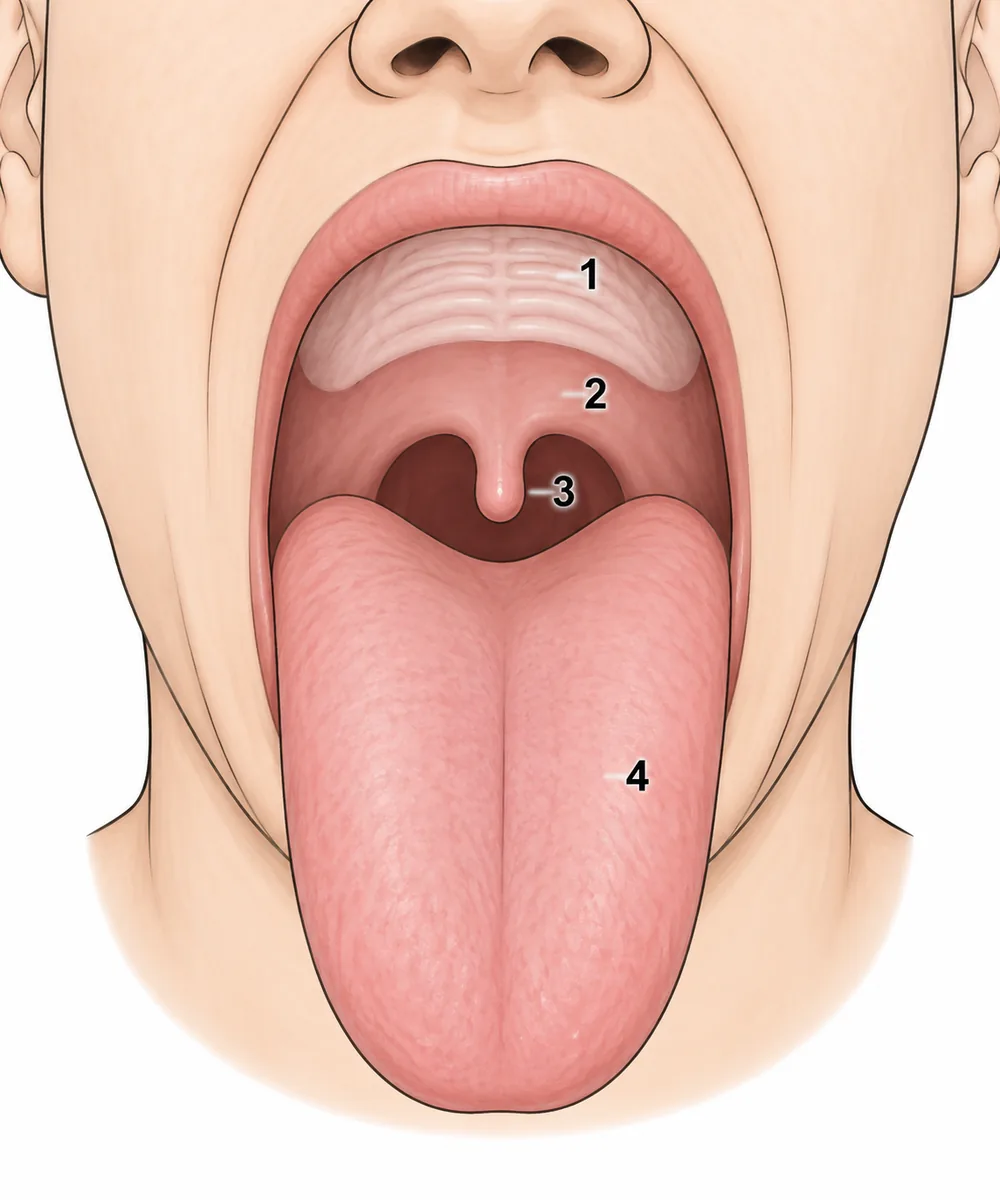
A woman of 45 is seen in the pre-anaesthetic clinic before a thyroidectomy. She sits upright, opens her mouth fully and protrudes her tongue without making a sound, and the view is drawn in the figure. What is her modified Mallampati class? The oropharynx seen from the front with the patient sitting, mouth fully open and the tongue protruded; four structures are numbered.
Look first: check the whole uvula and both sides of the throat; visible structures decide the class.
 View larger ↗⤢ Tap to enlarge
- AClass III
- BClass II
- CClass IV
- DClass I
Show the answer and explanation
Answer: B. Class II
B. Class II. The soft palate, fauces and whole uvula are visible, but the tonsillar pillars are hidden by the tongue. That combination is modified Mallampati class II. Read what remains visible rather than judging how crowded the mouth looks. The sitting position, full mouth opening, protruded tongue and absence of phonation make this the modified test.
Why the other options lose: Class III (A) shows only the soft palate and the base of the uvula; this figure shows the uvula down to its tip. Class IV (C) shows only the hard palate, whereas the soft palate is visible here. Class I (D) would also show both tonsillar pillars, and neither pillar is visible in this drawing. Mallampati is one part of airway assessment, rather than a guarantee of the view at laryngoscopy.
Recallab question 68927 · Anaesthesia › Pre-anaesthetic Evaluation & Airway · reference: Morgan & Mikhail's Clinical Anesthesiology
Recallab example 2 · measure before inserting
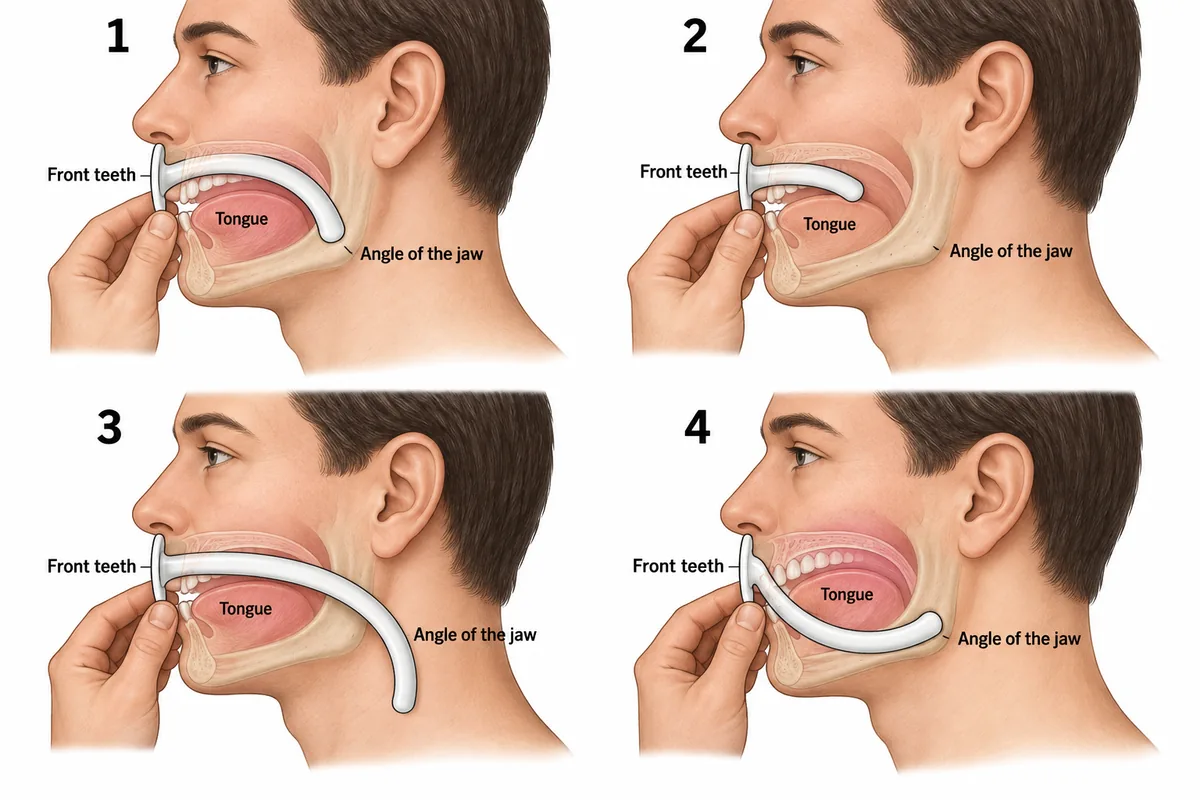
An unresponsive adult who is still breathing needs a curved device placed in the mouth to hold the tongue forward. Four devices are drawn in the figure on the same side view of one face, the flange at the front teeth, numbered and with no size written on any of them. Which numbered device is the right one? Four curved airway devices held against the side of one face before insertion.
Look first: compare the flange and tip with the front teeth and angle of the jaw, then check the curve.
 View larger ↗⤢ Tap to enlarge
- ADevice 4
- BDevice 1
- CDevice 3
- DDevice 2
Show the answer and explanation
Answer: B. Device 1
B. Device 1. An oropharyngeal airway is sized externally from the front teeth to the angle of the jaw. Device 1 reaches that landmark and has the appropriate orientation. Its purpose is to hold the tongue away from the back of the throat. A device that is too short can press the tongue backwards and worsen obstruction. It is tolerated only when the gag reflex is absent.
Why the other options lose: Device 4 (A) has the right length but its curve is shown facing the wrong way, so it would not seat correctly as drawn. Device 3 (C) extends beyond the jaw angle and is too long. Device 2 (D) stops at the cheek and is too short; its tip would press on the tongue rather than hold it forward. Length and orientation both matter.
Recallab question 56544 · Anaesthesia › Pre-anaesthetic Evaluation & Airway · reference: Morgan & Mikhail's Clinical Anesthesiology
Recallab example 3 · open the airway with an injured neck
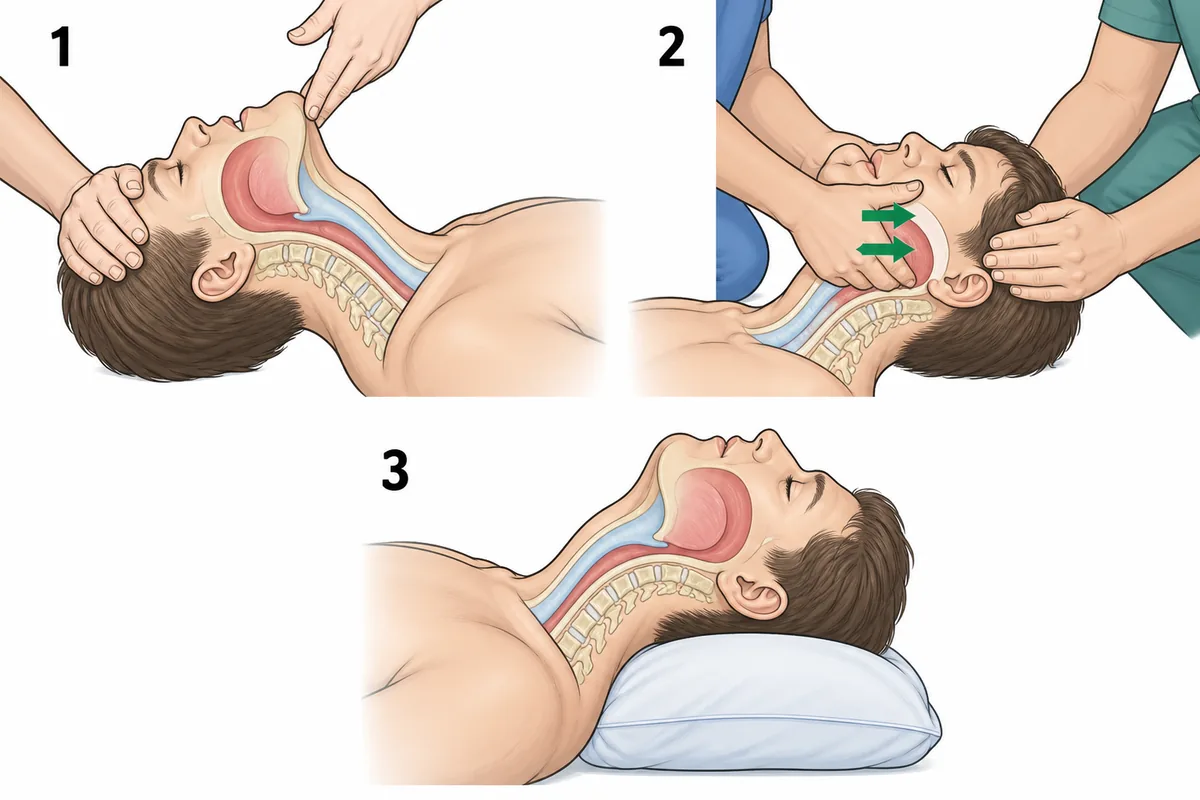
An unconscious motorcyclist with a suspected cervical spine injury is snoring. Three ways of opening the airway are drawn in the figure, numbered 1 to 3. Why is drawing 2 the one to use? Three ways of opening the airway of an unconscious patient, numbered 1 to 3.
Look first: follow the hands and the neck position in each drawing; ask which structure is moved forwards.
 View larger ↗⤢ Tap to enlarge
- AIt opens the airway most fully
- BIt reduces the injured spine
- CIt aligns the three airway axes
- DIt opens the airway without neck movement
Show the answer and explanation
Answer: D. It opens the airway without neck movement
D. It opens the airway without neck movement. Drawing 2 shows a jaw thrust with manual in-line stabilisation. Moving the mandible forwards carries the tongue away from the pharynx, while a second rescuer keeps the head neutral. Snoring is the clue to upper airway obstruction. With suspected cervical spine injury, this manoeuvre opens the airway while limiting neck movement.
Why the other options lose: It opens the airway most fully (A) misses the reason for choosing it here: the priority in this comparison is protecting the neck while opening the airway. It reduces the injured spine (B) is incorrect; stabilisation holds the head still rather than reducing a spinal injury. It aligns the three airway axes (C) describes the aim of the sniffing position in drawing 3, which involves neck flexion and head extension.
Recallab question 55580 · Anaesthesia › Pre-anaesthetic Evaluation & Airway · reference: Morgan & Mikhail's Clinical Anesthesiology
Read the tube and check oxygen delivery
Recallab example 4 · a second route for gas
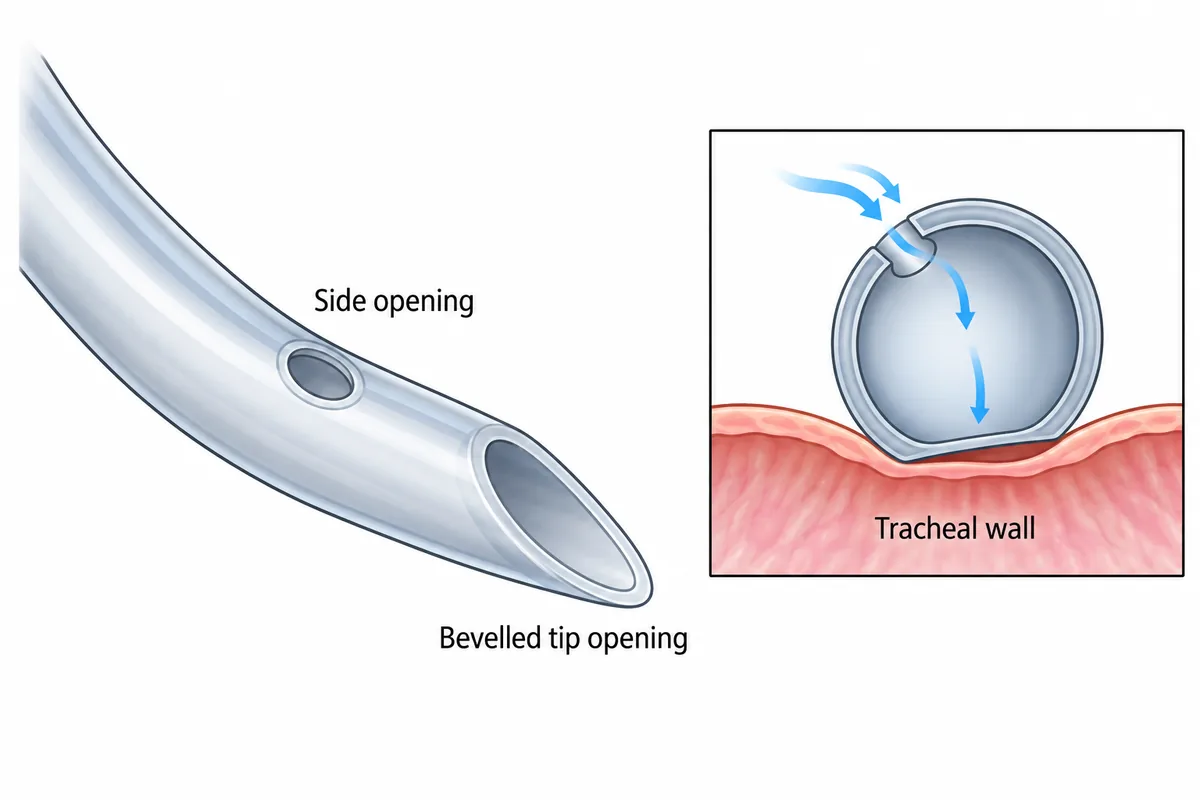
An endotracheal tube tip is drawn in the figure in cross-section and side view, with a bevelled opening at the very tip and a separate round opening in the tube wall just proximal to it. What is that second opening called? An endotracheal tube tip with a bevelled end opening and a separate round side opening.
Look first: compare the bevelled end with the round side opening and trace where gas can pass.
 View larger ↗⤢ Tap to enlarge
- AMurphy's eye
- BThe cuff inflation port
- CA suction channel
- DA stylet guide
Show the answer and explanation
Answer: A. Murphy's eye
A. Murphy's eye. The round side opening just proximal to the bevel provides another route for gas if the main opening presses against the tracheal wall. The figure tests a mechanical feature of the tube: follow the gas path through the side opening when the bevel is obstructed.
Why the other options lose: The cuff inflation port (B) belongs to a separate thin inflation lumen, rather than an opening into the main tube bore. A suction channel (C) is a separate channel leading to a suction port, such as one above the cuff. A stylet guide (D) does not describe this opening; a stylet is placed inside the tube lumen to help shape and direct the tube.
Recallab question 57044 · Anaesthesia › Pre-anaesthetic Evaluation & Airway · reference: Morgan & Mikhail's Clinical Anesthesiology
Recallab example 5 · recognise the reservoir and valves
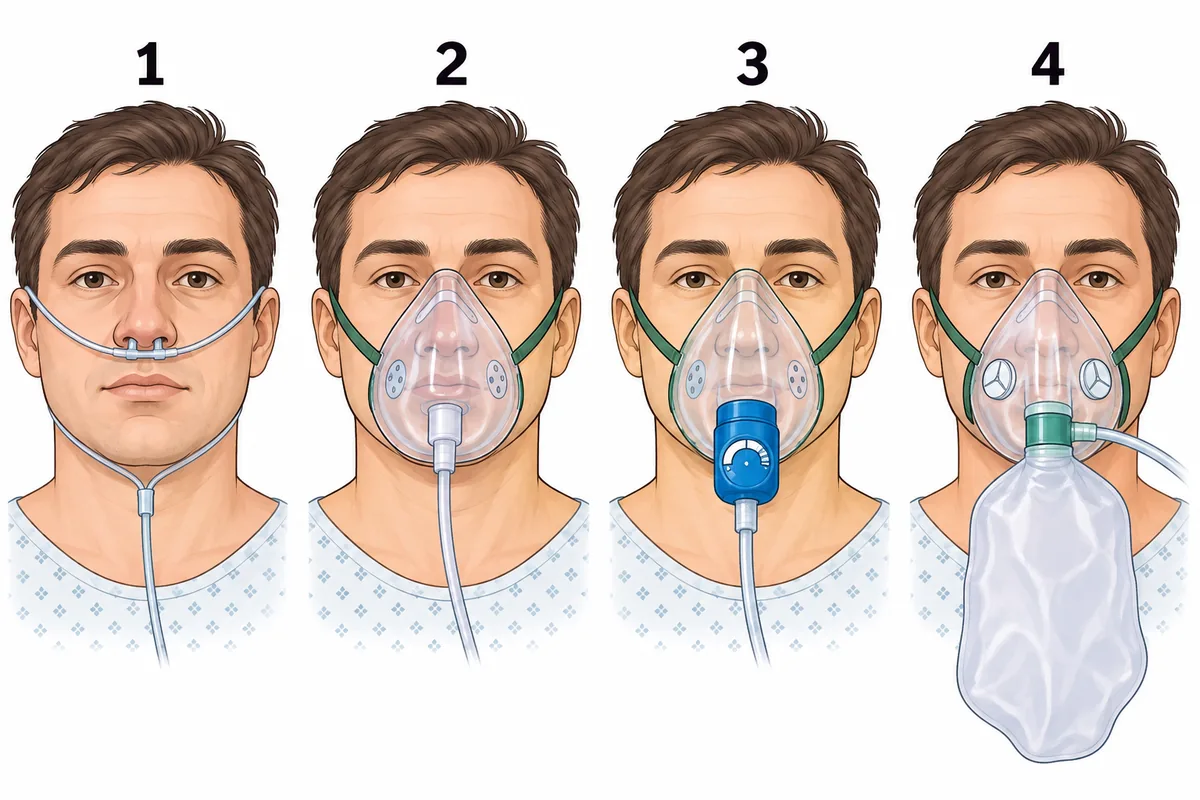
Four oxygen delivery devices are drawn in the figure. Which one delivers the highest fraction of inspired oxygen? Four oxygen delivery devices drawn on a face, numbered.
Look first: compare what each device adds to a simple mask: prongs, an adaptor, or a reservoir with valves.
 View larger ↗⤢ Tap to enlarge
- ADevice 2
- BDevice 3
- CDevice 1
- DDevice 4
Show the answer and explanation
Answer: D. Device 4
D. Device 4. This is the non-rebreathing reservoir mask. The bag stores oxygen between breaths, and the one-way valves reduce dilution by room air and prevent exhaled gas entering the reservoir. With adequate oxygen flow, it delivers the highest inspired oxygen fraction of these four devices, about 0.6 to 0.9 at 10 to 15 litres per minute. The delivered fraction still depends on the fit and the patient's breathing.
Why the other options lose: Device 2 (A) is a simple face mask, giving a moderate and variable inspired oxygen fraction without a reservoir. Device 3 (B) is a Venturi mask: its advantage is a fixed, controlled fraction, rather than the highest fraction in this comparison. Device 1 (C) is nasal cannulae, which give a modest, variable fraction. Identify the bag and valves before comparing oxygen delivery.
Recallab question 55680 · Anaesthesia › Monitoring, Fluids & Critical Care · reference: Morgan & Mikhail's Clinical Anesthesiology
Recallab example 6 · watch the bag through inspiration
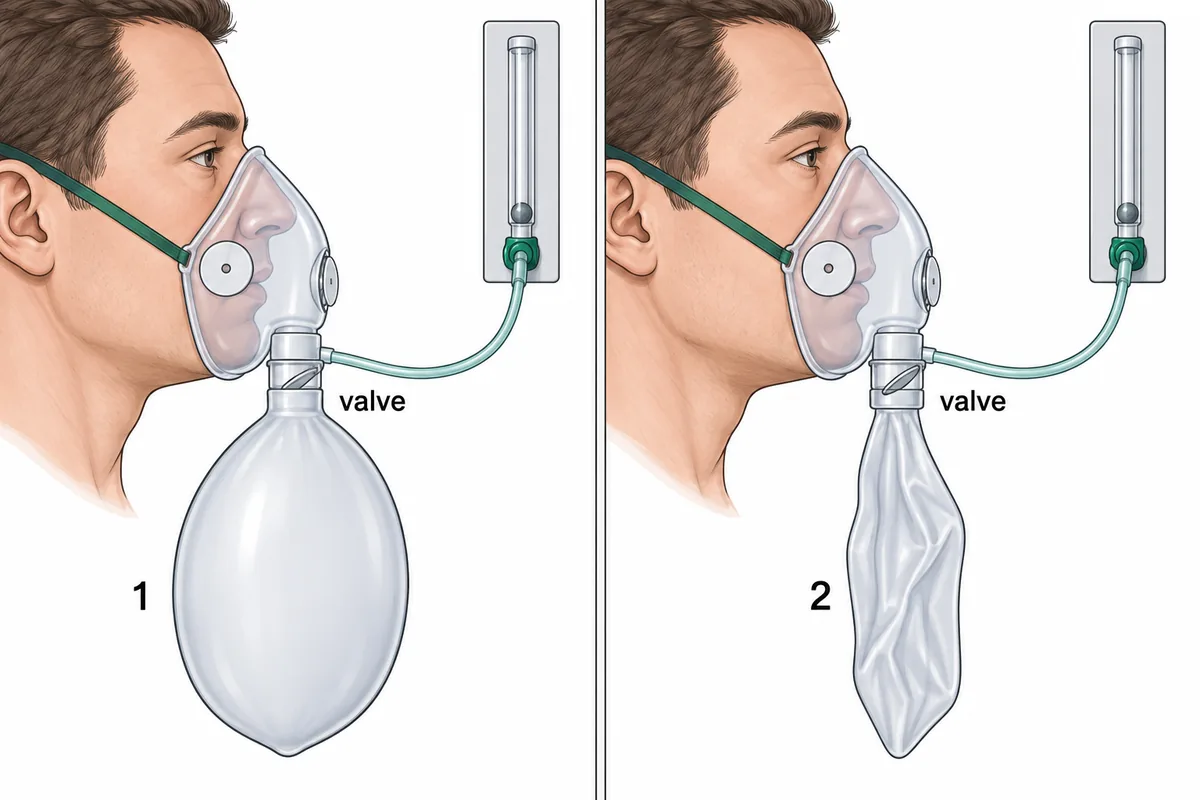
A man of 58 with community-acquired pneumonia is breathing 30 times a minute. He has been put on a non-rebreathing mask, but his oxygen saturation is 86%. The mask, the reservoir bag and the flowmeter are drawn at two moments of one breath. What is the most appropriate immediate action? The same oxygen mask drawn twice in one breath: panel 1 at the end of expiration, panel 2 in the middle of inspiration.
Look first: compare the bag at the two moments of the breath, then check the mask fit and flowmeter.
 View larger ↗⤢ Tap to enlarge
- AIncrease the oxygen flow
- BRemove the one-way valves
- CChange to nasal cannulae
- DTighten the mask seal
Show the answer and explanation
Answer: A. Increase the oxygen flow
A. Increase the oxygen flow. The reservoir is full after expiration but completely flat during inspiration. Oxygen is not replenishing the bag fast enough to meet this tachypnoeic patient's demand. Increase the flow, usually to 10 to 15 litres per minute, until the bag remains partly inflated throughout inspiration. The low flowmeter float supports this explanation. If oxygen saturation remains low with a properly supplied mask, urgent reassessment and escalation of respiratory support are needed.
Why the other options lose: Remove the one-way valves (B) would allow more dilution by room air and compromise separation of inspired and expired gas. Change to nasal cannulae (C) would reduce the available inspired oxygen fraction. Tighten the mask seal (D) does not address the visible problem: the mask already fits snugly, while the bag empties as the patient draws oxygen from it. Check the reservoir throughout the breath, rather than assuming that a mask in place means enough oxygen is arriving.
Recallab question 69241 · Anaesthesia › Monitoring, Fluids & Critical Care · reference: Morgan & Mikhail's Clinical Anesthesiology
The one-minute routine
| If the figure gives | Ask first | It usually settles |
|---|---|---|
| An open mouth with the tongue protruded | Are the whole uvula and both pillars visible? | The modified Mallampati class |
| An airway held against the cheek | Does it reach from the front teeth to the jaw angle? | The correct airway length |
| Airway manoeuvres after a neck injury | Can the jaw move forwards while the head stays neutral? | Jaw thrust with in-line stabilisation |
| A tube tip with two openings | Can gas pass if the bevel rests against the tracheal wall? | The purpose of the side opening |
| Several oxygen devices | Which has a reservoir and one-way valves? | The highest inspired oxygen fraction among these devices |
| A reservoir at two points in a breath | Does it remain partly inflated during inspiration? | Whether oxygen flow is sufficient |
For more figure practice, see ten NEET PG image questions and physiology graphs. The Resuscitation Council UK ABCDE approach explains why reservoir-mask flow must prevent the bag collapsing during inspiration.
Why candidates use Recallab
- Built towards 22,000 — a batch at a time
- Illustrations drawn for the question
- Every option explained, not just the right one
- AI study tools that are live today
- Start free, today
Or see the plans, or try a timed mock section.
Register to practise NEET PG anaesthesia questionsFree account, no card needed. Practise with every option explained and a reference on every question.Drawn from questions #68927, #56544, #55580, #57044, #55680, #69241 in the Recallab bank, each with its own verified answer and current-edition reference. Last reviewed 14 October 2026.