
Recallab › Blog › Physiology graphs for NEET PG: six curves and what each one is really asking
Physiology graphs for NEET PG: six curves and what each one is really asking
Physiology graphs test one skill again and again: reading what a shift, a slope or a crossing point means for the body.
Register to practise NEET PG physiology questions →Free account, no card needed.
The same handful of curves carries most physiology graph questions in NEET PG: oxygen dissociation, lung pressure-volume curves, the cardiac pressure-volume loop, venous return and renal clearance. Each has one feature that settles most questions built on it. Below are six real Recallab MentorQs, each on a graph. Try each before you open the answer.
Before any graph: three questions
- What is on each axis, and in what units? Tension or content, volume or pressure, amount or clearance.
- Which feature is being asked about? A shift left or right, a slope, a point where two lines meet or cross zero.
- What stays fixed? If one curve moves and the other does not, the unmoved one tells you what has not changed.
Breathing: shifts, slopes and crossing points
Recallab example 1 · oxygen dissociation
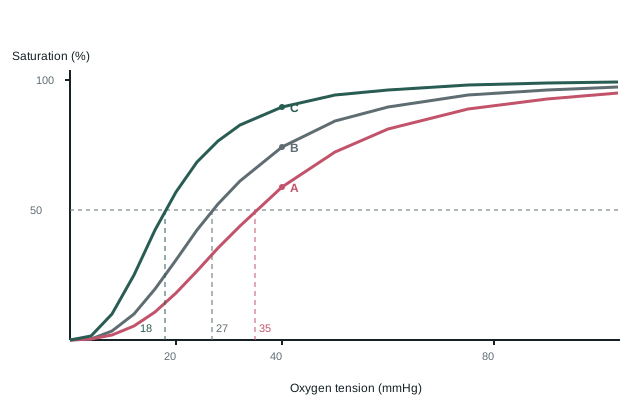
Three oxygen dissociation curves are drawn in the figure on one pair of axes, with the tension at which each is half saturated dropped to the axis beneath it. A unit of red cells stored for five weeks is transfused. Its curve is one of the three drawn. What has changed inside the stored cells to put it there?
Look first: read the three half-saturation tensions first, then decide which way storage moves them.
 View larger ↗⤢ Tap to enlarge
- ALoss of cell potassium
- BFall in 2,3-bisphosphoglycerate
- CRise in 2,3-bisphosphoglycerate
- DAcidification of the stored cells
Show the answer and explanation
Answer: B. Fall in 2,3-bisphosphoglycerate
Rule: the lower the half-saturation tension, the tighter haemoglobin holds oxygen. Stored red cells lose 2,3-bisphosphoglycerate steadily over weeks. Without it the curve moves left, to curve C (half saturated at 18 mmHg), and the tissues are given less oxygen at any tension.
Why the closest rival loses: acid (D) shifts a curve to the right, the opposite of what stored blood shows. A rise in 2,3-bisphosphoglycerate (C) also shifts it right. Potassium leaks out of stored cells (A) but does nothing to oxygen affinity.
Recallab question 57310 · Physiology › Respiratory Physiology · reference: Ganong's Review of Medical Physiology
Recallab example 2 · lung compliance
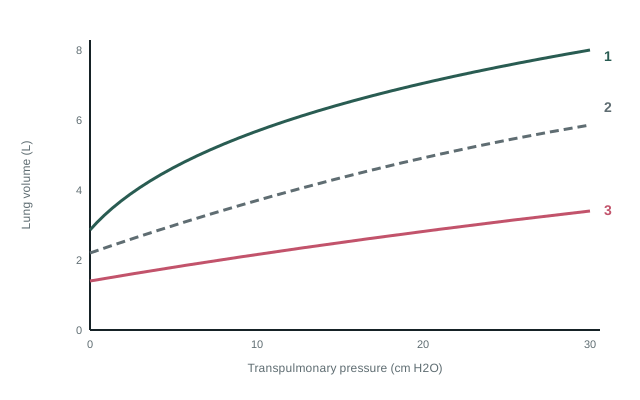
Static pressure-volume curves of the lungs of three adults are drawn in the figure. What has happened to the lung that gives curve 1?
Look first: compliance is the slope: find the steepest curve before you name a disease.
 View larger ↗⤢ Tap to enlarge
- AIts airways have narrowed
- BIts surfactant production has increased
- CIts elastic tissue has been destroyed
- DIts alveolar walls have thickened
Show the answer and explanation
Answer: C. Its elastic tissue has been destroyed
Rule: compliance is the change in volume for each unit of pressure, so on this graph it is the slope. Curve 1 is the steepest and holds the most volume at every pressure. Losing elastic fibres, as in emphysema, removes recoil, and the lung distends easily.
Why the closest rival loses: thickened alveolar walls (D) are fibrosis, the stiff lung of flat curve 3. Narrowed airways (A) leave the static curve unchanged, because it is measured without flow. No adult disease raises compliance by adding surfactant (B).
Recallab question 55710 · Physiology › Respiratory Physiology · reference: Guyton and Hall Textbook of Medical Physiology
Recallab example 3 · lung and chest wall
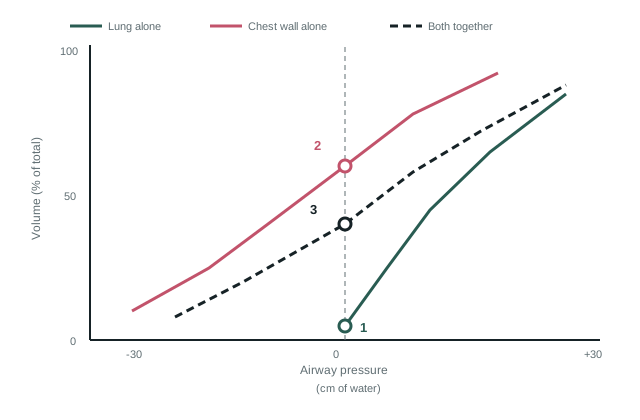
Volume is plotted against airway pressure in the figure for the lung alone, for the chest wall alone, and for the two together, and each curve is marked where it crosses the line of zero pressure. Which numbered crossing is the volume the whole respiratory system settles at with the muscles relaxed?
Look first: at zero pressure nothing needs holding: find the curve for the two together.
 View larger ↗⤢ Tap to enlarge
- ACrossing 1
- BCrossing 3
- CCrossing 2
- DThe top of the dashed curve
Show the answer and explanation
Answer: B. Crossing 3
Rule: the relaxed respiratory system rests where the combined curve crosses zero pressure. That is crossing 3, the functional residual capacity, about 40 per cent of the total. There the lung's pull inwards and the chest wall's spring outwards balance.
Why the closest rival loses: crossing 2 (C) is the chest wall on its own, which is why an opened chest springs outwards. Crossing 1 (A) is the lung on its own, emptied almost completely. The top of the dashed curve (D) is total lung capacity, reached only by maximal effort.
Recallab question 56307 · Physiology › Respiratory Physiology · reference: Guyton and Hall Textbook of Medical Physiology
The heart and the circulation
Recallab example 4 · pressure-volume loop
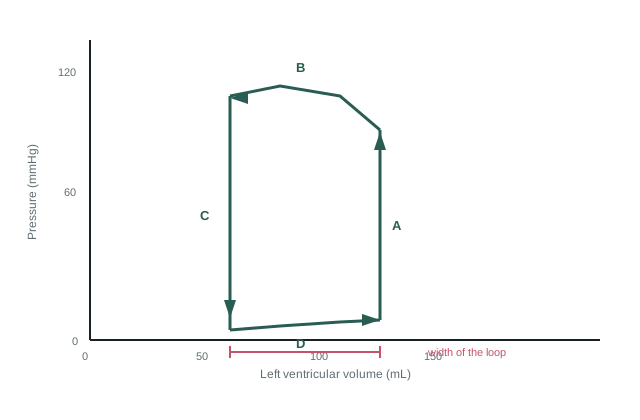
A left ventricular pressure-volume loop is drawn in the figure with its four sides lettered. During which lettered side are both valves closed while pressure is rising?
Look first: a vertical side means volume is not changing, so no valve can be open.
 View larger ↗⤢ Tap to enlarge
- ASide D
- BSide C
- CSide B
- DSide A
Show the answer and explanation
Answer: D. Side A
Rule: a vertical side of the loop is isovolumetric, with both valves shut. Side A rises vertically, so pressure climbs while volume is unchanged: isovolumetric contraction. The loop's width, from end-diastolic to end-systolic volume, is the stroke volume.
Why the closest rival loses: side C (B) is also vertical with both valves shut, but pressure is falling there: isovolumetric relaxation. The aortic valve is open along side B (C), and the mitral valve along side D (A).
Recallab question 55110 · Physiology › Cardiovascular Physiology · reference: Guyton and Hall Textbook of Medical Physiology
Recallab example 5 · venous return
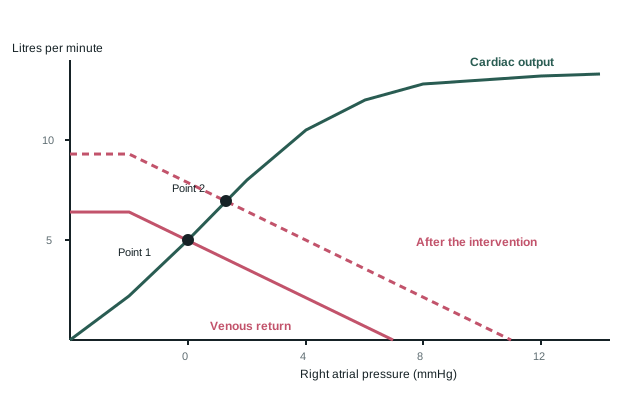
Cardiac output and venous return are plotted in the figure against right atrial pressure, with the normal working point marked where the two lines meet and a second venous return line drawn after an intervention. Which intervention produced the second line?
Look first: see which curve moved, then whether it moved parallel or changed its slope.
 View larger ↗⤢ Tap to enlarge
- ASudden haemorrhage
- BA negative inotropic drug
- CRapid transfusion
- DArteriolar dilatation
Show the answer and explanation
Answer: C. Rapid transfusion
Rule: a parallel shift of the venous return line is a change in filling pressure, which means a change in volume. The line has moved right without changing slope, so the mean systemic filling pressure is higher. The heart's curve is unchanged, and the new working point has a higher output and a higher atrial pressure.
Why the closest rival loses: arteriolar dilatation (D) changes the slope of the line from the same axis point rather than moving it parallel. Haemorrhage (A) moves the line to the left, and a negative inotropic drug (B) depresses the output curve, which has not moved here.
Recallab question 57309 · Physiology › Cardiovascular Physiology · reference: Guyton and Hall Textbook of Medical Physiology
The kidney
Recallab example 6 · renal clearance
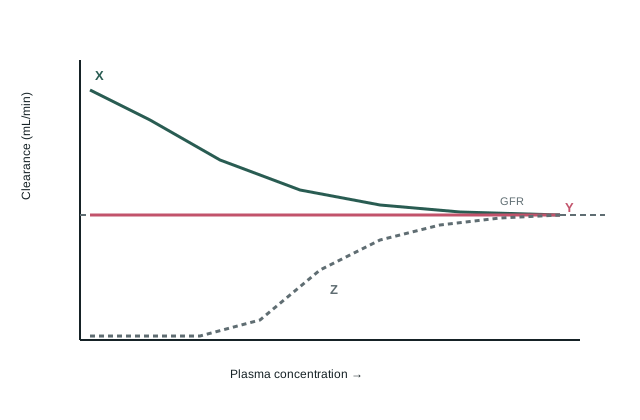
Renal clearance is plotted against rising plasma concentration for three substances X, Y and Z in the figure, with a dashed line marking the glomerular filtration rate. Substance X is the one used to estimate renal plasma flow. Why does its clearance fall as plasma concentration rises?
Look first: use the GFR line: above it means secretion, below it means reabsorption.
 View larger ↗⤢ Tap to enlarge
- AIt binds plasma proteins
- BIts secretory transporter saturates
- CIt is progressively reabsorbed
- DIts glomerular filtration falls
Show the answer and explanation
Answer: B. Its secretory transporter saturates
Rule: clearance above the GFR line means the substance is secreted; below it, reabsorbed. X is filtered and secreted, so it starts near the plasma flow. As its level rises, the fixed number of secretory carriers saturates, and clearance falls towards the GFR, which filtration alone can remove. Y is filtered only; Z is reabsorbed until its carrier is overwhelmed.
Why the closest rival loses: progressive reabsorption (C) would give a curve below the line, like Z, not X. Filtration (D) is not saturable, and protein binding (A) would lower clearance at every level rather than bring it down towards the line.
Recallab question 57107 · Physiology › Renal Physiology · reference: Ganong's Review of Medical Physiology
The one-minute routine
| If you see | Ask first | It usually settles |
|---|---|---|
| Oxygen dissociation curves | Which way has the half-saturation tension moved? | Left: tighter binding (low 2,3-BPG). Right: acid or high 2,3-BPG |
| Lung pressure-volume curves | Which is steepest? | Emphysema (steep) or fibrosis (flat) |
| Lung, chest wall and both together | Where does each cross zero pressure? | Functional residual capacity on the combined curve |
| A pressure-volume loop | Is the side vertical or horizontal? | Vertical: both valves shut. Horizontal: filling or ejection |
| Venous return and cardiac output | Which curve moved, and parallel or not? | Volume change, resistance change or a change in the heart |
| Clearance against plasma level | Above or below the GFR line? | Secreted (above), filtered only (on it), reabsorbed (below) |
This is the third post on reading graphs, after six NEET PG pharmacology graphs and biostatistics without fear. If you miss one, see how to review a wrong answer.
Why candidates use Recallab
- Built towards 22,000 — a batch at a time
- Illustrations drawn for the question
- Every option explained, not just the right one
- AI study tools that are live today
- Start free, today
Or see the plans, or try a timed mock section.
Register to practise NEET PG physiology questionsFree account, no card needed. Practise with every option explained and a reference on every question.Drawn from questions #57310, #55710, #56307, #55110, #57309, #57107 in the Recallab bank, each with its own verified answer and current-edition reference. Last reviewed 29 September 2026.