
Recallab › Blog › Gynaecology for NEET PG: six figures that guide menopause prescribing
Gynaecology for NEET PG: six figures that guide menopause prescribing
A menopause prescription depends on more than the symptom. Read what tissue remains, where the medicine acts and when the new symptom began.
Register to practise NEET PG gynaecology questions →Free account, no card needed.
These six illustrated Recallab questions use clinic cards, diaries, charts and a drug list to make those decisions visible. HRT means hormone replacement therapy; a progestogen protects the uterine lining when systemic oestrogen is used. Try each question before opening its worked answer.
Before you choose a plan: three questions
- What tissue remains? Read the operation and its reason, not just whether periods stopped.
- Where does the medicine act? Separate systemic replacement from low-dose vaginal treatment, and check the route.
- What does the timeline change? Early spotting, late bleeding, longer treatment and planned immobility lead to different decisions.
Choose the preparation and protect the lining
Recallab example 1 · what remains after surgery
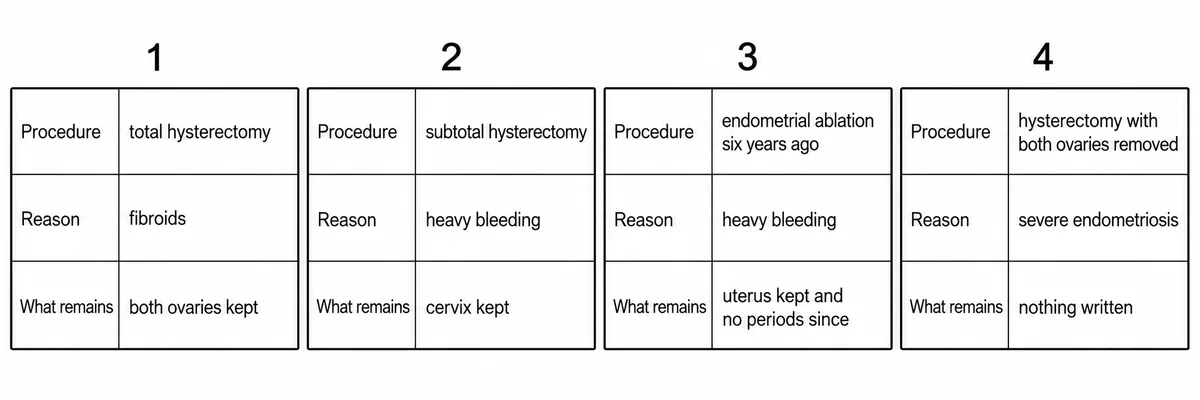
Four women aged 50 to 53 with troublesome flushes ask for hormone replacement. Each card in the figure records the one uterine procedure in her past. Which woman may be given oestrogen without a progestogen? Four menopause clinic cards, each recording one past uterine procedure and what was left behind.
Look first: read the procedure, its reason and what remains on every card; absent periods do not prove absent endometrium.
 View larger ↗⤢ Tap to enlarge
- ACards 1, 2 and 4
- BCard 1 only
- CCard 3 only
- DCards 1 and 3
Show the answer and explanation
Answer: B. Card 1 only
B. Card 1 only. Card 1 records a total hysterectomy for fibroids: the uterus, including its lining, has been removed. Keeping the ovaries does not create a need for progestogen. The other cards raise the possibility of tissue that systemic oestrogen could stimulate: endometrium in a cervical stump, surviving lining after ablation, or residual endometriosis. Card 1 is therefore the choice for oestrogen alone.
Why the other options lose: cards 1, 2 and 4 (A) wrongly include the subtotal hysterectomy and the operation for severe endometriosis. Card 2 may retain functioning endometrium in the cervical stump; card 4 may retain endometriotic deposits outside the uterus. Card 3 only (C) excludes the suitable woman and selects an ablated uterus, where islands of endometrium can remain despite absent periods. Cards 1 and 3 (D) wrongly includes the ablated uterus. For systemic treatment, ask what tissue remains and why the operation was done, rather than relying on the word hysterectomy.
Recallab question 59970 · Gynaecology › Gynaecology: Menstrual & Endocrine · reference: DC Dutta's Textbook of Gynecology
Recallab example 2 · aura in the old pill record
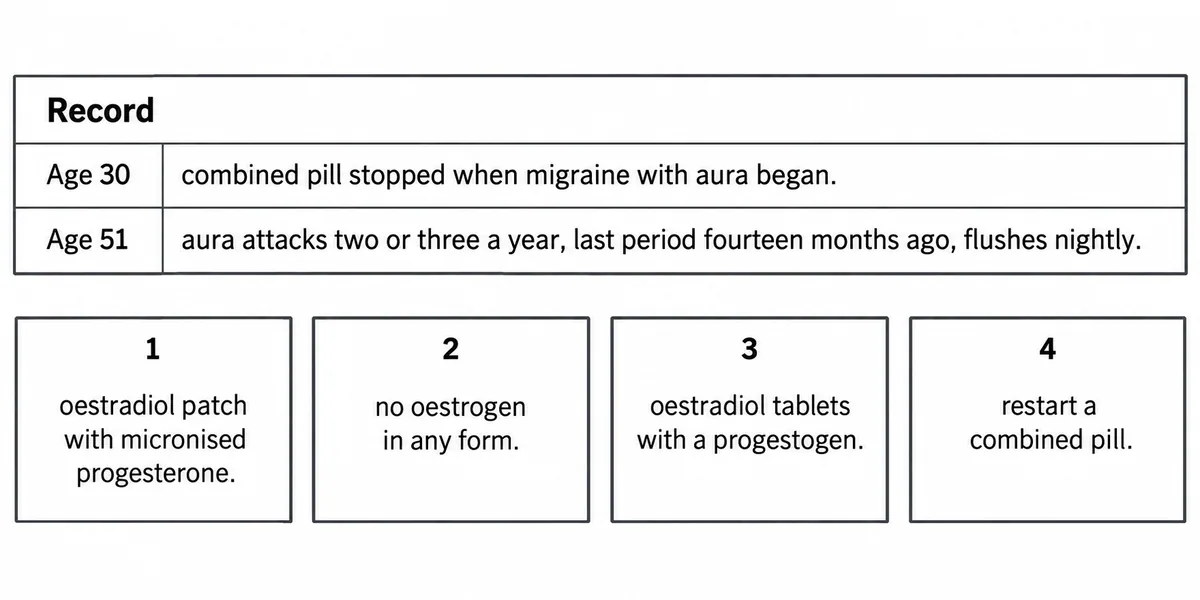
A woman of 51 whose last period was fourteen months ago has hot flushes that wake her several times a night. She has a uterus. Her record and four plans for the flushes are set out in the figure. Which plan is right? One woman's record across two decades, with four plans for her flushes printed beneath it.
Look first: read why the pill was stopped, then compare the oestrogen route and endometrial protection in the four plans.
 View larger ↗⤢ Tap to enlarge
- APlan 4
- BPlan 1
- CPlan 2
- DPlan 3
Show the answer and explanation
Answer: B. Plan 1
B. Plan 1. The figure offers an oestradiol patch with micronised progesterone. Migraine with aura rules out combined hormonal contraception, but it does not itself rule out menopausal hormone replacement therapy (HRT). Transdermal oestradiol gives steadier levels and avoids first-pass passage through the liver; use the lowest dose that controls the flushes. Her uterus is present, so systemic oestrogen needs progestogen to protect its lining. This distinction is supported by the British Menopause Society guidance on migraine and HRT.
Why the other options lose: plan 4 (A) restarts the combined pill that was stopped because of aura and its associated stroke risk. Plan 2 (C) excludes oestrogen in every form, extending the contraceptive restriction to replacement treatment. Plan 3 (D) provides oral oestradiol with a progestogen; it protects the endometrium, but the patch is preferred here for steadier hormone levels. The deciding distinction is between combined contraception and replacement oestradiol, followed by the choice of route.
Recallab question 60070 · Gynaecology › Gynaecology: Menstrual & Endocrine · reference: Williams Gynecology
Recallab example 3 · a blank progestogen row
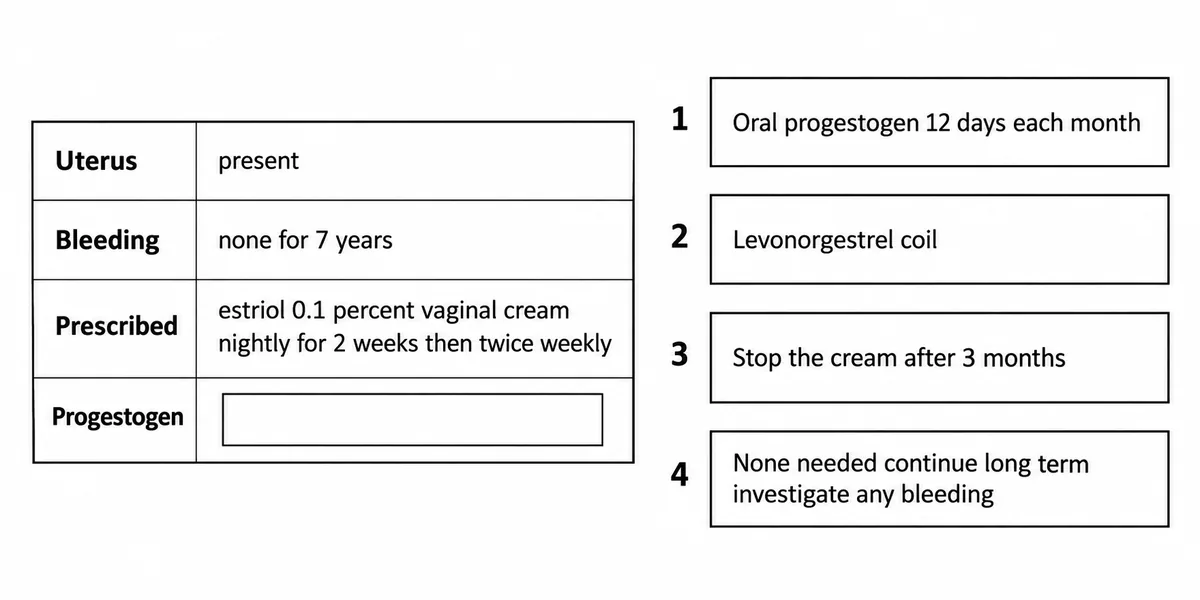
A woman of 58 with an intact uterus has vaginal dryness and pain on intercourse. She does not want systemic hormones. Her prescription card, with the progestogen row still blank, and four entries for that row are drawn in the figure. Which entry is right? One prescription card with a blank row, beside four entries for it.
Look first: read the preparation, dose and route on the prescription before applying the rule about a uterus.
 View larger ↗⤢ Tap to enlarge
- ACard 4, no progestogen
- BCard 3, stop after three months
- CCard 1, oral progestogen
- DCard 2, levonorgestrel coil
Show the answer and explanation
Answer: A. Card 4, no progestogen
A. Card 4, no progestogen. The prescription is low-dose vaginal estriol for dryness and painful intercourse. It treats the local lining with minimal systemic absorption, so an added progestogen is not routinely needed even when the uterus is present. Treatment can continue as long as it is needed, with review; any postmenopausal bleeding needs assessment. The NHS guidance on vaginal oestrogen also distinguishes this from systemic HRT.
Why the other options lose: card 3, stop after three months (B), imposes an arbitrary limit; symptoms commonly return when treatment stops. Card 1, oral progestogen (C), applies the endometrial protection rule for systemic oestrogen to a low-dose local preparation and adds unnecessary treatment. Card 2, levonorgestrel coil (D), likewise provides endometrial protection that this prescription does not routinely require. Route and dose decide whether the systemic rule applies.
Recallab question 60379 · Gynaecology › Vagina · reference: Williams Gynecology
Read bleeding, risk and the next operation
Recallab example 4 · two different bleeding timelines
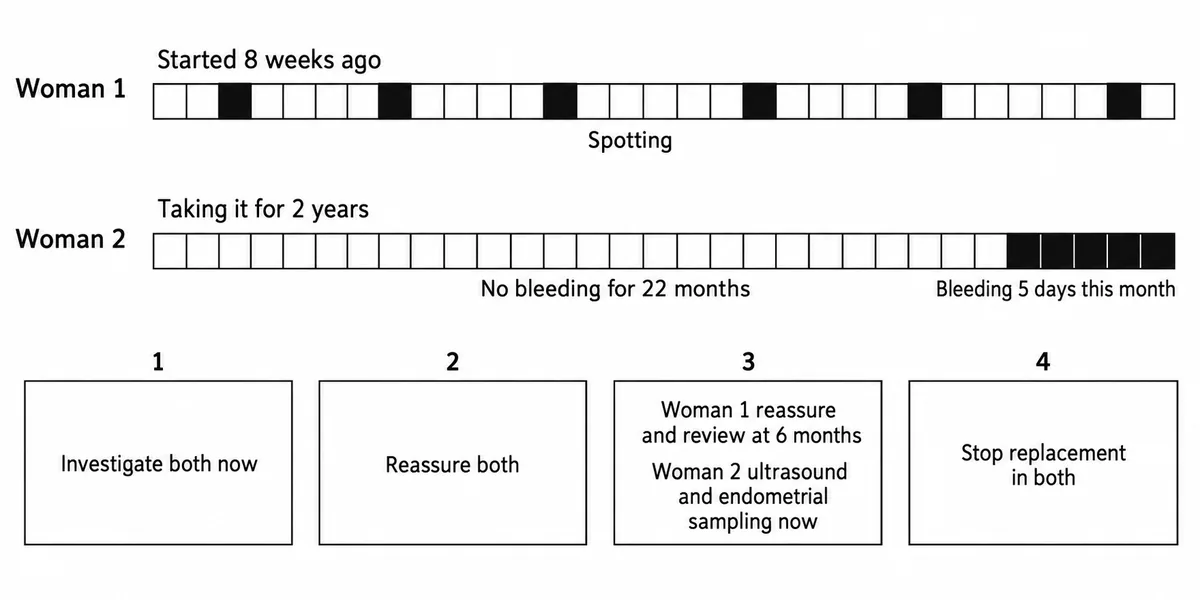
Two women of 54, each more than a year past her last period, take continuous combined hormone replacement. Each brings a bleeding diary. The diaries and four plans are drawn in the figure. What should be done? Two bleeding diaries above four plans.
Look first: compare when treatment began with when bleeding began; count the months without bleeding on each diary.
 View larger ↗⤢ Tap to enlarge
- AStop replacement in both
- BInvestigate both women
- CReassure both women
- DInvestigate woman 2 only
Show the answer and explanation
Answer: D. Investigate woman 2 only
D. Investigate woman 2 only. Woman 1 has light spotting eight weeks after starting continuous combined HRT, when the endometrium is still adjusting. Reassurance and review fit the pattern shown. Woman 2 has new bleeding after 22 months without it: this is not an early treatment effect. The bank plan calls for a transvaginal scan and endometrial sampling. In clinical practice, ultrasound findings and risk factors guide whether sampling is needed; the British Menopause Society bleeding guideline supports prompt ultrasound for bleeding first presenting this late.
Why the other options lose: stop replacement in both (A) neither explains woman 2's bleeding nor addresses woman 1's expected early spotting. Investigate both women (B) treats the two timelines as equivalent; the light, scattered spotting shown at eight weeks can be reviewed without immediate invasive investigation. Reassure both women (C) overlooks woman 2's new bleeding after established amenorrhoea. Heavy or prolonged bleeding, or endometrial cancer risk factors, would change the assessment of an early bleed; the diary here shows light spotting.
Recallab question 60377 · Gynaecology › Gynaecology: Menstrual & Endocrine · reference: Williams Gynecology
Recallab example 5 · read the risk curve
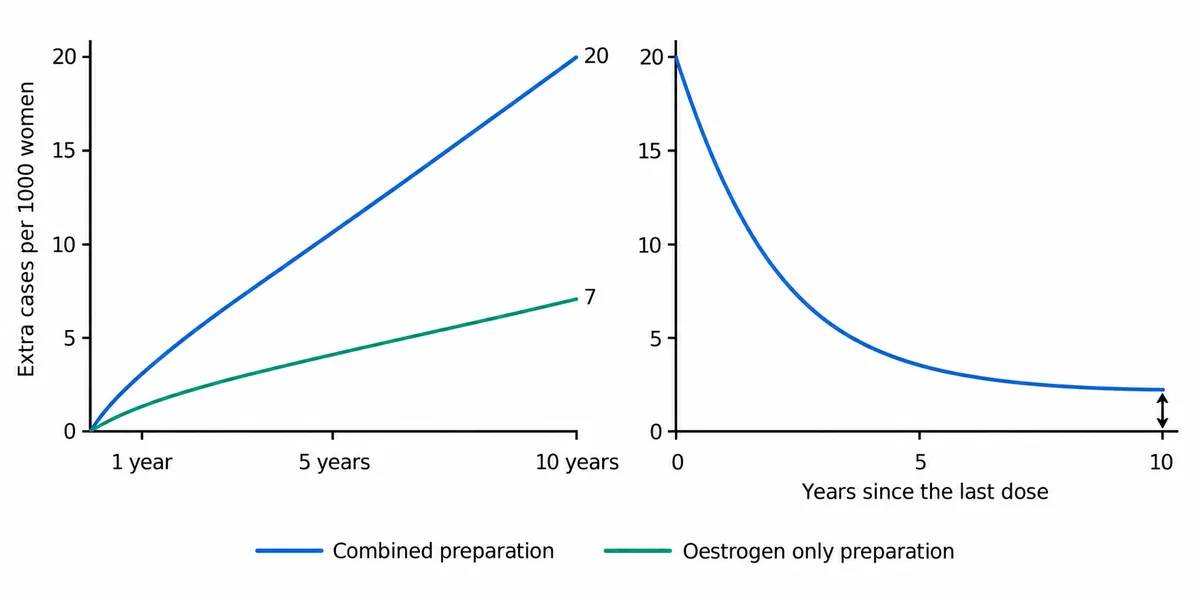
A woman of fifty-three with troublesome flushes has read that treatment causes breast cancer and asks by how much. The figure sets out what was counted in two preparations and what happened in the years after women stopped. Which statement does the figure support? Extra cases counted against duration of use in two preparations, and against years since the last dose.
Look first: read both axes and the legend, then compare each curve as duration increases and after the last dose.
 View larger ↗⤢ Tap to enlarge
- AExcess fixed whatever the duration
- BBoth add the same
- CExcess risk grows with duration
- DOestrogen-only adds more
Show the answer and explanation
Answer: C. Excess risk grows with duration
C. Excess risk grows with duration. Both curves in the left chart rise as years of use increase. The combined preparation lies above the oestrogen-only preparation. In the right chart, the excess falls after stopping but remains above the baseline at ten years. Read the vertical axis as extra cases per thousand women, rather than as a percentage or the total number of cases. The rising curves decide the answer. The MHRA risk update describes the same duration and persistence pattern; the plotted values here answer this figure-reading question, rather than giving a personalised estimate.
Why the other options lose: excess fixed whatever the duration (A) would require flat curves, whereas both rise. Both add the same (B) would require the two curves to overlap, whereas the combined curve is higher. Oestrogen-only adds more (D) reverses the legend: that curve is lower in the drawing. Preparation, duration and time since stopping are three separate things to read before discussing the size of an excess.
Recallab question 59080 · Gynaecology › Miscellaneous · reference: DC Dutta's Textbook of Gynecology
Recallab example 6 · a medicine before immobility
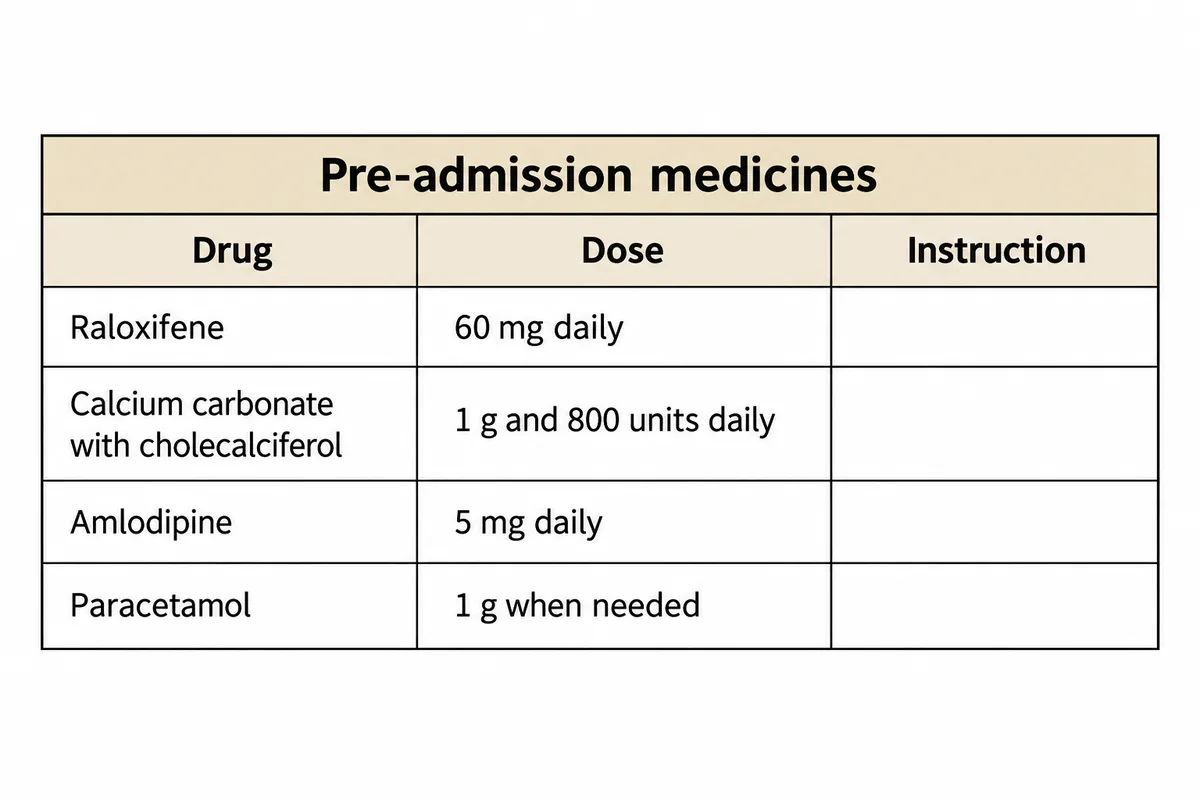
A woman of 66 with postmenopausal osteoporosis is listed for a total knee replacement, after which she will be slow to mobilise. Her drug list at pre-admission is drawn in the figure. Which instruction is right? A pre-admission drug list with an empty instruction column.
Look first: read the whole drug list and connect the planned period of reduced mobility with each medicine's effects.
 View larger ↗⤢ Tap to enlarge
- AStop raloxifene three days before
- BStop calcium with cholecalciferol
- CStop amlodipine the day before
- DStop raloxifene four weeks before
Show the answer and explanation
Answer: A. Stop raloxifene three days before
A. Stop raloxifene three days before. Raloxifene is a selective oestrogen receptor modulator used for postmenopausal osteoporosis. It increases venous thromboembolism risk, which surgery and prolonged immobility also increase. Stop it at least 72 hours before the anticipated immobilisation, and restart only once she is fully mobile. The raloxifene product information specifies this interval. The figure tests a medicine-related risk in a woman with postmenopausal bone disease.
Why the other options lose: stop calcium with cholecalciferol (B) targets a supplement that does not cause this clotting risk. Stop amlodipine the day before (C) targets an antihypertensive that is usually continued perioperatively, rather than the medicine relevant to immobility. Stop raloxifene four weeks before (D) identifies the right drug but uses an unnecessarily long interval for this question; the specified minimum is three days. Match the drug to the risk, then check the stopping interval.
Recallab question 60480 · Gynaecology › Miscellaneous · reference: DC Dutta's Textbook of Gynecology
The one-minute routine
| If the figure gives | Ask first | It settles |
|---|---|---|
| Past uterine procedures | Could endometrium or endometriosis remain | Whether systemic oestrogen needs a progestogen |
| Migraine with aura in a pill record | Is the plan contraception or replacement, and by which route | A patch with endometrial protection in this case |
| A low-dose vaginal prescription | Is the treatment local or systemic | No routine added progestogen for low-dose local treatment |
| Bleeding diaries on continuous combined HRT | Early light spotting or new bleeding after amenorrhoea | Review the early pattern; investigate the late one |
| Breast cancer risk curves | Which preparation, for how long, and how long since stopping | The duration-dependent excess shown in the chart |
| Raloxifene before surgery with immobility | Which drug adds clot risk and when must it stop | Stop at least 72 hours before; restart when fully mobile |
For more illustrated practice, see ten NEET PG image questions and physiology graphs. Continue with gynaecology questions.
Why candidates use Recallab
- Built towards 22,000 — a batch at a time
- Illustrations drawn for the question
- Every option explained, not just the right one
- AI study tools that are live today
- Start free, today
Or see the plans, or try a timed mock section.
Register to practise NEET PG gynaecology questionsFree account, no card needed. Practise with every option explained and a reference on every question.Drawn from questions #59970, #60070, #60379, #60377, #59080, #60480 in the Recallab bank, each with its own verified answer and current-edition reference. Last reviewed 14 October 2026.