
Recallab › Blog › Thyroid function tests for NEET PG: read TSH and free T4 as a pair
Thyroid function tests for NEET PG: read TSH and free T4 as a pair
TSH is the pituitary's opinion of the thyroid. Free T4 is the thyroid's output. Read them together, and most thyroid results explain themselves.
Register to practise NEET PG endocrinology questions →Free account, no card needed.
A failing thyroid drives the TSH up; an overactive one switches it off. The questions that catch candidates are the results that break this rule: a low thyroxine with a TSH that is not high, a high thyroxine with a TSH that is not suppressed, and results that change when nothing about the gland has changed. These six illustrated Recallab questions work through those patterns, for NEET PG and INI-CET revision. Try each question before opening its worked answer.
Before you name the problem: three questions
- Do TSH and free T4 move in opposite directions? If they do, the pituitary is answering normally, and the cause lies in the gland or in something acting on it; if they do not, look above the gland, at the pituitary and its feedback.
- Could something other than the gland explain it? Pregnancy, recovery from illness, a supplement or a new tablet can each move the numbers.
- Is the result physiologically possible in this patient? A very high thyroxine in a calm woman with a normal pulse points to the assay, not the gland.
Read TSH and free T4 as a pair
Recallab example 1 · a low T4 with a TSH that is not high
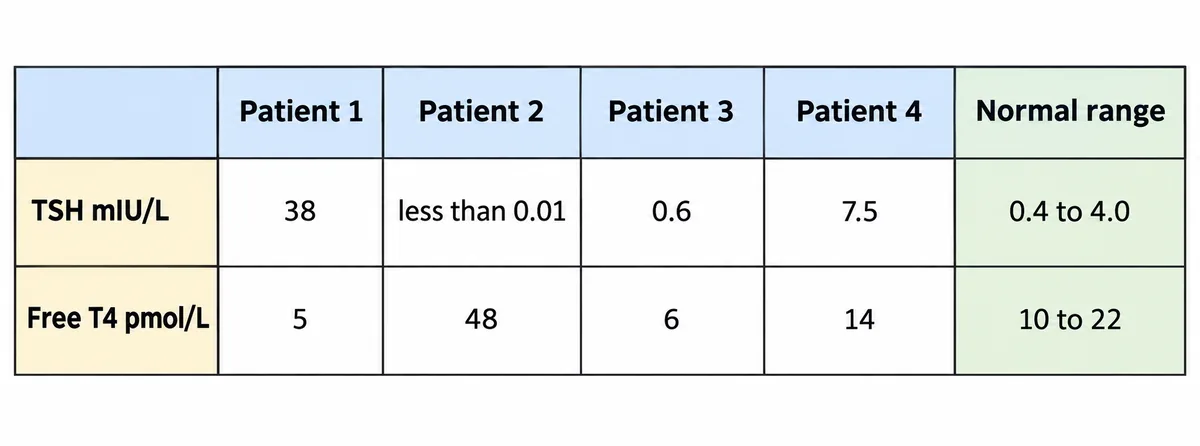
Thyroid function results from four patients are drawn in the figure. One of them also has a large pituitary tumour. Which patient is that? Thyroid-stimulating hormone and free thyroxine for four patients, printed beside the normal ranges.
Look first: decide for each patient whether the TSH is answering the thyroxine correctly, then find the one where it is not.
 View larger ↗⤢ Tap to enlarge
- APatient 2
- BPatient 4
- CPatient 1
- DPatient 3
Show the answer and explanation
Answer: D. Patient 3
D. Patient 3. Patient 3 has a low free thyroxine with a TSH inside the normal range. A failing thyroid would drive the TSH high; here the pituitary cannot respond. That is central hypothyroidism, which fits a large pituitary tumour. The same tumour may have cut corticotropin, leaving hidden cortisol deficiency, and thyroxine speeds cortisol clearance, so cortisol is checked and replaced before thyroxine is started. Treatment is then monitored by free T4, not TSH.
Why the other options lose: Patient 2 (A), with a suppressed TSH and a high thyroxine, is primary thyrotoxicosis, the pituitary correctly switched off by the excess. Patient 4 (B), with a raised TSH and a normal thyroxine, is subclinical primary hypothyroidism, not pituitary failure. Patient 1 (C), with a very high TSH and a low thyroxine, is primary thyroid failure, with the pituitary working hard.
Recallab question 55854 · Medicine › Endocrinology · reference: Harrison's Principles of Internal Medicine
When something outside the gland moves the TSH
Recallab example 2 · a suppressed TSH at ten weeks
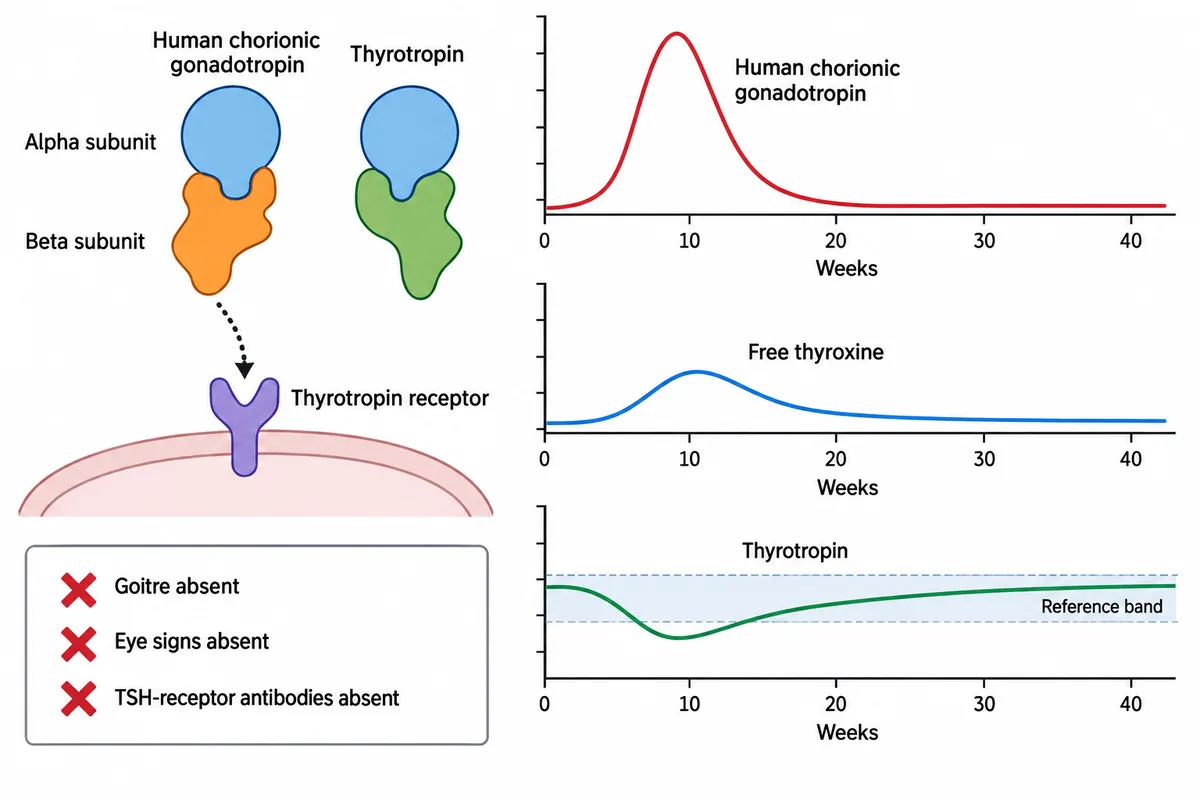
A woman at ten weeks with severe vomiting has a suppressed thyrotropin and a slightly raised free thyroxine, with no goitre and no eye signs. What is the explanation?
Look first: think about which hormone peaks at ten weeks, and what it shares with thyrotropin.
- AGraves disease
- BGestational transient thyrotoxicosis
- CSubacute thyroiditis
- DLaboratory error
Show the answer and explanation
Answer: B. Gestational transient thyrotoxicosis
 View larger ↗⤢ Tap to enlarge
B. Gestational transient thyrotoxicosis. Human chorionic gonadotropin shares an identical alpha subunit with thyrotropin and stimulates its receptor. Its level peaks at around ten weeks, when the effect is greatest, and it is commoner and more marked in hyperemesis and in multiple pregnancy. The absence of goitre, eye signs and antibodies distinguishes it from Graves disease. It resolves as the hormone falls after the first trimester, so no antithyroid drug is needed and the tests are repeated after twenty weeks.
Why the other options lose: Graves disease (A) does not fit: there is no goitre, no eye signs, and the picture is transient. Subacute thyroiditis (C) gives a painful, tender gland, and painless thyroiditis usually follows delivery; she has neither. Laboratory error (D) is wrong because this is a recognised physiological pattern.
Recallab question 53995 · Obstetrics › Early Pregnancy Complications · reference: Williams Obstetrics
Recallab example 3 · a raised TSH after pneumonia
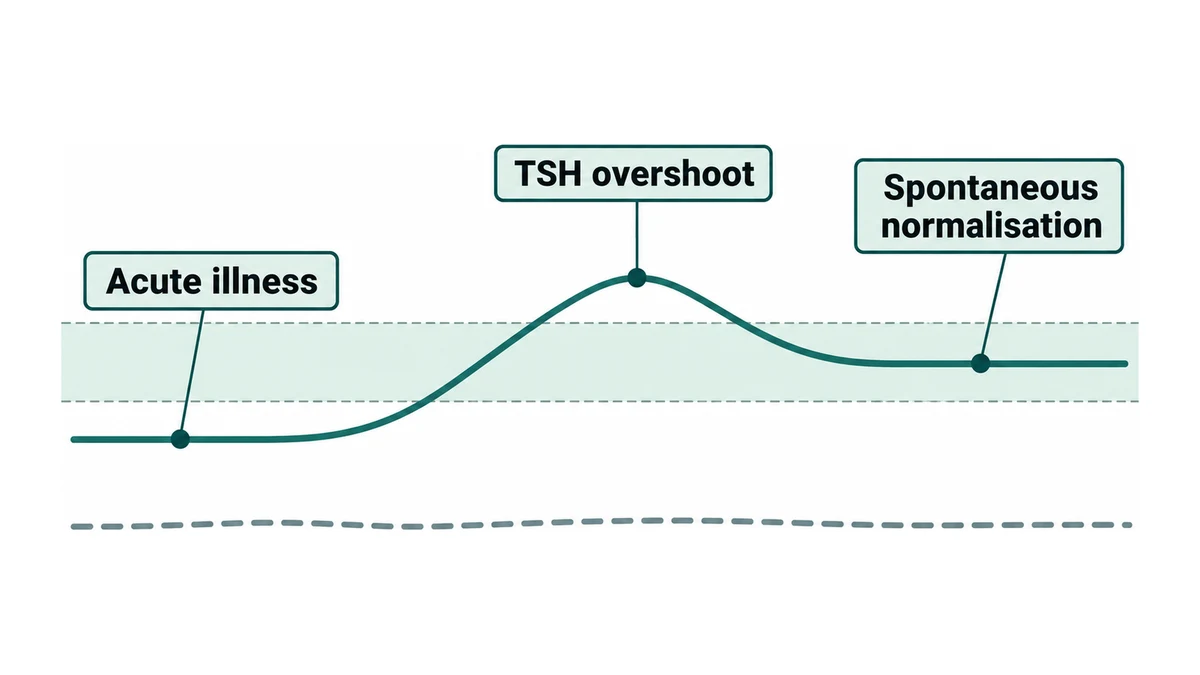
A 59-year-old woman recovering from severe pneumonia in Chandigarh has TSH 8 mIU/L with normal free T4. TSH was low during intensive care, while pre-admission tests were normal. She has no goitre or specific thyroid symptoms but remains tired. Six weeks later TSH normalises untreated. What best explains this course?
Look first: follow the TSH through three stages: before the illness, in intensive care, and in recovery.
- APermanent primary hypothyroidism
- BRecovery-phase TSH rebound
- CPersistent central hypothyroidism
- DAutonomous TSH secretion
Show the answer and explanation
Answer: B. Recovery-phase TSH rebound
 View larger ↗⤢ Tap to enlarge
B. Recovery-phase TSH rebound. Severe systemic illness alters thyroid hormone metabolism and hypothalamic-pituitary signalling, so TSH may fall during the acute phase without any destructive thyroid disease. During convalescence, pituitary secretion can briefly overshoot its usual reference interval. A normal free T4 and spontaneous resolution argue against true thyroid hormone deficiency, and tiredness after pneumonia does not establish hypothyroidism. Repeating the tests after recovery separates this transient pattern from persistent thyroid dysfunction.
Why the other options lose: Permanent primary hypothyroidism (A) would not usually normalise without replacement. Persistent central hypothyroidism (C) features a low free T4 with an inadequate TSH, unlike the normal hormone level here. Autonomous TSH secretion (D) keeps the TSH inappropriately high alongside raised thyroid hormones, rather than giving a transient rise in recovery.
Recallab question 74240 · Medicine › Endocrinology · reference: Harrison's Principles of Internal Medicine
A high thyroxine that is not thyrotoxicosis
Recallab example 4 · a high T4 and a mother with the same results
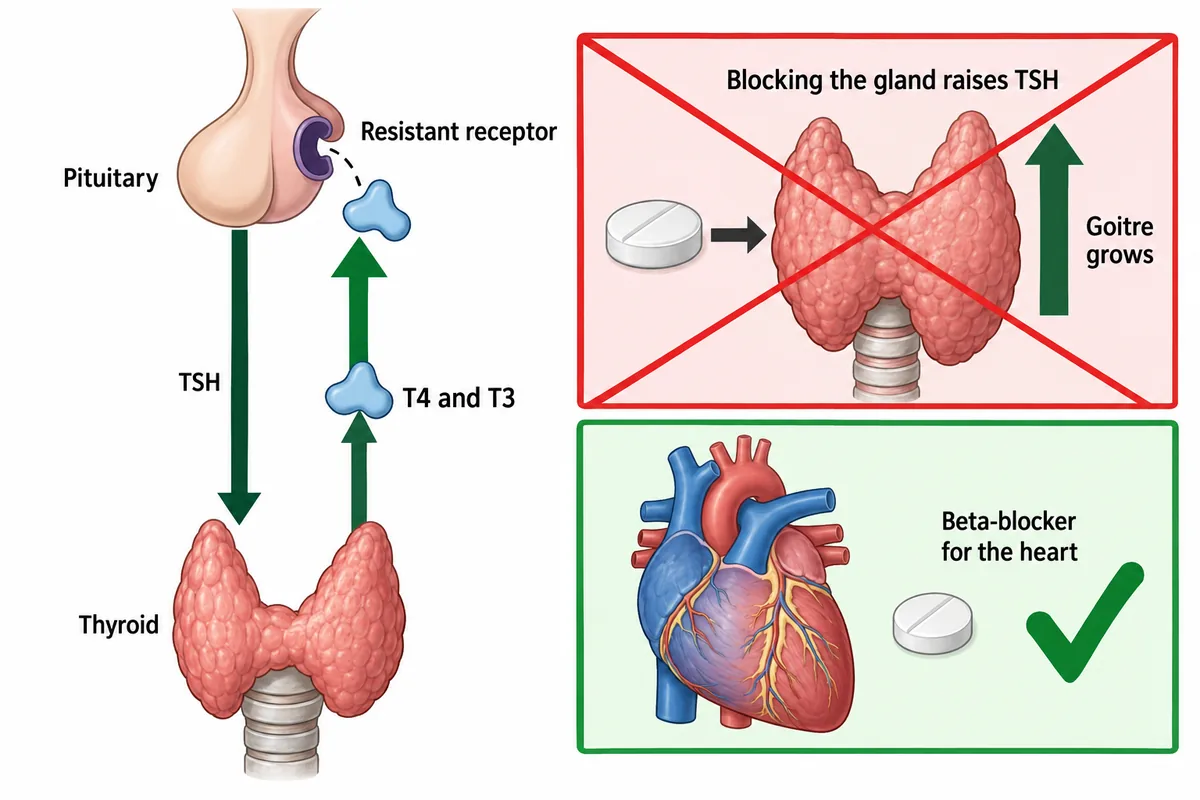
A woman of 26 has palpitations and a small, smooth goitre. Free T4 is 3.1 ng/dL (0.8-1.8) and free T3 is raised, yet TSH is 3.4 mIU/L (0.4-4.0). Her mother has had identical results for years and is well. Pituitary MRI, alpha-subunit and sex hormone-binding globulin are normal. What is the most appropriate management?
Look first: ask why the TSH is not suppressed, then ask what happens to the tissues if the hormone level is lowered.
- AAtenolol alone
- BCarbimazole
- CTranssphenoidal surgery
- DRadioiodine ablation
Show the answer and explanation
Answer: A. Atenolol alone
 View larger ↗⤢ Tap to enlarge
A. Atenolol alone. Rising thyroid hormone normally suppresses TSH through T3 receptors in the pituitary. A high free T4 and T3 with an unsuppressed TSH mean that feedback is failing. A normal pituitary MRI and alpha-subunit, and an affected mother, point to inherited resistance to thyroid hormone. The high levels are the body's compensation for resistant tissues, so they must not be lowered; only the palpitations are treated, and a beta-blocker settles them.
Why the other options lose: Carbimazole (B) lowers hormone output, so the TSH rises further and the goitre grows. Transsphenoidal surgery (C) is for a TSH-secreting adenoma, which shows on MRI and usually raises the alpha-subunit; both are normal here. Radioiodine ablation (D) treats Graves disease, where TSH is suppressed; here it would remove compensating hormone and leave her hypothyroid.
Recallab question 70003 · Medicine › Endocrinology · reference: Harrison's Principles of Internal Medicine
Recallab example 5 · impossible results in a well woman
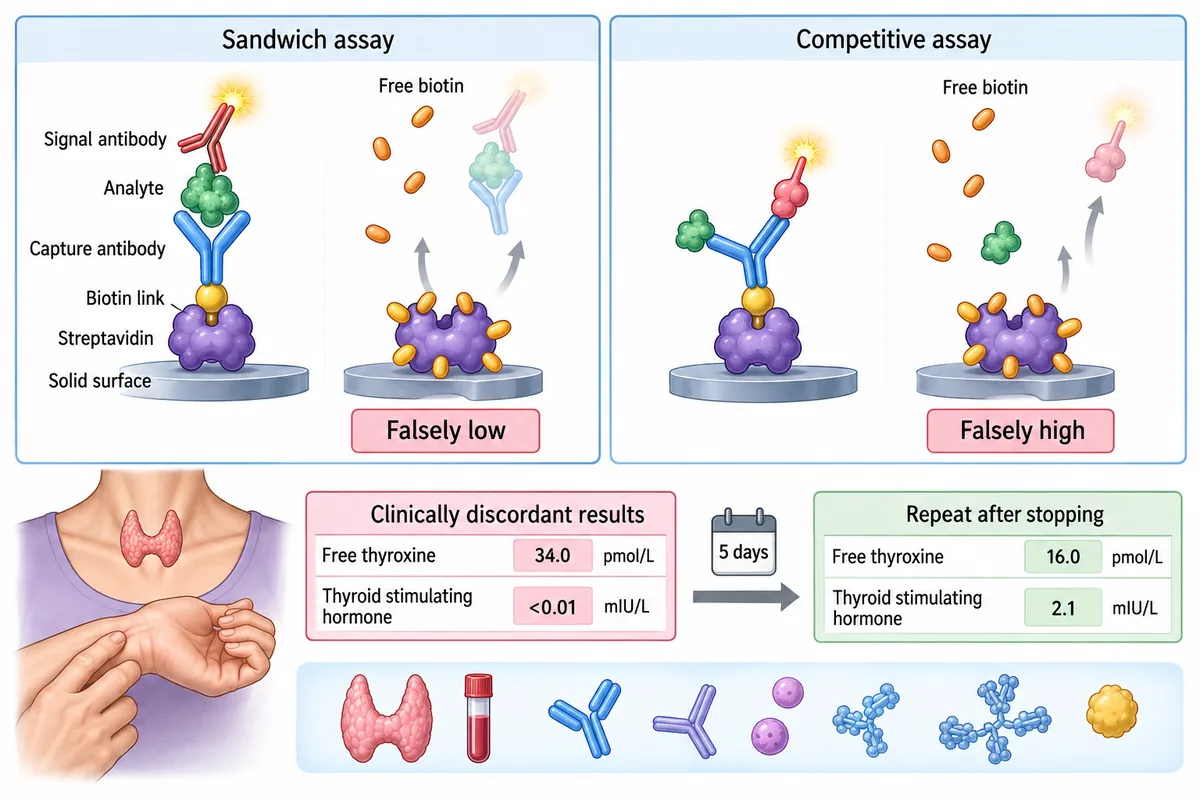
A well woman taking a high-dose hair supplement has a very high free thyroxine with an undetectable thyroid stimulating hormone, but no symptoms and a normal pulse. Repeat testing after five days off the supplement is entirely normal. What happened?
Look first: set the results against the patient, then ask how a single substance could push two tests in opposite directions.
- AThyroid hormone resistance
- BTransient thyrotoxicosis
- CA haemolysed first sample
- DBiotin assay interference
Show the answer and explanation
Answer: D. Biotin assay interference
 View larger ↗⤢ Tap to enlarge
D. Biotin assay interference. Many immunoassays anchor the antibody complex with a biotin and streptavidin link, and a high circulating biotin concentration saturates those binding sites. In a competitive assay, as used for free thyroxine, less signal is captured and the result reads high. In a sandwich assay, as used for TSH, the complex is not captured and the result reads low. The pattern is physiologically impossible in a well patient, and it disappears once the supplement is stopped, because biotin is cleared quickly.
Why the other options lose: Thyroid hormone resistance (A) is genetic and permanent, with a normal or raised TSH. Transient thyrotoxicosis (B) of that severity would not resolve in five days, and she had no signs. A haemolysed first sample (C) neither raises thyroid hormones nor suppresses TSH.
Recallab question 54614 · Biochemistry › Clinical Biochemistry · reference: Harper's Illustrated Biochemistry
When the binding globulin moves
Recallab example 6 · a stable dose that stops working
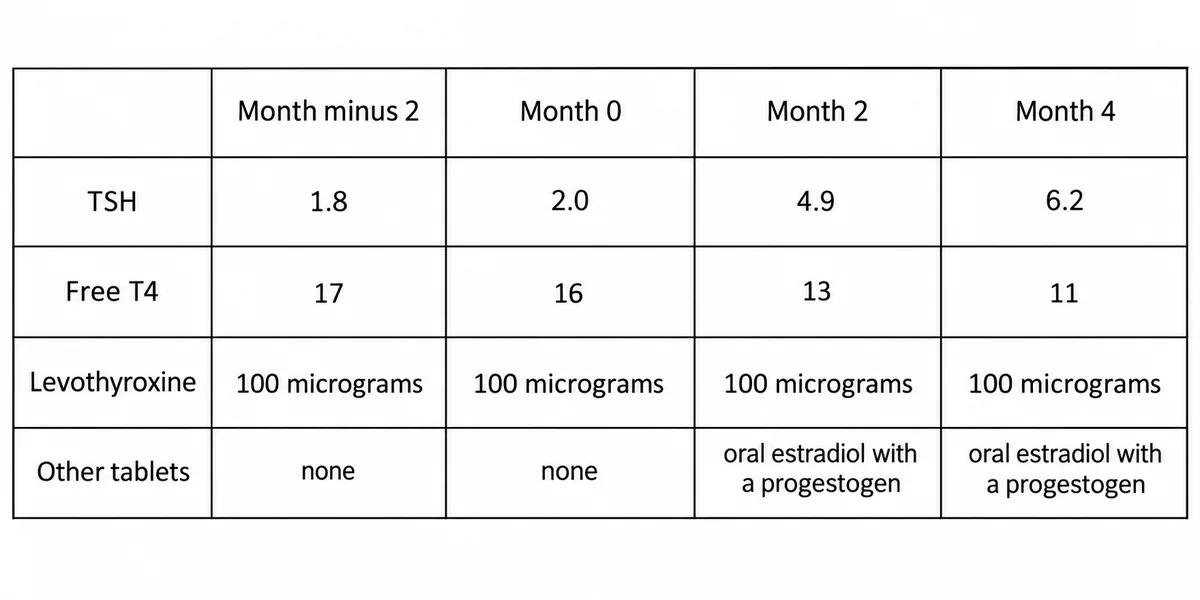
A woman of 52 had a total thyroidectomy eight years ago and has been stable on the same levothyroxine dose since. She started hormone replacement for hot flushes at month 0. Her results are drawn in the figure. What explains the change? A four-column results table running from two months before to four months after.
Look first: find the month the results start to drift, then read the row of other tablets for that month.
 View larger ↗⤢ Tap to enlarge
- ASuppression of her remaining thyroid tissue
- BAssay interference by oestrogen
- CProgestogen binding levothyroxine in the gut
- DRaised thyroxine-binding globulin
Show the answer and explanation
Answer: D. Raised thyroxine-binding globulin
D. Raised thyroxine-binding globulin. The table is stable until month 0 and the dose never changes. Oral oestrogen passes through the liver in high concentration, and the liver makes more thyroxine-binding globulin. More hormone is bound, so the free fraction falls. A normal gland simply makes more, and its TSH hardly moves; after thyroidectomy there is no gland to compensate, so the TSH climbs. The levothyroxine dose is raised, or transdermal oestradiol is used instead, because it skips the first pass and leaves the globulin unchanged.
Why the other options lose: Suppression of her remaining thyroid tissue (A) is impossible after total thyroidectomy. Assay interference by oestrogen (B) is wrong because the change is real, tracks the start of treatment and matches a rising TSH. Progestogen binding levothyroxine in the gut (C) does not happen; calcium and iron are the tablets to separate from levothyroxine.
Recallab question 60576 · Gynaecology › Menstrual & Endocrine · reference: Williams Gynecology
The one-minute routine
| If the question gives | Ask first | It settles |
|---|---|---|
| A low free T4 with a TSH that is not high | Can the pituitary respond? | Central hypothyroidism: check cortisol before thyroxine |
| A suppressed TSH in early pregnancy | Is the pregnancy hormone at its peak? | Gestational transient thyrotoxicosis: no antithyroid drug |
| A raised TSH while recovering from severe illness | What was the TSH before and during the illness? | A recovery overshoot: repeat the tests later |
| A high T4 and T3 with a TSH that is not suppressed | Is there a pituitary tumour, or an affected parent? | Resistance is left alone; an adenoma is removed |
| Impossible results in a well patient | Is she taking a supplement? | Biotin interference: stop it and repeat the tests |
| A stable dose that stops working | Has a new tablet changed the binding globulin? | Oral oestrogen raises it: increase the dose or change the route |
Practise endocrinology questions and obstetrics questions. For another set of results that are read in pairs, see acid-base and electrolytes.
Why candidates use Recallab
- Built towards 22,000 — a batch at a time
- Illustrations drawn for the question
- Every option explained, not just the right one
- AI study tools that are live today
- Start free, today
Or see the plans, or try a timed mock section.
Register to practise NEET PG endocrinology questionsFree account, no card needed. Practise with every option explained and a reference on every question.Drawn from questions #55854, #53995, #74240, #70003, #54614, #60576 in the Recallab bank, each with its own verified answer and current-edition reference. Last reviewed 27 October 2026.