
Recallab › Blog › How many MCQs should you solve before NEET PG or INI-CET?
How many MCQs should you solve before NEET PG or INI-CET?
10,000? 22,000? 40,000? Count what you can use again—not just what you have clicked.
Create your free Recallab account →Free account, no card needed.
Two candidates finish the same 100 questions. Both score 70.
One can explain the answers, identify why the close alternatives are wrong and solve a related case a week later. The other recognised some familiar stems, guessed several answers correctly and moved on without examining the mistakes.
The dashboard gives them the same score. Their preparation is different.
That is why “How many questions should I finish?” needs a second question: “What will I be able to do with what I have learned?” Numbers such as 10,000 or 40,000 describe a workload. On their own, they tell you little about curriculum coverage, question quality or what remains in memory on exam day.
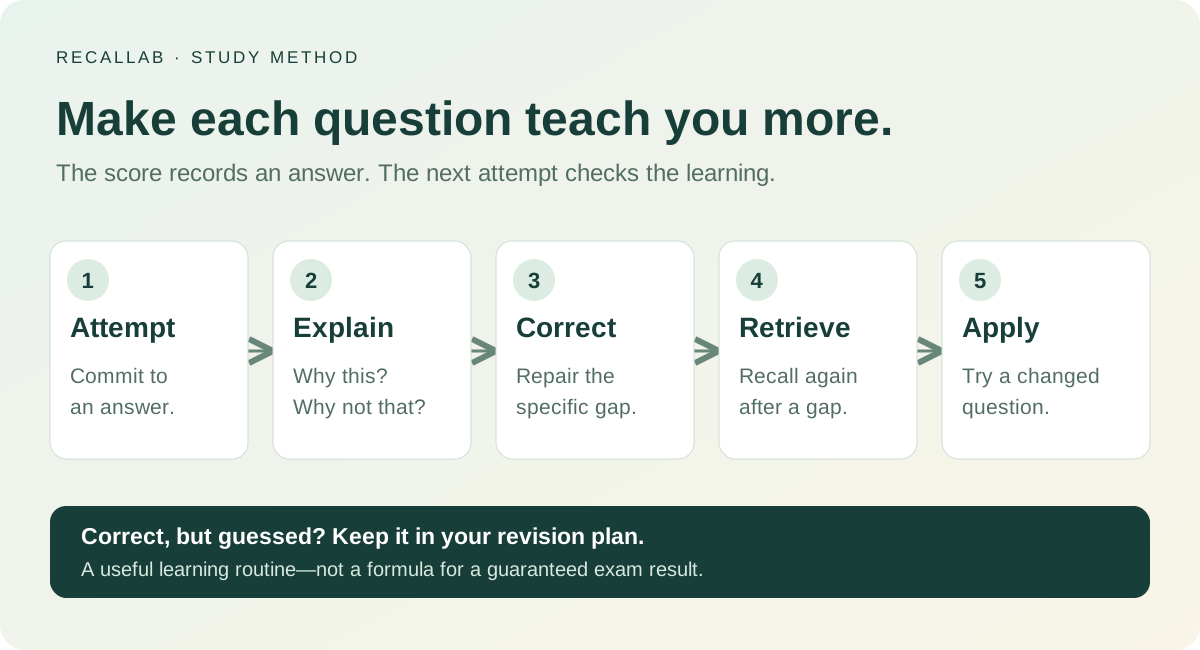 View larger ↗⤢ Tap to enlarge
There is no magic question count
A useful target depends on your starting knowledge, time remaining, subject coverage, pace of careful review and performance on unfamiliar questions. The learning studies discussed below do not establish a universal NEET PG or INI-CET question-count threshold.
Volume still matters. You need breadth, repeated encounters with important concepts and practice making decisions under time pressure. But repeatedly answering near-duplicates can increase your total without filling a neglected subject gap. Equally, spending an entire day on a handful of questions while avoiding the rest of the curriculum is not a complete preparation strategy.
Aim for broad coverage with enough depth to explain and reuse what you learn. A question bank is a resource for that work; its total size is not automatically your personal completion target.
What makes one question worth studying properly?
A well-developed, curriculum-based bank needs a sensible spread of subjects and topics, appropriate difficulty, clear questions and accurate explanations. Its value also depends on the choices.
Plausible wrong options expose the distinctions you need to understand. If three options are obviously absurd, getting the fourth right may tell you very little. If two are plausible, a good explanation should identify the detail that separates them.
Look for four things:
- A clear learning objective
- Meaningful alternatives
- An explanation of the reasoning
- A route to the wider topic
The last point matters. A strong explanation should leave you better prepared for more than the exact sentence you just answered. It need not become an entire textbook chapter; it should teach the relevant idea thoroughly enough to apply it elsewhere.
In a study of 64 medical students, feedback explaining responses or underlying concepts supported performance on related new questions better than simple right/wrong feedback. That is evidence for doing more with an MCQ than checking its answer key. Ryan and colleagues, 2020, Perspectives on Medical Education
Want to judge the approach for yourself? [Browse Recallab’s subject-organised question bank](/neet-pg/) and inspect the explanations as carefully as the questions.
Learning is more than answering
Answering from memory is itself useful practice. But a tick, a score and a quick glance at the explanation do not establish durable learning.
After a difficult question, ask:
- What was the decisive clue?
- Why did my preferred alternative seem plausible?
- What fact or reasoning step would have changed my choice?
- Can I explain the answer after closing the explanation?
- Can I still do that later, when the wording is different?
For an error, write a short correction that addresses its cause. “Revise anatomy” is too vague. “I confused the posterior wall with the floor; identify both on the diagram and recall them without labels” gives you a specific task.
A mistake does not doom you to repeat it. But if the underlying confusion remains, another question can expose it again. Correction, followed by a later attempt, checks whether you have actually resolved the problem. Treat the error as information about what needs work.
A correct guess still deserves revision
A guessed answer can earn the same mark as a well-reasoned answer. It should not automatically earn the same confidence in your preparation.
There is also a difference between a blind guess and a reasoned choice after eliminating alternatives. Elimination can reflect real knowledge. The question is whether you can explain what ruled the other options out and whether the remaining uncertainty needs attention.
During practice, be honest about that uncertainty. If you guessed and happened to be right, read the explanation anyway. Identify the clue you missed and revisit the concept later. Otherwise a favourable result can hide the very gap you need to repair.
This is a study method, not advice to leave every uncertain exam answer blank. Exam-day decisions also depend on the marking scheme, time and the alternatives you can confidently eliminate.
How to find guessed answers again in Recallab
Recallab’s practice interface offers Sure, Think so and Guess when it asks “How sure are you?” Make that judgement before revealing the answer.
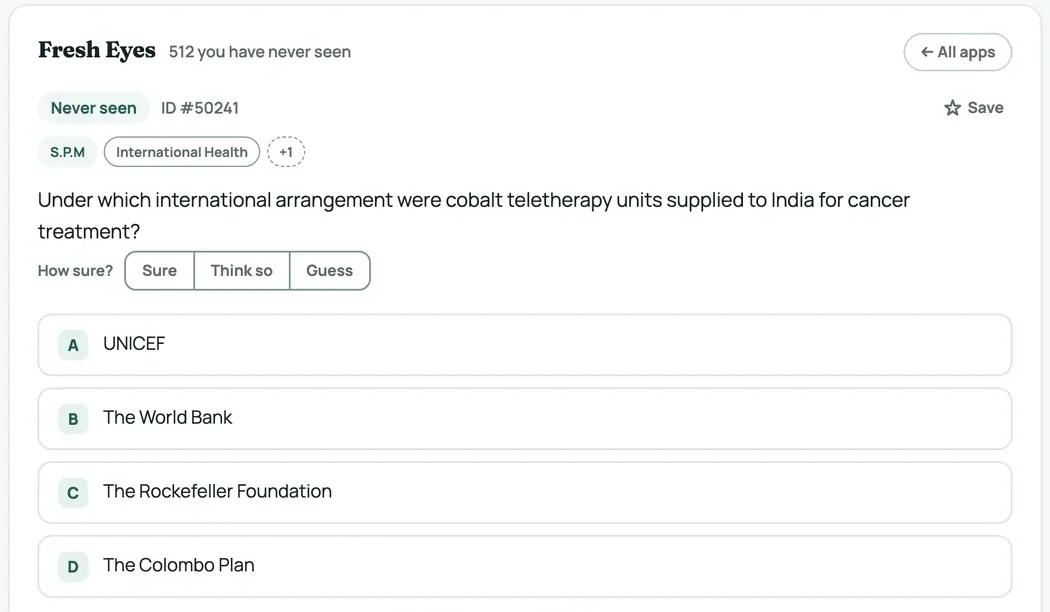 View larger ↗⤢ Tap to enlarge
That sampling detail is important: you will not necessarily see the prompt on every question, or exactly once in each group of four. The app uses the confidence you report. It cannot read your mind or identify every unreported guess.
For a practical routine:
- In a practice session, choose Sure, Think so or Guess when prompted, then answer.
- Read the explanation, including why the other choices do not fit.
- Open Apps and choose Lucky Guesses to revisit questions whose latest answered attempt was correct and rated Guess.
- Use False Certainty for questions whose latest answered attempt was wrong and rated Sure.
- Return to the concept after a gap, even when you have just corrected it successfully.
These lists reflect the latest answered attempt; they are not permanent archives of every guess you have ever made. An empty list does not prove there are no gaps, especially when many answers were unrated.
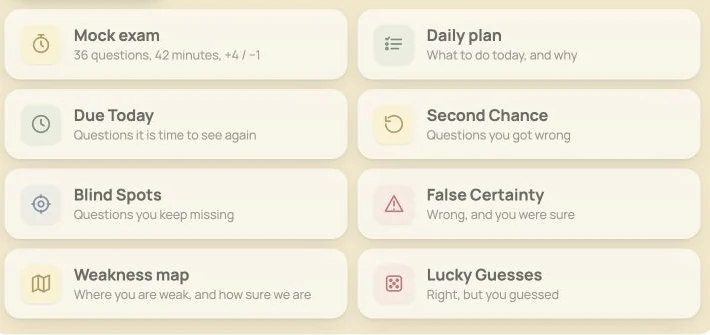 View larger ↗⤢ Tap to enlarge
| What needs attention? | Recallab tool | What to do with it |
|---|---|---|
| Correct, but rated Guess | Lucky Guesses | Find the missing reasoning before treating the answer as secure. |
| Wrong, but rated Sure | False Certainty | Examine the rule or assumption you trusted. |
| A wrong answer still to put right | Second Chance | Correct the specific error and attempt the question again. |
| Questions missed more often than answered correctly | Blind Spots | Revisit the underlying topic, not only the latest stem. |
| Questions scheduled for review | Due Today | Attempt recall again before rereading. |
[Open Recallab Apps](/#/apps) and make one of these review lists part of your next session. Feature access depends on your account’s current entitlement.
Why revisiting helps memory
Closing the explanation and reconstructing the answer requires retrieval. Coming back later checks that you can retrieve it after the immediate familiarity has faded. Feedback then helps you correct what you could not retrieve accurately.
In a randomised medical-education study, repeated testing with feedback produced better retention more than six months later than repeated, spaced study. The finding supports returning to questions and actively answering them, rather than relying solely on rereading. It does not establish a particular question-bank size or guarantee an examination result. Larsen, Butler and Roediger, 2009, Medical Education
For everyday revision, combine three actions: retrieve, check, revisit. A short note or diagram can help organise a confusing concept, but use it as something to explain from memory. Looking at it repeatedly is a different task.
Recallab’s Due Today tool is designed to organise repeat practice. A review schedule gives you a structure; your ability to explain and apply the material remains the meaningful check.
Prepare for a changed question
Build your preparation around concepts that can be tested in different ways. Do not plan on receiving exact copies of questions from any commercial pool. No trustworthy repeat percentage can be promised here.
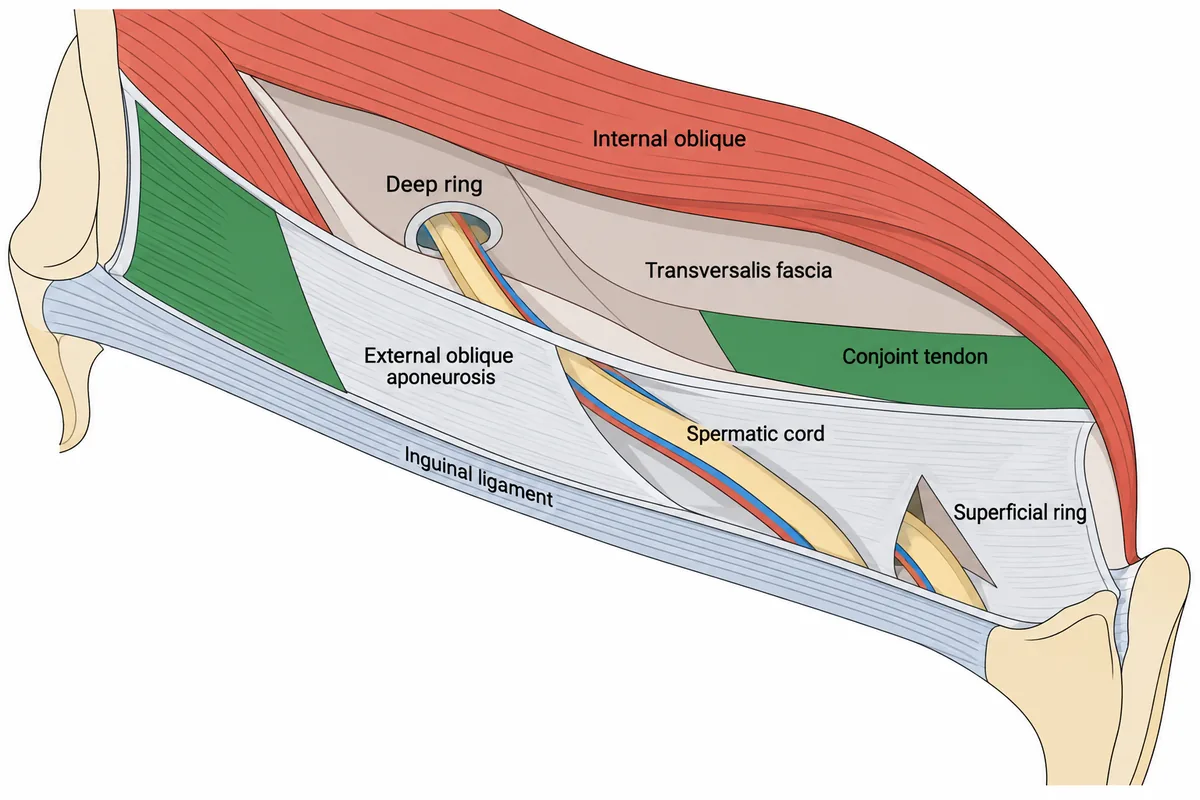
Consider this inguinal-canal illustration from Recallab question 51804:
 View larger ↗⤢ Tap to enlarge
The original bank question asks about the posterior wall medially and the floor. Learning that explanation connects the transversalis fascia and conjoint tendon with the posterior wall, and the inguinal ligament with the floor — one of the abdomen and pelvis anatomy questions.
A related question could ask you to identify the medial reinforcement on an illustration, distinguish it from the anterior wall, or explain why a proposed boundary is wrong. These are examples of different question angles—not recalled examination questions or a preview of released Morphs.
If you learned only the answer’s position on the screen, those changes are troublesome. If you learned the arrangement, you have reasoning you can use again.
Research has found that repeated testing can support transfer to new inferential questions, although transfer is not automatic and depends on the task. That is the educational rationale for testing an idea through more than one formulation. Butler, 2010, Journal of Experimental Psychology
Recallab’s 22,000 MentorQs commitment—and what follows
Recallab is building towards a bank of 22,000 MentorQs by 1 January 2027. As checked on 23 September 2026, the bank had passed 10,000 MentorQs, with 10,047 live. The commitment describes the bank we are building towards, not the number already available today.
Our view is that a carefully structured provision of 22,000 questions, supported by substantial explanations and revision, can provide a strong practice resource for both NEET PG and INI-CET. That is a curriculum and product judgement, not a scientifically established minimum or a promise that every candidate must complete all 22,000.
After the bank reaches 22,000 MentorQs, Recallab plans to provide 100 morphed questions daily. These are planned variations on existing concepts, intended to test learning through changed vignettes or different angles. They are not a claim about 100 questions being repeated in the examination, and they are not presented here as a feature already delivering that daily volume.
The aim is to help candidates distinguish “I recognise this question” from “I understand this topic.” Merely changing an answer letter is not enough; the variation needs to make the learner apply the idea. How well this works should be judged by performance on the changed questions, not by the size of the release counter.
Set a target you have time to learn from
Start with a week of measured practice. Find out how long you actually spend answering new questions and reviewing their explanations. Reserve time for old errors, guessed answers, curriculum gaps and timed practice before calculating how many new questions fit.
For illustration, suppose you have 120 study days and allocate 90 minutes each day to new questions and their explanations, plus a separate hour for revision. If a carefully reviewed new question averages three minutes, that gives you about 30 new questions a day, or 3,600 across those 120 days. At five minutes each, the same new-question time allows about 2,160.
Those are planning calculations, not recommended quotas. They show why copying someone else’s target without checking their starting point or review time can produce an unrealistic schedule. Reattempts belong in your workload too; keep them separate from your count of unique questions.
Review your plan each week against a few useful signs: subjects still uncovered, recurring mistakes, correct guesses that remain unresolved, recall after a gap, and performance on unfamiliar mixed questions under time limits. As the exam approaches, protect the time needed to consolidate what you have already studied instead of chasing a final impressive total.
Tomorrow’s target can be simple: cover a defined topic, explain the difficult answers, repair a specific error and revisit something you previously guessed. Your question count will record the work. Your next unfamiliar question will help reveal what you learned.
For the visual side of revision, read why illustrated MCQs can help, or try a timed NEET PG mock section.
Why candidates use Recallab
- Built towards 22,000 — a batch at a time
- Illustrations drawn for the question
- Every option explained, not just the right one
- AI study tools that are live today
- Start free, today
Or see the plans, or try a timed mock section.
Create your free Recallab accountFree account, no card needed. Practise with every option explained and a reference on every question.Drawn from questions #51804 in the Recallab bank, each with its own verified answer and current-edition reference. Last reviewed 20 September 2026.