
Recallab › Blog › National health programmes for NEET PG: six worked questions from India's field practice
National health programmes for NEET PG: six worked questions from India's field practice
National programme questions reward the candidate who has pictured the field: the test report, the immunisation card, the refrigerator log, the tape on a child's arm.
Register to practise NEET PG community medicine questions →Free account, no card needed.
Community medicine in NEET PG is anchored in India's own programmes, and their rules are specific: a time limit, a cut-off, a classification. Most questions turn on one of those numbers, applied to what a health worker actually sees. Below are six real Recallab MentorQs, one for each programme theme. Try each before you open the answer.
Before any programme question: three questions
- Which programme is this? NTEP, the immunisation programme, malaria, leprosy or nutrition: each has its own rules.
- Which number decides it? An age limit, a temperature band, a patch count, a centimetre cut-off.
- What happens next? Most answers are an action: treat, discard, refer, or manage in the community.
Tuberculosis and immunisation
Recallab example 1 · NTEP testing
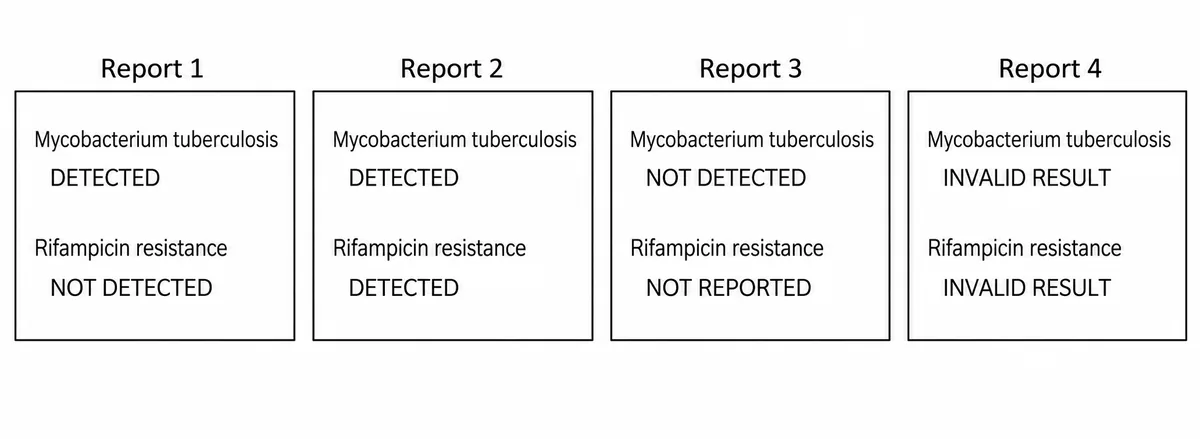
Four molecular test report screens are drawn in the figure. A smear-negative man with HIV has cough and weight loss and is tested under NTEP. Which report needs a regimen for drug-resistant tuberculosis?
Look first: read the second line of each report; the first only says whether TB is there.
 View larger ↗⤢ Tap to enlarge
- AReport 4, invalid result
- BReport 3, tuberculosis not detected
- CReport 2, rifampicin resistance detected
- DReport 1, rifampicin sensitive
Show the answer and explanation
Answer: C. Report 2, rifampicin resistance detected
Report 2. Rifampicin resistance on a cartridge-based molecular test closely predicts multidrug-resistant tuberculosis, so it needs a drug-resistant regimen and a line probe assay for isoniazid and fluoroquinolone resistance. The test detects bacterial DNA directly, so it works even when the smear is negative.
Why the closest rival loses: report 3 (B) is negative, but a negative molecular result does not exclude tuberculosis in a person with HIV. Report 4 (A) is invalid and is repeated; report 1 (D) is rifampicin sensitive, so first-line treatment fits.
Recallab question 55332 · Social and Preventive Medicine › Tuberculosis (NTEP) · reference: Ananthanarayan and Paniker's Textbook of Microbiology
Recallab example 2 · birth doses
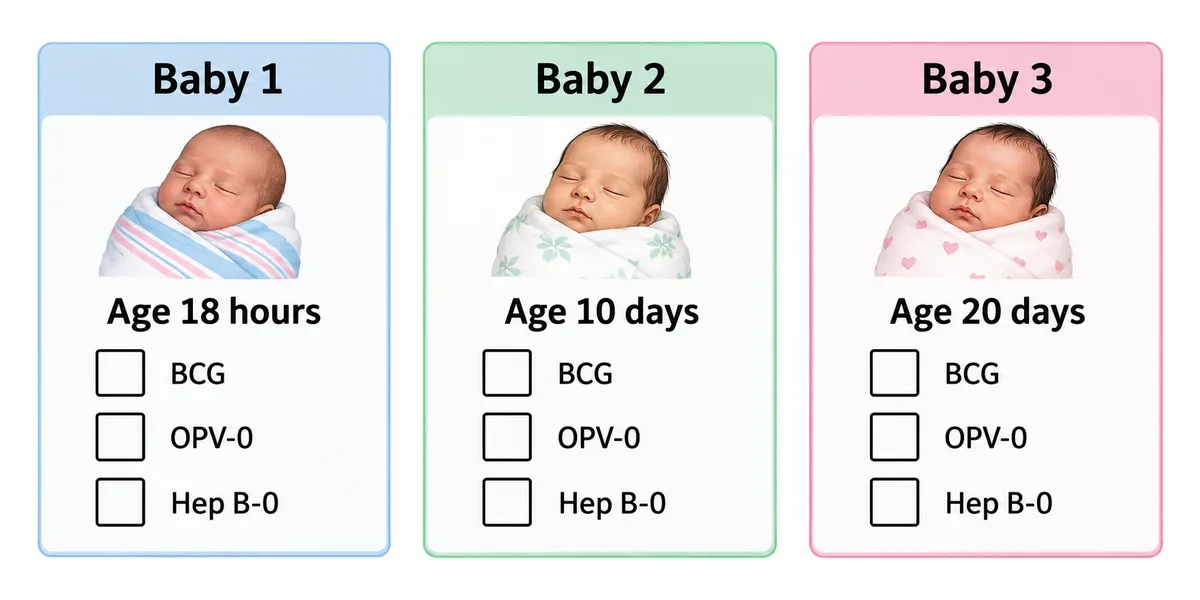
Three babies born at home are brought to the same immunisation session for their first vaccines, and each baby's card is drawn in the figure. Under India's schedule, which baby can still be given all three birth doses today?
Look first: each birth dose has its own deadline; check every baby against all three.
 View larger ↗⤢ Tap to enlarge
- ABabies 1 and 3
- BBabies 1 and 2
- CBabies 2 and 3
- DBaby 1 only
Show the answer and explanation
Answer: D. Baby 1 only
Baby 1 only. Under India's schedule the hepatitis B birth dose is given only within 24 hours, the oral polio zero dose up to 15 days, and BCG up to one year. Baby 1, at 18 hours, can have all three; baby 2 can have oral polio and BCG; baby 3, at 20 days, BCG alone. A missed birth dose is not made up: the six-week doses follow as usual.
Why the closest rival loses: babies 1 and 2 (B) treats 15 days as the hepatitis B limit, but that is the oral polio limit. Baby 3 (A, C) is past both the hepatitis B and the oral polio limits.
Recallab question 55998 · Social and Preventive Medicine › Immunisation · reference: Park's Textbook of Preventive and Social Medicine
Recallab example 3 · cold chain
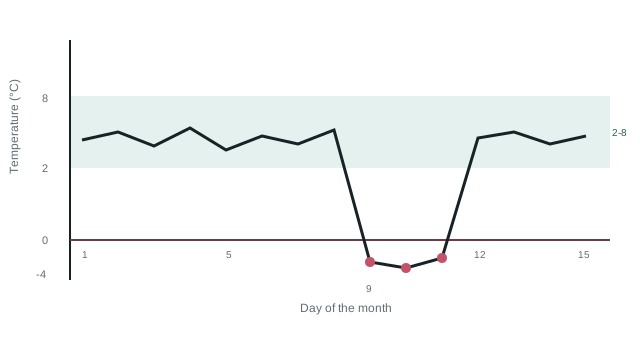
The temperature log from a primary health centre's vaccine refrigerator is shown. What has gone wrong?
Look first: find the shaded band first, then every reading that falls outside it, and which way.
 View larger ↗⤢ Tap to enlarge
- AIt froze for three days
- BThe thermometer is faulty
- CNothing, every reading is in range
- DIt ran too warm for three days
Show the answer and explanation
Answer: A. It froze for three days
It froze for three days. Days 9, 10 and 11 sit below zero, outside the 2 to 8 degree band. Adjuvanted vaccines such as hepatitis B, pentavalent and the tetanus and diphtheria toxoids clump irreversibly when frozen and lose potency, although the vial looks normal and the vaccine vial monitor, which reports only heat, is unchanged. They must be discarded.
Why the closest rival loses: the excursion runs downwards, so it is not too warm (D). Freezing in a vaccine refrigerator is common, from a thermostat set too low or vials against the back wall, so a faulty thermometer (B) is not the first explanation; and three readings are plainly out of range (C).
Recallab question 54737 · Social and Preventive Medicine › Immunisation (cold chain) · reference: Park's Textbook of Preventive and Social Medicine
Malaria and leprosy
Recallab example 4 · malaria rapid test
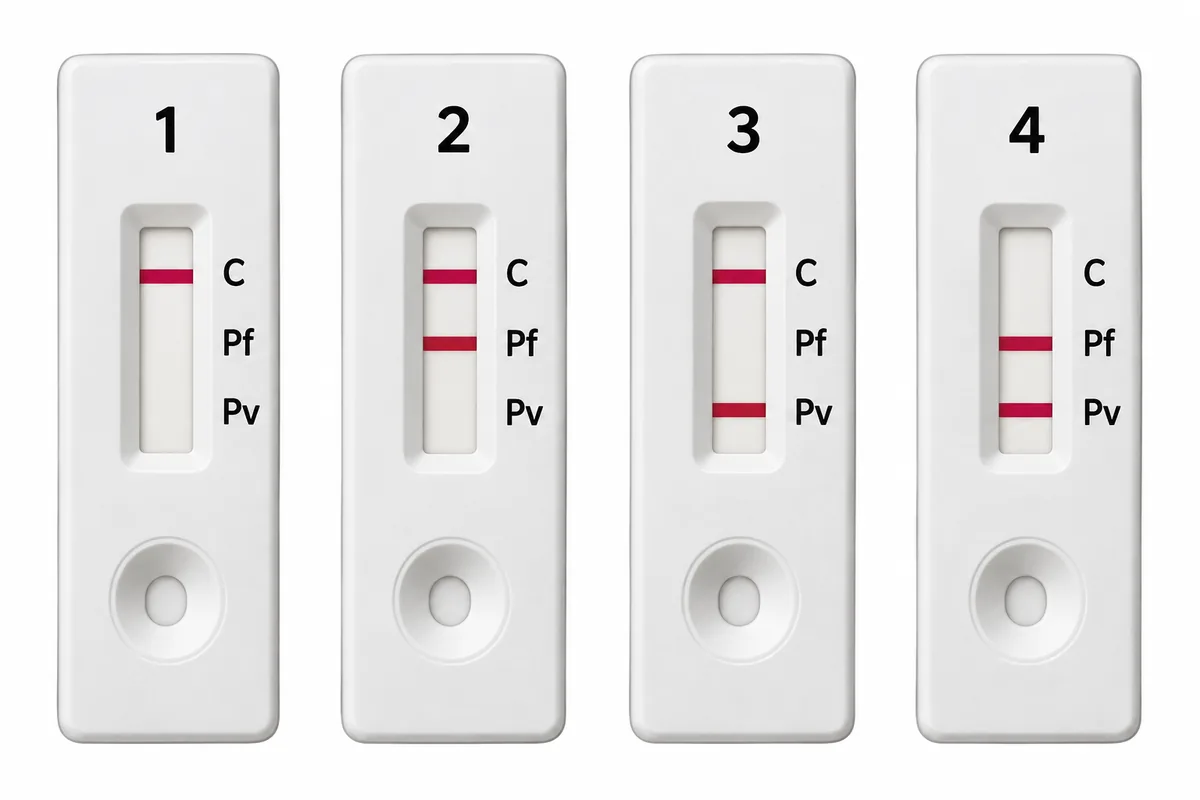
Four bivalent malaria rapid diagnostic test cassettes from four febrile patients at a primary health centre are drawn in the figure. Which cassette shows vivax malaria alone?
Look first: check the control line on every cassette before reading anything else.
 View larger ↗⤢ Tap to enlarge
- ACassette 2
- BCassette 3
- CCassette 1
- DCassette 4
Show the answer and explanation
Answer: B. Cassette 3
Cassette 3. A result can be read only if the control line appears; control and Pv lines alone mean vivax malaria. It is treated with chloroquine for three days and primaquine for fourteen days, which kills the dormant liver stages that cause relapse. Primaquine is withheld in pregnancy, in infants and in known G6PD deficiency.
Why the closest rival loses: cassette 4 (D) shows both Pf and Pv but no control line, so it is invalid and must be repeated. Cassette 2 (A) is falciparum, and cassette 1 (C) a valid negative.
Recallab question 55536 · Social and Preventive Medicine › Malaria · reference: Park's Textbook of Preventive and Social Medicine
Recallab example 5 · leprosy classification
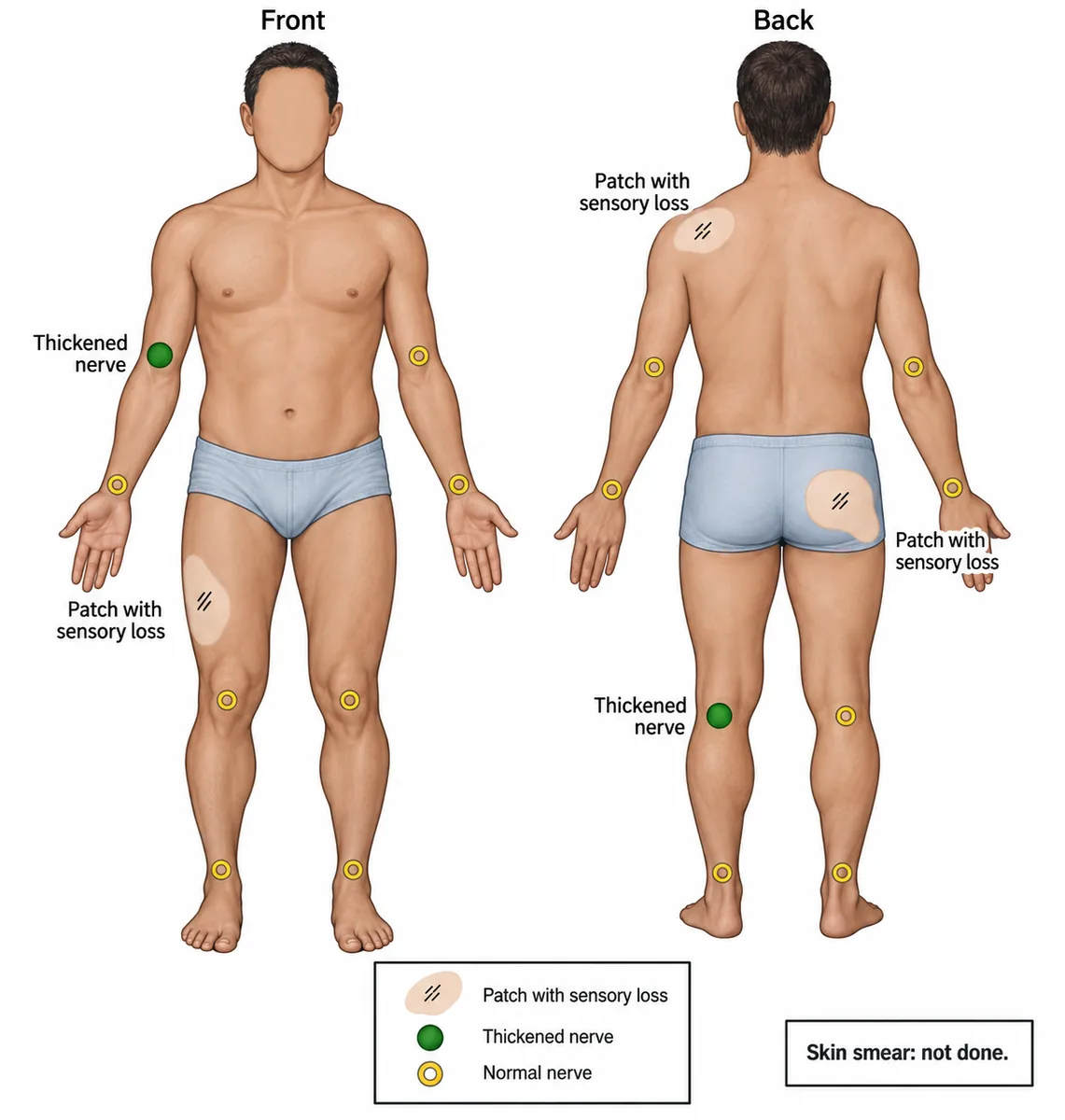
A man's body chart from a leprosy clinic in Chhattisgarh is drawn in the figure, front and back, with his skin patches shaded and his peripheral nerves examined. No skin smear was done. For how long is he treated under the national programme?
Look first: count the patches, then count the thickened nerve trunks, separately.
 View larger ↗⤢ Tap to enlarge
- ATwelve months
- BTwenty-four months
- CSix months
- DUntil the smear is negative
Show the answer and explanation
Answer: A. Twelve months
Twelve months. Under the programme, leprosy is multibacillary if there are six or more patches, or more than one nerve trunk involved, or a positive smear; any one criterion is enough. He has only three patches, but two thickened nerve trunks, ulnar and common peroneal, so he is multibacillary, and multibacillary multidrug therapy runs for twelve months.
Why the closest rival loses: six months (C) is the paucibacillary course, chosen by counting patches alone. Twenty-four months (B) was the old multibacillary course, and the programme uses fixed-duration therapy, so no smear is needed to start or stop (D).
Recallab question 55535 · Social and Preventive Medicine › Leprosy · reference: Park's Textbook of Preventive and Social Medicine
Nutrition at the anganwadi
Recallab example 6 · MUAC screening
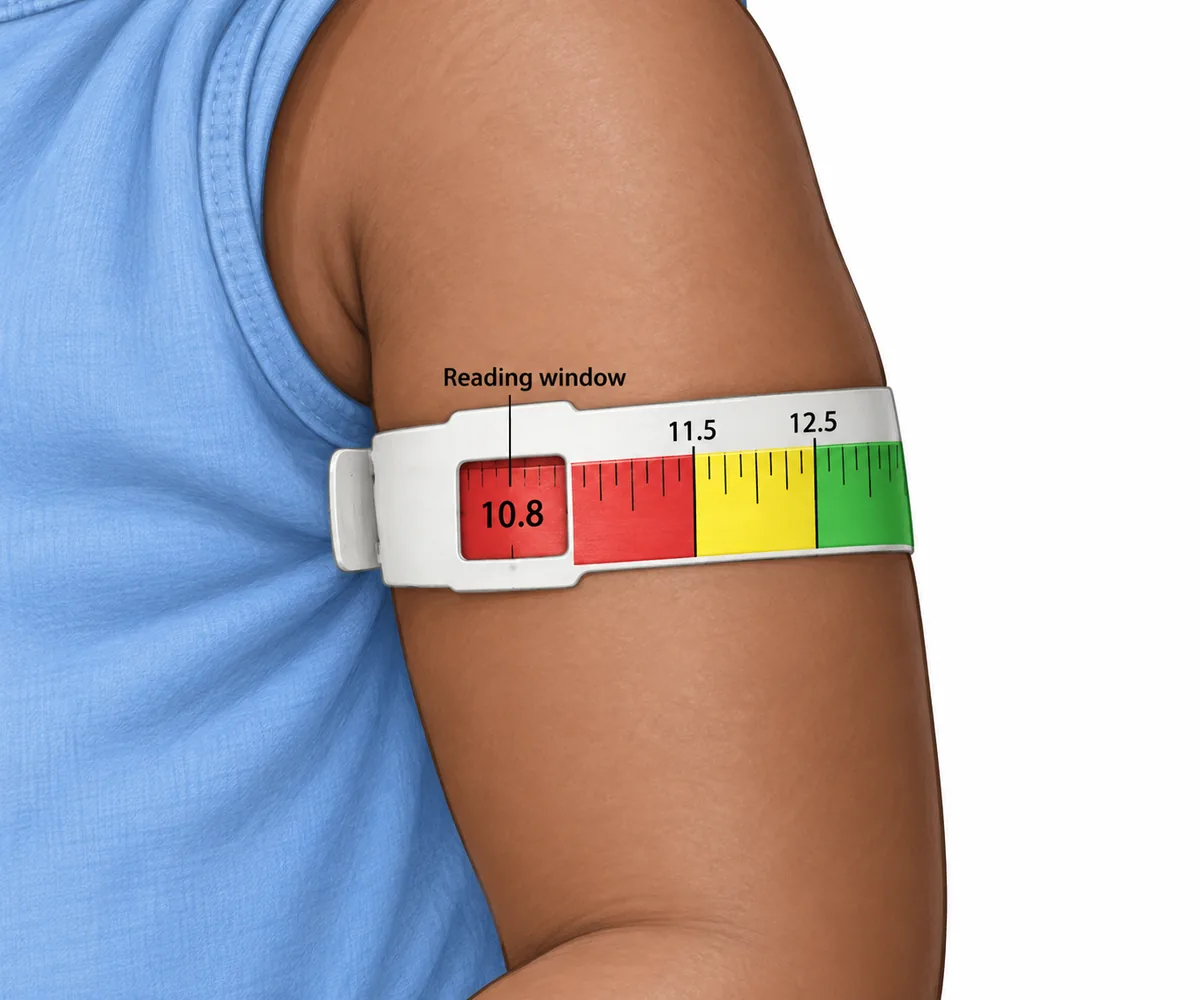
A boy of two is screened at an anganwadi. The tape reads as shown in the figure. He is alert, feeding eagerly, has no oedema and passes the appetite test. What follows?
Look first: the colour gives the severity; the appetite test and complications decide where.
 View larger ↗⤢ Tap to enlarge
- AAdmit for inpatient management
- BReassure and continue routine monitoring
- CSupplementary feeding and review
- DOutpatient care with therapeutic food
Show the answer and explanation
Answer: D. Outpatient care with therapeutic food
Outpatient care with therapeutic food. A reading under 11.5 cm is severe acute malnutrition at any age from six to fifty-nine months; this one is 10.8 cm. He has no oedema, is alert and eats the test dose, so there are no complications, and an uncomplicated case is managed at home with ready-to-use therapeutic food and weekly review.
Why the closest rival loses: admission (A) is for oedema, a failed appetite test, lethargy or an infection needing inpatient care. Supplementary feeding (C) is for the yellow band, 11.5 to 12.5 cm, and reassurance (B) for green.
Recallab question 54751 · Social and Preventive Medicine › Nutrition · reference: Ghai Essential Pediatrics
The one-minute routine
| If you see | Ask first | It usually settles |
|---|---|---|
| A molecular TB report | Is rifampicin resistance detected? | Drug-resistant regimen, and a line probe assay |
| A newborn's immunisation card | How old is the baby? | Hep B within 24 hours, OPV-0 within 15 days, BCG within a year |
| A refrigerator temperature log | Did any reading fall below zero? | Freeze damage: discard adjuvanted vaccines |
| A bivalent malaria rapid test | Is the control line there? | Valid or invalid, then Pf, Pv or both |
| A leprosy body chart | Patches six or more, or more than one nerve trunk? | Multibacillary (12 months) or paucibacillary (6 months) |
| A MUAC tape | Red, yellow or green? | SAM, moderate malnutrition or normal |
Community medicine also has its charts and tables: see biostatistics without fear. To practise the topics that matter most one at a time, see high impact topics for NEET PG.
For growth monitoring and the first days of life in pictures, see six NEET PG paediatrics questions.
Why candidates use Recallab
- Built towards 22,000 — a batch at a time
- Illustrations drawn for the question
- Every option explained, not just the right one
- AI study tools that are live today
- Start free, today
Or see the plans, or try a timed mock section.
Register to practise NEET PG community medicine questionsFree account, no card needed. Practise with every option explained and a reference on every question.Drawn from questions #55332, #55998, #54737, #55536, #55535, #54751 in the Recallab bank, each with its own verified answer and current-edition reference. Last reviewed 2 October 2026.