
Recallab › Blog › High impact topics for NEET PG: five to master first, and how to screen them
High impact topics for NEET PG: five to master first, and how to screen them
Not every topic carries the same weight in your preparation. A few sit at the centre of a subject, and time spent on them pays back across many questions.
Register to practise NEET PG high impact questions →Free account, no card needed.
Recallab's editors have marked out these topics that matter most for NEET PG preparation: antenatal care, glaucoma, stroke, leukaemia, hernia and a few hundred more across the subjects. We call them high impact topics. Below, five real Recallab MentorQs show what one looks like in practice, one topic from each of five subjects. Then we show how to practise a whole topic at a time.
What makes a topic high impact
Five high impact topics, five questions
Recallab example 1 · antenatal care
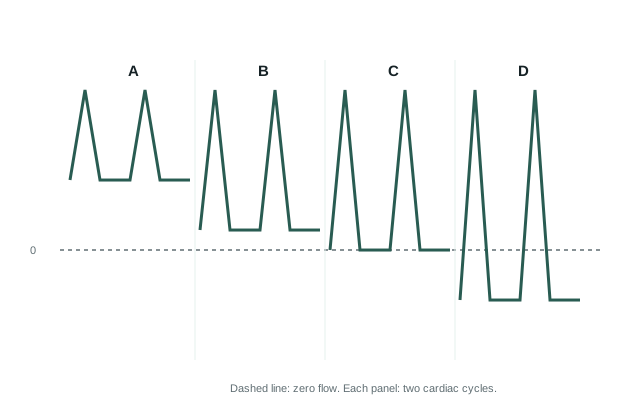
Four umbilical artery Doppler waveforms from a growth-restricted fetus are drawn in the figure, in the order seen as the pregnancy has worsened. Which pattern demands delivery after steroids?
Look first: follow the diastolic part of each wave down to the zero line, and below it.
 View larger ↗⤢ Tap to enlarge
- APanel A
- BPanel B
- CPanel C
- DPanel D
Show the answer and explanation
Answer: D. Panel D
Panel D, reversed end-diastolic flow. As placental resistance rises, diastolic flow falls in stages: normal, reduced, absent, then reversed. Reversed flow means blood runs back towards the placenta in diastole, the most severe pattern, with a high risk of fetal acidaemia and stillbirth. Corticosteroids are given for lung maturity where time allows, and delivery follows promptly.
Why the closest rival loses: absent flow (C) is severe and needs close monitoring, but it is one stage short of reversed. Reduced flow (B) calls for closer surveillance; normal flow (A) is reassuring.
Recallab question 55689 · Obstetrics › Antenatal assessment of the fetus · reference: Williams Obstetrics
Recallab example 2 · glaucoma
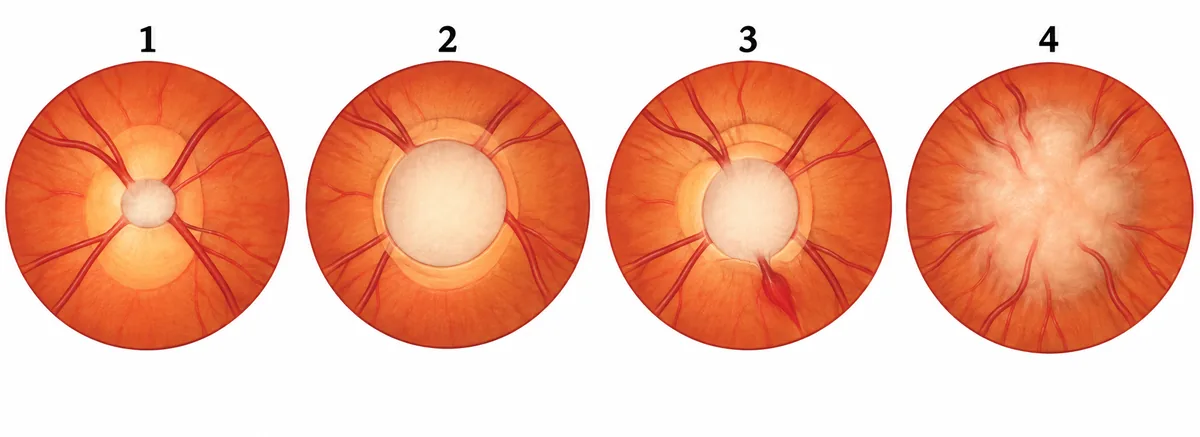
Four optic discs are drawn in the figure with the cup outlined on each. Which disc is glaucomatous?
Look first: ignore the size of each cup at first and compare the rim, pole by pole.
 View larger ↗⤢ Tap to enlarge
- ADisc 4
- BDisc 2
- CDisc 3
- DDisc 1
Show the answer and explanation
Answer: C. Disc 3
Disc 3. The rim is normally widest at the lower pole and narrowest on the temporal side. Disc 3 has a notch at the lower pole, so the rim there is thinner than the temporal rim, and that break in the order is the finding, whatever the cup-to-disc ratio. The haemorrhage at the notch marks recent progression.
Why the closest rival loses: disc 2 (B) has a large cup, but its rim keeps the normal order, which fits a physiologically large disc. Disc 1 (D) is normal, and disc 4 (A) is a swollen disc, a different problem.
Recallab question 55088 · Ophthalmology › Glaucoma · reference: Khurana, Comprehensive Ophthalmology
Recallab example 3 · stroke
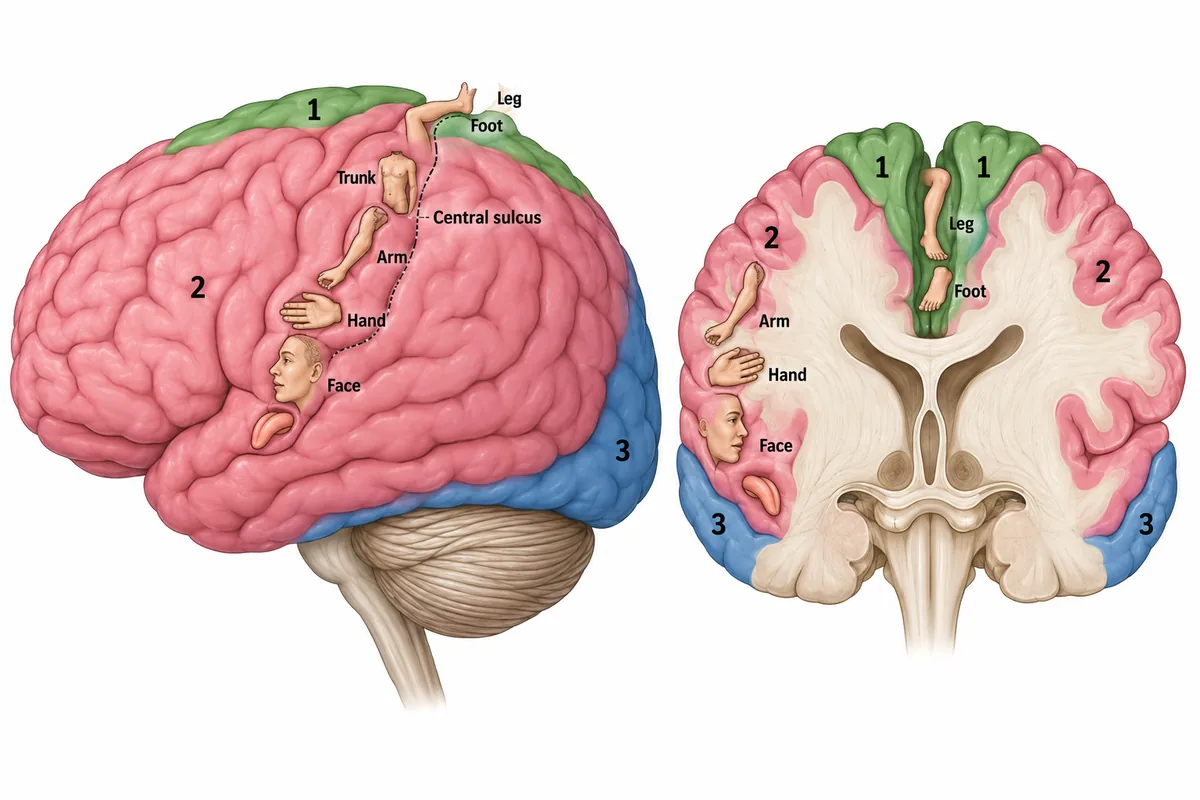
A brain is drawn in the figure with the body map laid along the cortex and three arterial territories shaded. A patient with an infarct in territory 1 has weakness of the leg far worse than the arm, with the face spared. Why does the pattern take that shape?
Look first: find where the leg sits on the body map, then which territory covers it.
 View larger ↗⤢ Tap to enlarge
- AThe leg area lies on the medial surface
- BThe leg area lies on the inferior surface
- CThe artery supplies the internal capsule
- DThe leg area lies on the lateral convexity
Show the answer and explanation
Answer: A. The leg area lies on the medial surface
The leg area lies on the medial surface. Face and hand occupy the lower lateral part of the motor strip; trunk, leg and foot continue over the top onto the medial surface. Territory 1, the anterior cerebral artery's, supplies that medial strip, so it takes the leg and spares the face.
Why the closest rival loses: the lateral convexity (D) carries face and hand, in territory 2, which gives the opposite pattern. An internal capsule lesion (C) affects face, arm and leg alike, and the underside (B) holds the visual cortex.
Recallab question 55069 · Medicine › Neurology · reference: Harrison's Principles of Internal Medicine
Recallab example 4 · leukaemia
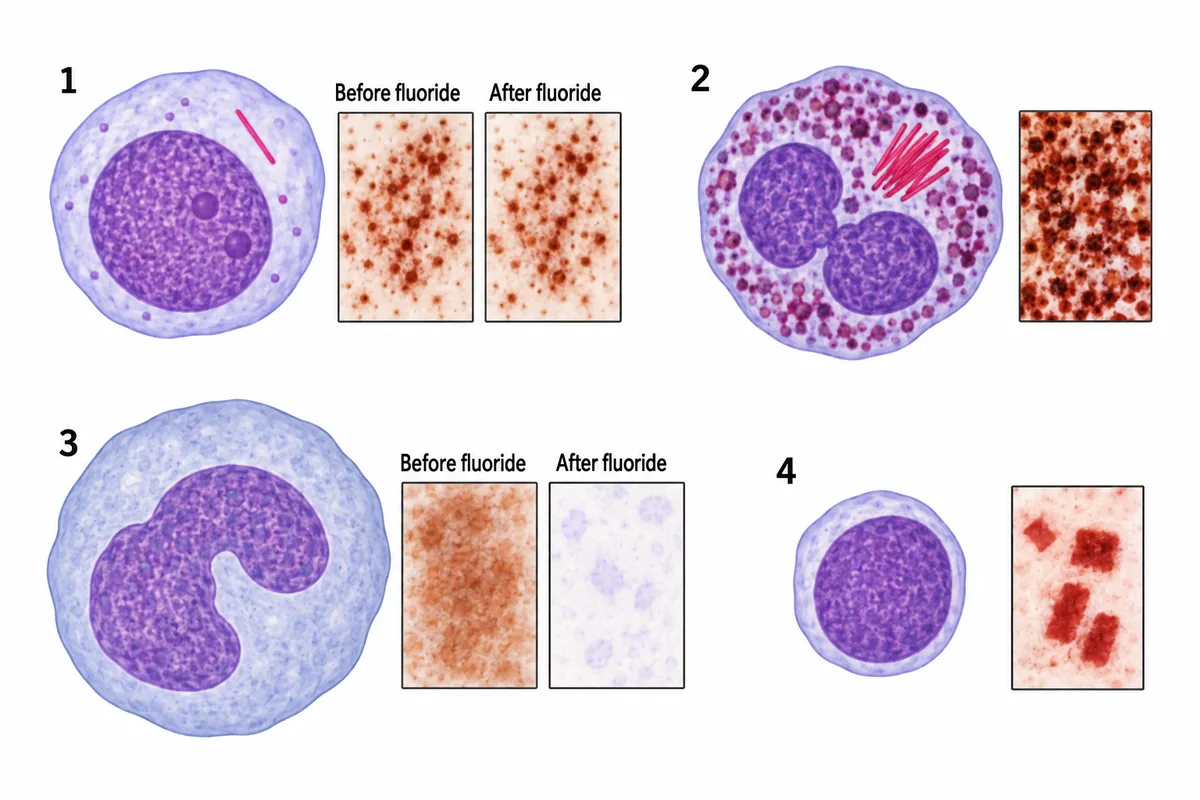
A man of fifty with fever and tiredness has swollen, spongy gums and firm nodules in his skin. Four leukaemic cells with their cytochemical stains are drawn in the figure. Which cell is his?
Look first: gums and skin point to one lineage; then find the stain that fluoride abolishes.
 View larger ↗⤢ Tap to enlarge
- ACell 1
- BCell 2
- CCell 3
- DCell 4
Show the answer and explanation
Answer: C. Cell 3
Cell 3. Gum swelling and skin nodules come from tissue infiltration by monocytic cells. Cell 3 has abundant grey cytoplasm and a folded nucleus, and its non-specific esterase is abolished by fluoride, which confirms the monocytic lineage: acute myeloid leukaemia with monocytic differentiation.
Why the closest rival loses: cell 2 (B), with bundles of rods, is the abnormal promyelocyte, which bleeds rather than infiltrates. Cell 1 (A) is a myeloblast without monocytic features, and cell 4 (D), with block PAS staining, is a lymphoblast.
Recallab question 55823 · Pathology › Haematology · reference: Robbins, Cotran & Kumar Pathologic Basis of Disease
Recallab example 5 · hernia
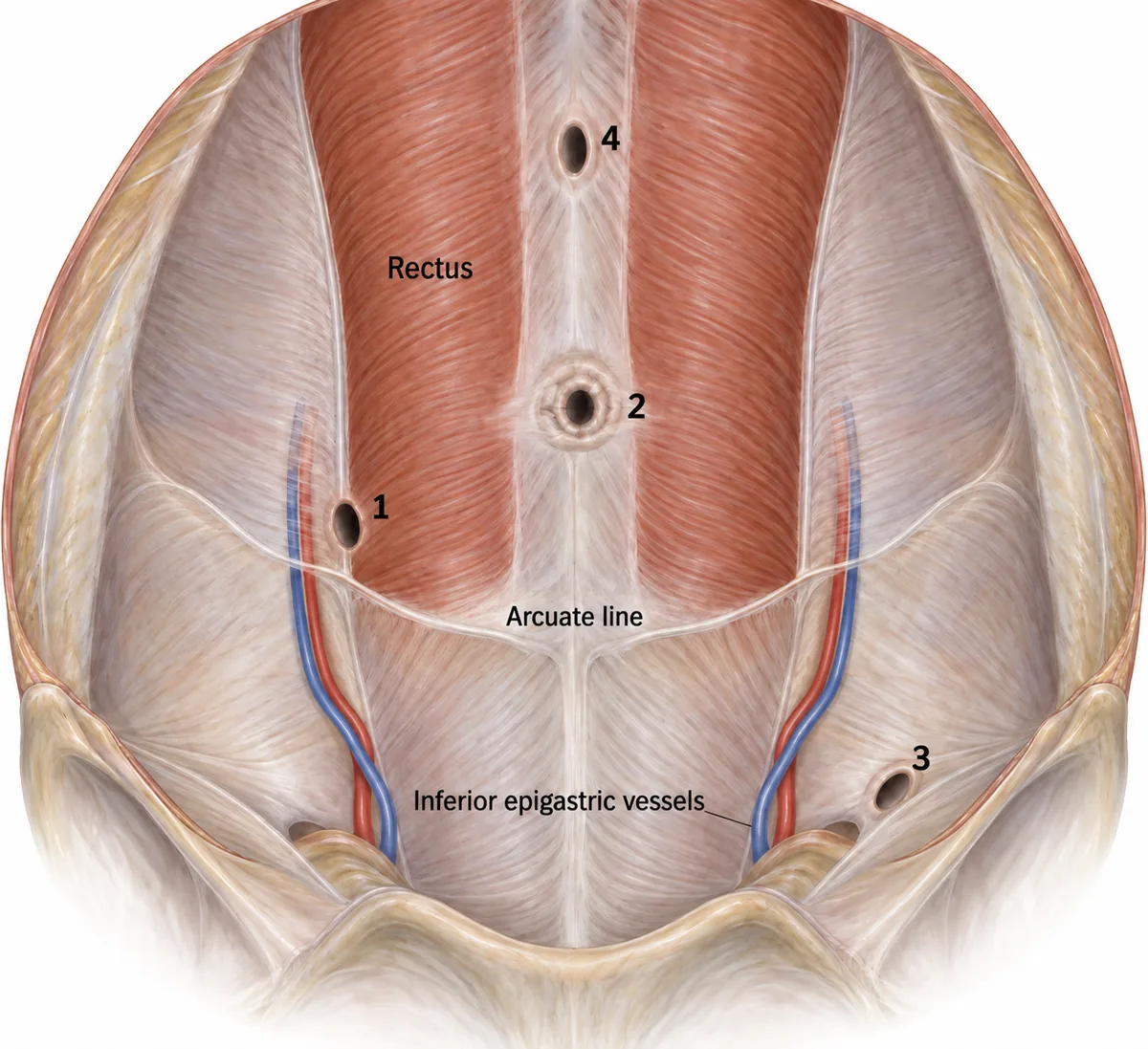
The anterior abdominal wall is drawn in the figure from inside, with four hernia sites numbered. Which is a Spigelian hernia?
Look first: find the lateral edge of the rectus, then where it meets the arcuate line.
 View larger ↗⤢ Tap to enlarge
- ASite 4
- BSite 2
- CSite 3
- DSite 1
Show the answer and explanation
Answer: D. Site 1
Site 1. A Spigelian hernia comes through the linea semilunaris at the lateral edge of the rectus, commonest where the arcuate line meets it. The sac spreads between the muscle layers under intact external oblique aponeurosis, so there may be pain without a visible lump. Its narrow neck makes strangulation likely, so it is repaired.
Why the closest rival loses: site 3 (C) is the deep ring lateral to the inferior epigastric vessels, where an indirect inguinal hernia begins. Site 2 (B) is umbilical, and site 4 (A) an epigastric hernia through the linea alba.
Recallab question 55279 · Surgery › Hernia · reference: Bailey & Love's Short Practice of Surgery
Practise one topic at a time: the High yield screener
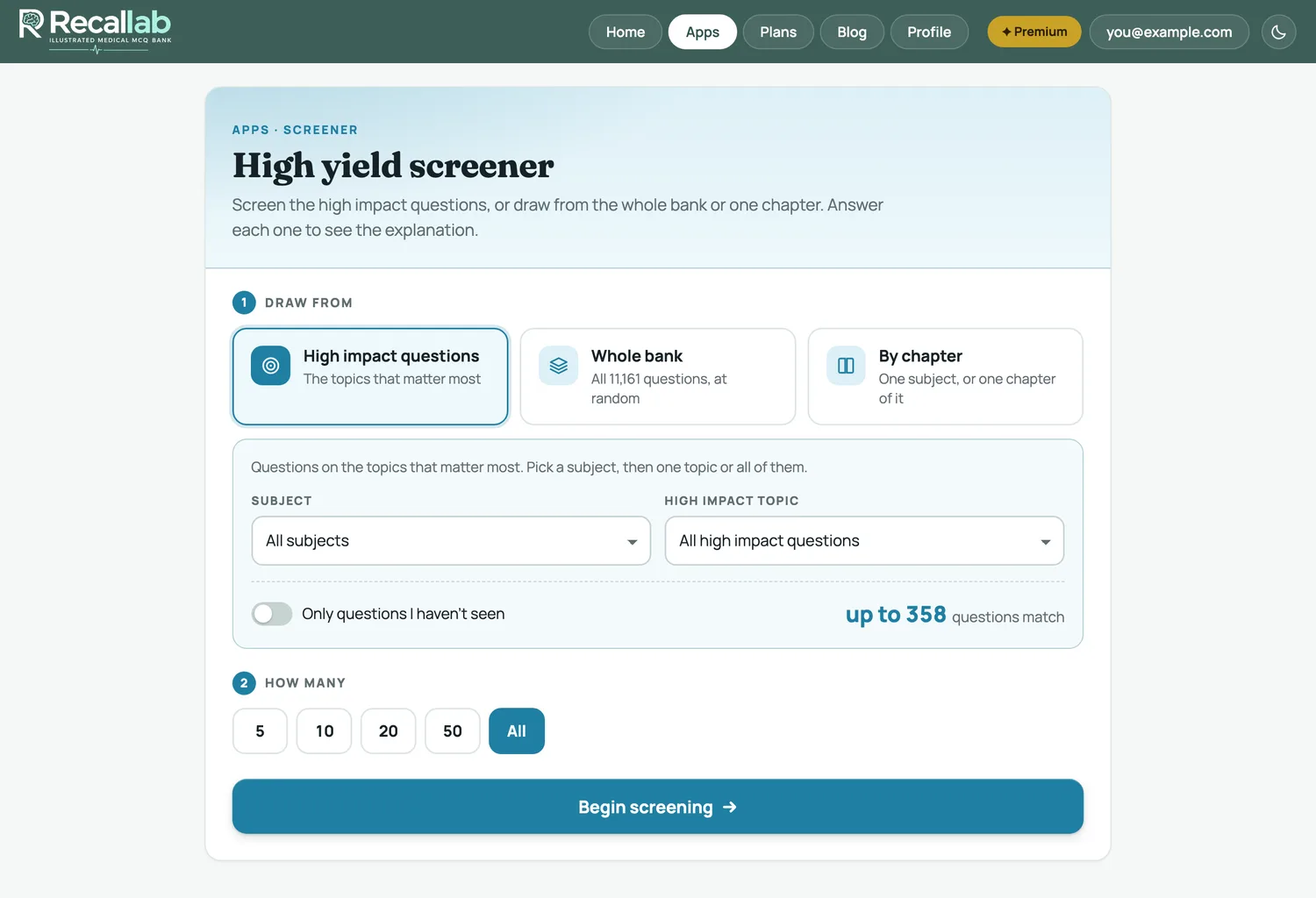
Recallab's High yield screener is built for exactly this. Choose High impact questions, pick a subject, then one topic or all of them, and the screener draws only from those questions. Tick Only questions I haven't seen to skip what you have already met; the page shows how many questions match before you begin.
 View larger ↗⤢ Tap to enlarge
- Screen one topic, then stop. Answer every question in it, read each explanation, and note what you got wrong.
- Save it to My topics. The screener keeps it as a card, shows how many of its questions you have met, and brings it back when it is due.
- Test yourself before you re-screen. Turn the card over, say what you remember, then take five quick questions, the ones you missed first.
- Move on only when it holds. Four or five right, and the topic waits longer before it returns; two or fewer, and it comes back sooner.
The High yield screener and My topics are part of Premium. The practice modes guide walks through every setting, and Plans lists what each one includes.
More topics that matter
Some high impact topics have posts of their own: six ECG strips, six pharmacology graphs, six physiology graphs and biostatistics without fear. When you miss a question in any of them, see how to review a wrong answer.
For a worked set on finding the lesion in the brainstem, cord and arm, see six NEET PG neurology localisation questions.
For a worked set on milestones, measuring a child and the newborn airway, see six NEET PG paediatrics questions.
Why candidates use Recallab
- Built towards 22,000 — a batch at a time
- Illustrations drawn for the question
- Every option explained, not just the right one
- AI study tools that are live today
- Start free, today
Or see the plans, or try a timed mock section.
Register to practise NEET PG high impact questionsFree account, no card needed. Practise with every option explained and a reference on every question.Drawn from questions #55689, #55088, #55069, #55823, #55279 in the Recallab bank, each with its own verified answer and current-edition reference. Last reviewed 1 October 2026.