
Recallab › Blog › Paediatrics for NEET PG: six pictures from growth and milestones to the first days of life
Paediatrics for NEET PG: six pictures from growth and milestones to the first days of life
Paediatrics questions are about age. The same finding is normal at one age and worrying at another, so the first thing to ask is always how old the child is.
Register to practise NEET PG paediatrics questions →Free account, no card needed.
These questions show a baby or a chart and ask what is expected at that age, how to measure it or what to do first. The pictures below are illustrations drawn for the questions, not photographs. Each is a real Recallab MentorQ, and each answer turns on one feature of the picture. Try each before you open the answer.
Before you answer a paediatrics question: three questions
- How old is the child? Head control, a fontanelle or a length measurement all change with age, so fix the age before you read the picture.
- Is this a method or a finding? Some questions ask how to measure or advise, others what is expected or what to do.
- Is anything urgent? Airway and hydration come before anything else.
Growing and developing
Recallab example 1 · pulling to sit
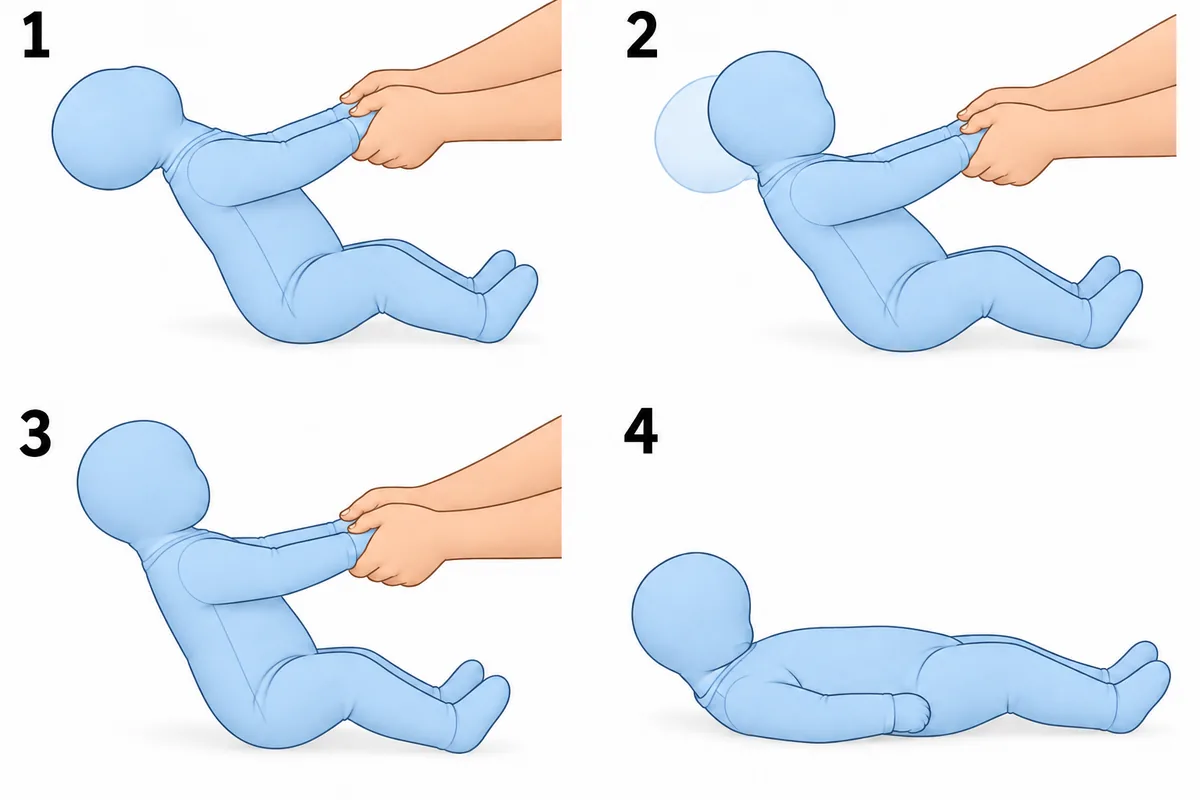
Four drawings of an infant pulled from lying to sitting by the hands are drawn in the figure, numbered. Which drawing is expected at about four months of age?
Look first: watch what the head does during the pull in each drawing, and place each on a timeline from birth.
 View larger ↗⤢ Tap to enlarge
- ADrawing 1, complete head lag
- BDrawing 2, partial head lag
- CDrawing 4, head lifted in anticipation
- DDrawing 3, no head lag
Show the answer and explanation
Answer: D. Drawing 3, no head lag
Drawing 3, no head lag. Head control develops over the first few months. By about three to four months the head no longer falls back and stays in line with the trunk throughout the pull. Persistent head lag beyond six months should prompt evaluation for hypotonia, cerebral palsy or a neuromuscular disorder.
Why the closest rival loses: drawing 2 (B), partial lag, fits an earlier stage, about two months. Drawing 1 (A), complete lag, is the pattern of a newborn. Option C, the head lifted in anticipation, describes a later skill, around five to six months. No head lag by three to four months; sits with support by five to six.
Recallab question 55393 · Paediatrics › Growth & Development · reference: Ghai Essential Pediatrics
Recallab example 2 · the soft spot
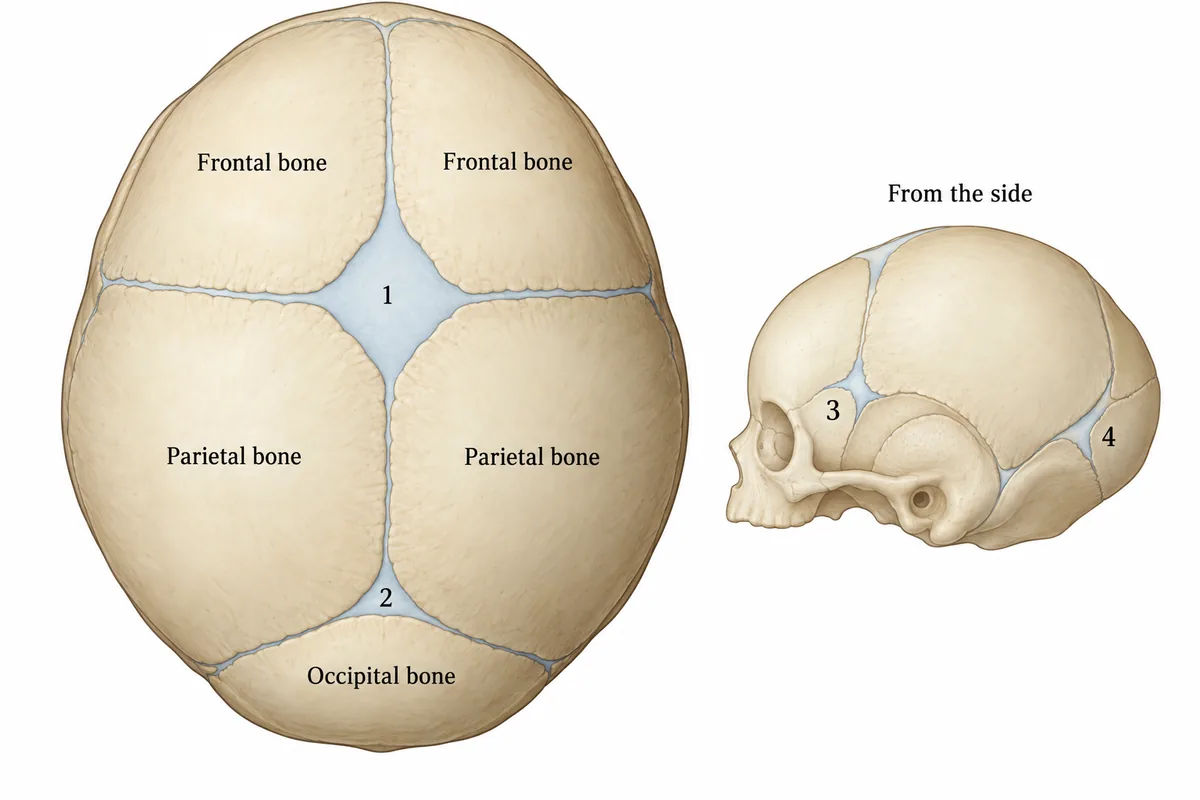
A mother asks when the soft spot on her baby's head will close. The skull of a newborn is drawn in the figure with four gaps numbered, and the one she is feeling is gap 1. By what age is it normally shut?
Look first: find gap 1 among the bones, then compare it with the other three gaps in size and place.
 View larger ↗⤢ Tap to enlarge
- AThree months
- BSix months
- CTwelve to eighteen months
- DSix to eight weeks
Show the answer and explanation
Answer: C. Twelve to eighteen months
Twelve to eighteen months. The soft spot a mother feels on the top of the head is the anterior fontanelle, the large diamond where the two frontal and the two parietal bones meet. It is the largest of the four gaps and the last to ossify. The size matters as much as the timing: one that stays open beyond eighteen months prompts thought about the thyroid, the bones and raised pressure.
Why the closest rival loses: six to eight weeks (D) is when the small triangular gap at the back, gap 2, shuts. Three months (A) and six months (B) are wrong by a year or half a year: the anterior gap is still open at both ages in nearly every infant. Diamond in front closes last; triangle behind closes first.
Recallab question 56481 · Paediatrics › Growth & Development · reference: Ghai Essential Pediatrics
Measuring and monitoring
Recallab example 3 · measuring length
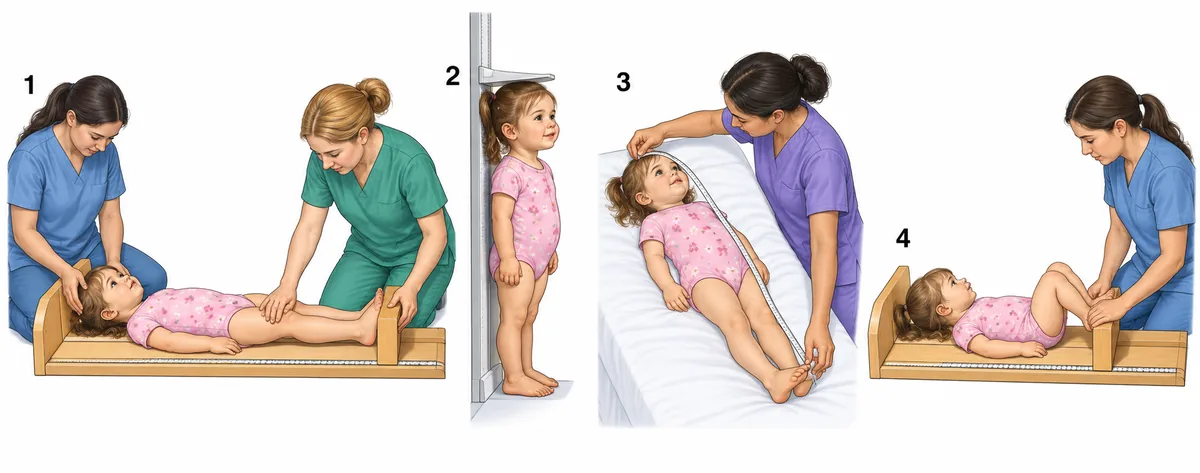
An 18-month-old girl has her length measured at an anganwadi growth-monitoring session, and four ways of measuring her are drawn in the figure. Which one is correct?
Look first: ask how old she is first, then whether the method matches the chart it will be plotted on.
 View larger ↗⤢ Tap to enlarge
- AMeasurement 1
- BMeasurement 4
- CMeasurement 2
- DMeasurement 3
Show the answer and explanation
Answer: A. Measurement 1
Measurement 1. Below two years, length is measured lying down on an infantometer, by two people: one holds the head against the fixed board with the eyes looking straight up, and the other holds the knees straight and brings the footboard to flat heels. The growth charts for children under two are built on length measured lying, which reads about 0.7 cm more than standing height, so the method has to match the chart.
Why the closest rival loses: measurement 2 (C) is standing height, used from two years: before that it reads short and does not match the length charts. Measurement 4 (B), with bent knees and no one at the head, reads falsely short. Measurement 3 (D), a tape along the curves of the body, overestimates and cannot be reproduced reliably. Under two, lie them down: two people, two ends.
Recallab question 57985 · Paediatrics › Growth & Development · reference: Ghai Essential Pediatrics
Recallab example 4 · the dehydration chart
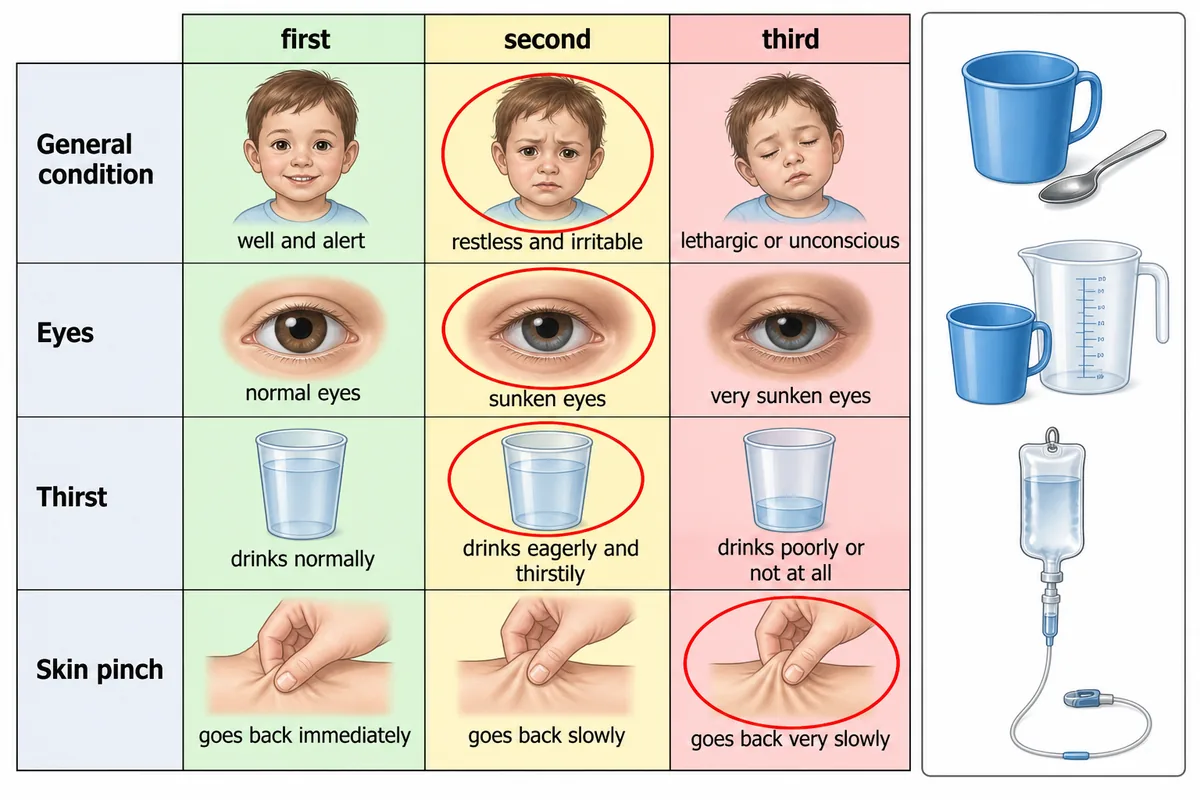
A child with diarrhoea is assessed at a sub-centre against the chart drawn in the figure, and the findings circled fall in two different columns. What fluid should the child be given?
Look first: count how many circled findings lie in each column; do not look only for the worst one.
 View larger ↗⤢ Tap to enlarge
- AIntravenous Ringer lactate
- BExtra home fluids only
- CMeasured oral rehydration solution
- DNasogastric oral rehydration solution
Show the answer and explanation
Answer: C. Measured oral rehydration solution
Measured oral rehydration solution. The column is chosen by counting signs, not by taking the worst one: two or more signs in a column place the child in that column. Three of the four circled findings lie in the second column, so the child has some dehydration and is treated on the middle plan: measured oral rehydration solution over four hours, with reassessment. The one circled sign in the third column does not move the classification.
Why the closest rival loses: intravenous Ringer lactate (A) belongs to the third column, which needs two of its signs, or to failure of the oral route. Extra home fluids only (B) belongs to the first column, and drinking eagerly is itself a sign of the second. Nasogastric oral rehydration solution (D) is the fallback for a child who cannot drink, and this child drinks eagerly. Two signs make the column: count them.
Recallab question 55052 · Paediatrics › Fluid & Electrolyte · reference: Ghai Essential Pediatrics
Safe at home and in the first days
Recallab example 5 · safe sleep
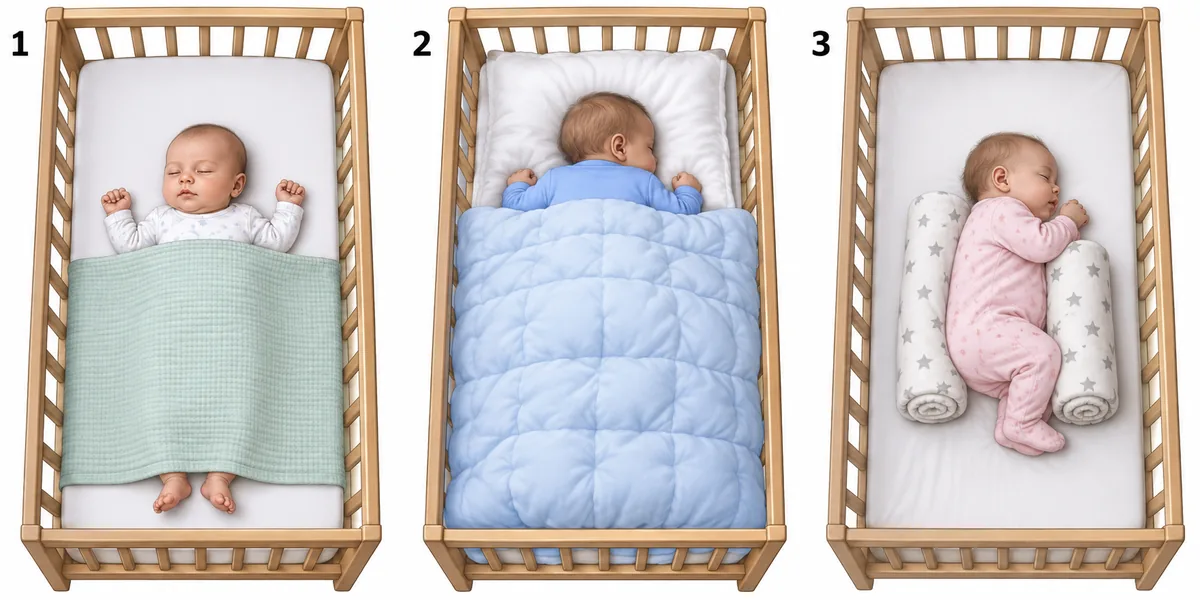
Three sleeping three-month-old infants are drawn in the figure. Which arrangement carries the lowest risk of sudden infant death syndrome?
Look first: compare the position, the surface and the bedding in each cot.
 View larger ↗⤢ Tap to enlarge
- AInfant 3, propped on the side
- BInfant 2, prone on soft bedding
- CInfant 2, prone with the face turned
- DInfant 1, supine in a bare cot
Show the answer and explanation
Answer: D. Infant 1, supine in a bare cot
Infant 1, supine in a bare cot. Babies should sleep on their backs on a firm mattress with no loose bedding and their feet to the foot of the cot. The supine position lowered sudden infant death rates sharply wherever it was adopted, while soft bedding and pillows can cover the face and cause rebreathing, and a vulnerable infant may fail to rouse. Healthy babies protect their airways on their backs.
Why the closest rival loses: infant 3 (A), propped on the side, is unstable: a baby on its side rolls prone easily. Infant 2 (B), prone on a soft pillow under a thick quilt, combines the two strongest risks. Turning the face sideways (C) does not rescue prone sleep. Back to sleep, feet to foot, nothing soft.
Recallab question 55251 · Paediatrics › Growth & Development · reference: Ghai Essential Pediatrics
Recallab example 6 · the newborn airway
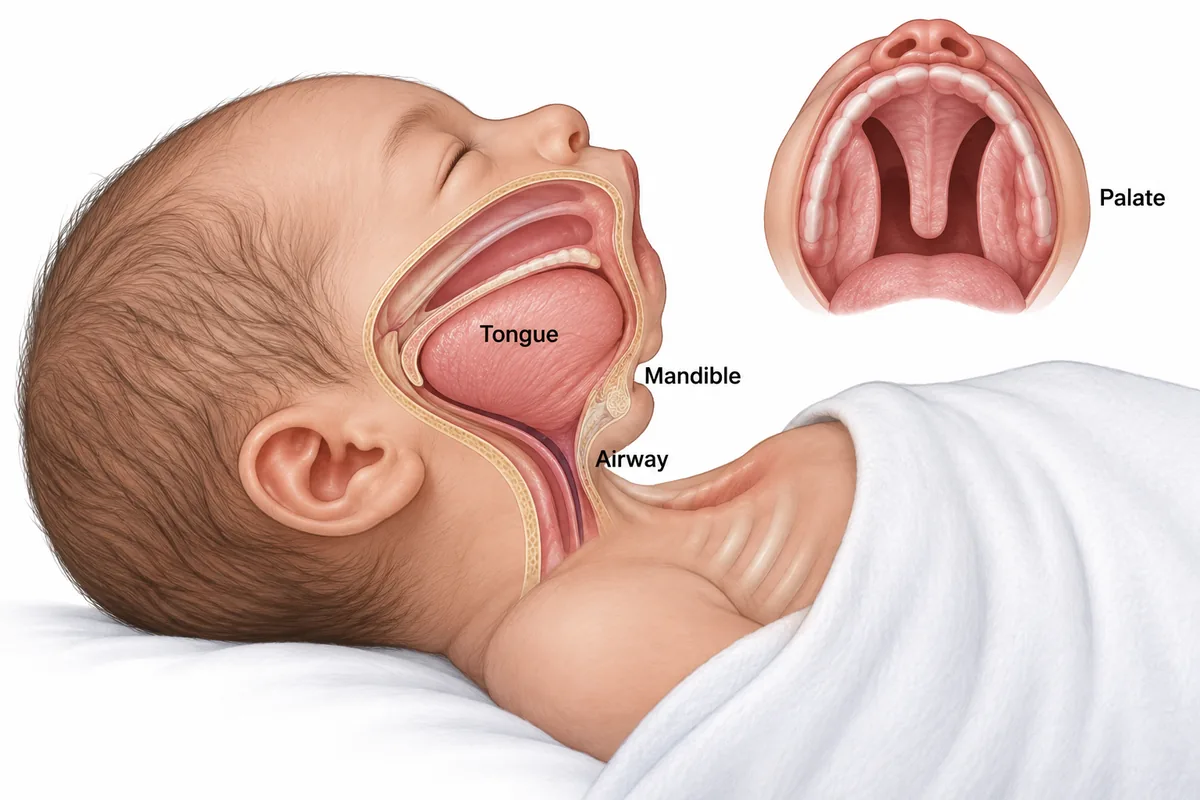
A newborn has noisy, obstructed breathing and difficulty feeding. The face and mouth are drawn in the figure. What is the first measure to relieve the obstruction?
Look first: read the jaw, the tongue and the palate together, and ask what gravity could do to help.
 View larger ↗⤢ Tap to enlarge
- AEarly palate repair
- BTongue-lip adhesion
- CImmediate intubation
- DProne or side-lying nursing
Show the answer and explanation
Answer: D. Prone or side-lying nursing
Prone or side-lying nursing. This is the picture of Pierre Robin sequence: a small mandible leaves the tongue no room in front, so on the back the tongue falls against the back wall of the throat and obstructs breathing. Lying the baby prone or on the side lets gravity bring the tongue forward and the airway opens. Many babies improve as the mandible grows. If positioning fails, a nasopharyngeal airway is passed, and a few need mandibular distraction.
Why the closest rival loses: tongue-lip adhesion (B) is a surgical step for babies who fail positioning, not the first measure. Immediate intubation (C) is kept for failure of simpler measures. Early palate repair (A) is done at about nine to twelve months, and the cleft is not the cause of the obstruction. Small jaw, tongue back, cleft palate: lie them prone.
Recallab question 56184 · Paediatrics › Newborn Infants · reference: Nelson Textbook of Pediatrics
The one-minute routine
| If you see | Ask first | It usually settles |
|---|---|---|
| An infant pulled to sit | What does the head do, and at what age | The expected milestone |
| A newborn skull with gaps | Which gap is which | When each one closes |
| Ways of measuring a toddler | Is the child under two | Length lying down, with two people |
| A chart with circled findings | How many circles lie in each column | The plan for that column |
| Cots with sleeping babies | Position, surface, bedding | The safest arrangement |
| A newborn with a small jaw | Where does the tongue fall | Position first, surgery later |
For other kinds of figure, see ten NEET PG image questions and six eye and ENT spotters. For the decision that follows the picture, see next-best-step management questions.
Why candidates use Recallab
- Built towards 22,000 — a batch at a time
- Illustrations drawn for the question
- Every option explained, not just the right one
- AI study tools that are live today
- Start free, today
Or see the plans, or try a timed mock section.
Register to practise NEET PG paediatrics questionsFree account, no card needed. Practise with every option explained and a reference on every question.Drawn from questions #55393, #56481, #55251, #57985, #55052, #56184 in the Recallab bank, each with its own verified answer and current-edition reference. Last reviewed 11 October 2026.