
Recallab › Blog › Forensic medicine spotters for NEET PG: wounds, weapons and time since death
Forensic medicine spotters for NEET PG: wounds, weapons and time since death
Forensic medicine spotters reward the candidate who knows where to look: a wound's margin, its site, its floor, what lies around it.
Register to practise NEET PG forensic medicine questions →Free account, no card needed.
Most forensic questions in NEET PG are a picture and a name. The pictures repeat: a stab or chop wound, a gunshot wound in section, a body at some point after death. Each has one feature that settles it, and once you know that feature the marks come quickly. Below are eight real Recallab MentorQs, each built on a figure. Try each before you open the answer.
Before you name anything: three questions
- Where is it? The site of an injury often matters more than its size: the palm, the back, the table of the skull.
- What is the margin doing? Turned in or out, clean or bruised, collared or not.
- What is around it or beneath it? Soot, powder marks, a crust, a groove in the bone.
Wounds and weapons
Recallab example 1 · defence wounds
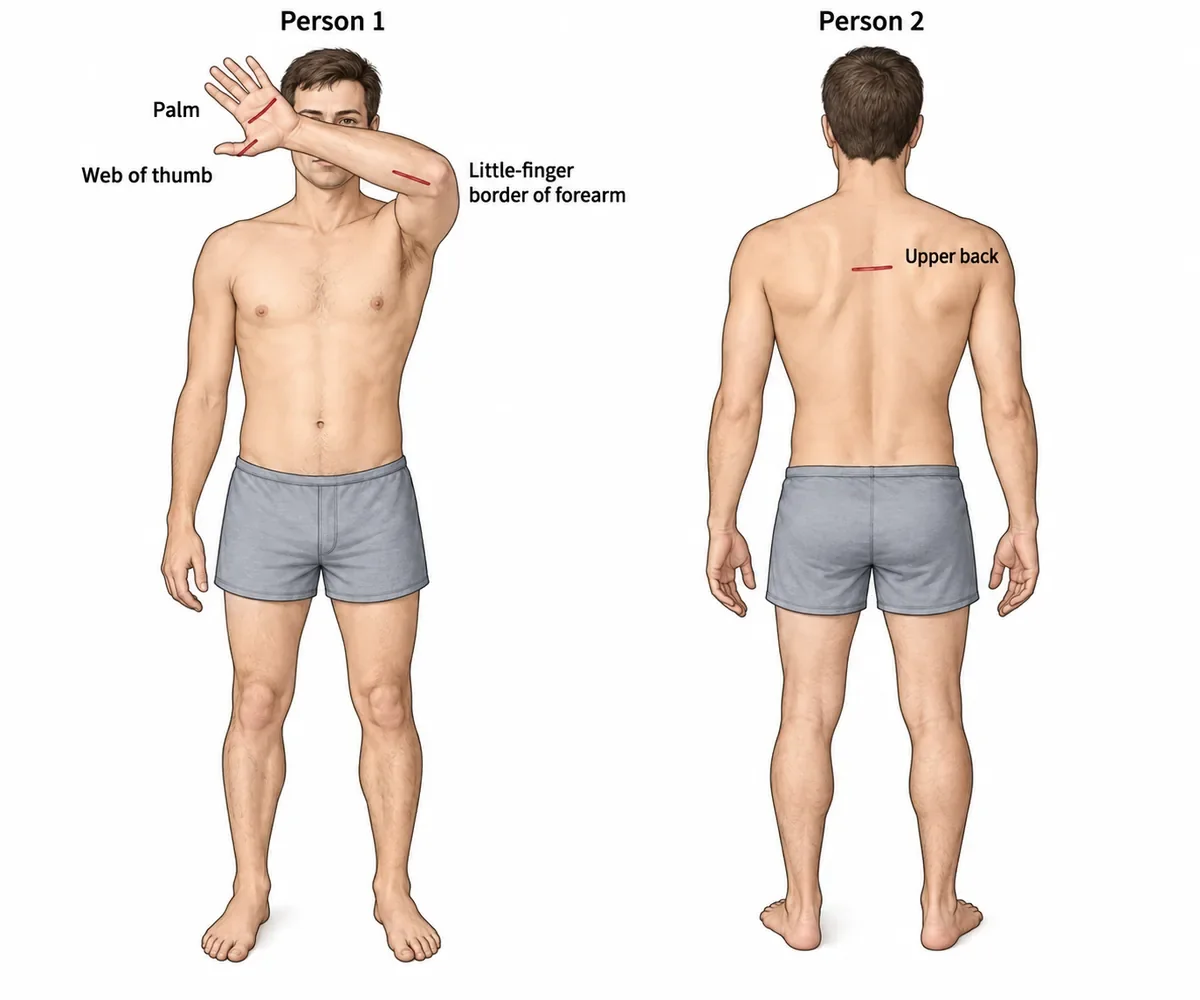
Two people examined after separate assaults with a sharp-edged weapon are drawn in the figure with their injuries marked. Person 1's injuries were sustained while warding the weapon off. What marks them as that?
Look first: look at where the cuts are, not how many there are.
 View larger ↗⤢ Tap to enlarge
- AA site beyond the person’s own reach
- BCuts on the palm and ulnar forearm
- CThe greater number of cuts
- DA cut high on the back
Show the answer and explanation
Answer: B. Cuts on the palm and ulnar forearm
Rule: a defence wound lies where the victim put a surface between the weapon and the body. A person facing a blade raises a forearm across the face and grasps or pushes at the weapon: grasping cuts the palm and the web of the thumb, and warding it off cuts the little-finger border of the forearm.
Why the closest rival loses: the number of cuts (C) carries no weight; a single cut on the ulnar forearm is a defence wound. A site beyond the victim's own reach (A) argues against self-infliction, not for defence, and a cut on the back (D) is taken from behind.
Recallab question 56430 · Forensic Medicine › Mechanical injuries · reference: Reddy, The Essentials of Forensic Medicine and Toxicology
Recallab example 2 · two wound sections
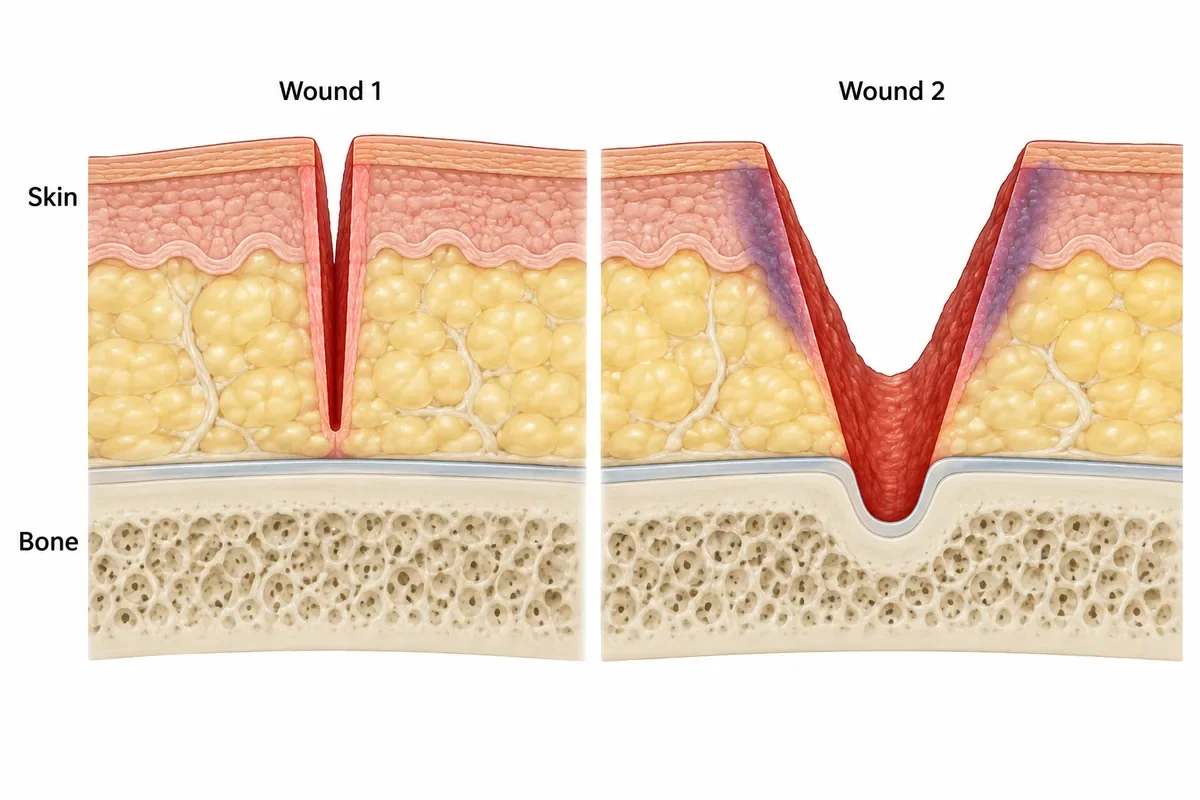
Two wounds from an assault are drawn in cross-section in the figure. What type of wound is wound 2?
Look first: check the margins for bruising and the floor for bone.
 View larger ↗⤢ Tap to enlarge
- AA chop wound
- BA split laceration
- CA stab wound
- DAn incised wound
Show the answer and explanation
Answer: A. A chop wound
Rule: a chop wound is a sharp edge with weight behind it. Wound 2 has clean straight edges, so an edge made it; its margins are bruised and it carries on into the bone as a clean groove, which a light blade does not do. That is an axe or a chopper.
Why the closest rival loses: an incised wound (D) is wound 1: clean, unbruised and stopping short of bone. A split laceration (B) would have tissue bridges and a crushed margin, and a stab wound (C) is deeper than it is long.
Recallab question 58030 · Forensic Medicine › Medicolegal aspects of wounds · reference: Reddy, The Essentials of Forensic Medicine and Toxicology
Recallab example 3 · age of a wound
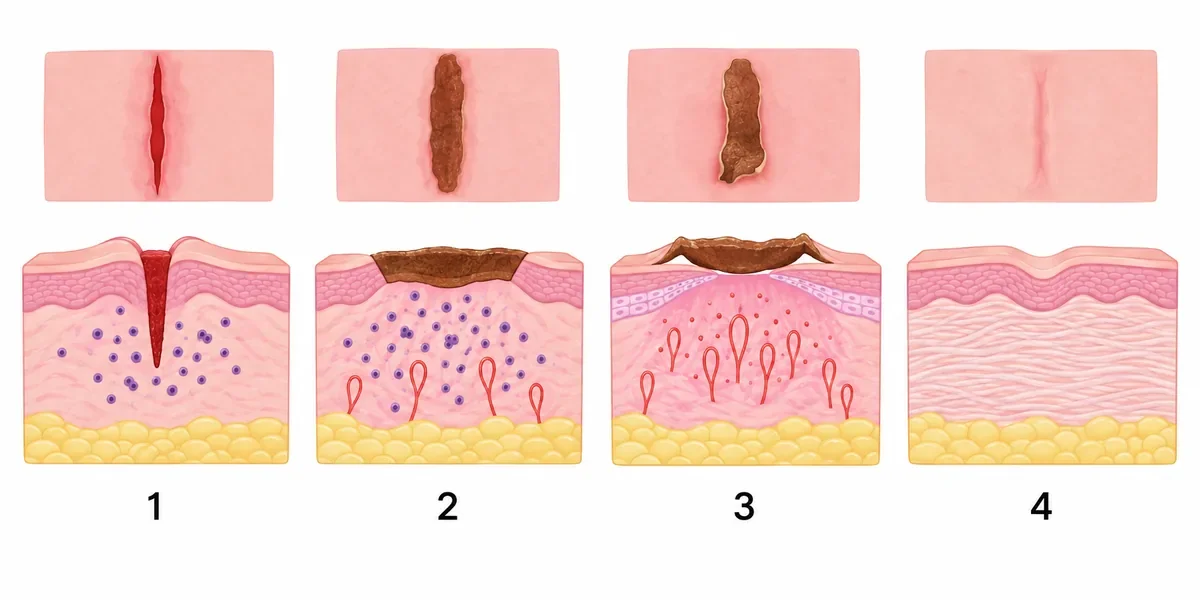
Four wounds are drawn in the figure at one scale as they appeared at examination. Which wound is about a week old?
Look first: read the crust first, then the base beneath it.
 View larger ↗⤢ Tap to enlarge
- AWound 4
- BWound 1
- CWound 3
- DWound 2
Show the answer and explanation
Answer: C. Wound 3
Rule: granulation tissue filling the base, with the crust separating at the edges, is the picture at about a week. Wound 3 shows both, and new surface cells are growing in from each side.
Why the closest rival loses: wound 2 (D) has a crust that is still firmly attached, with only early vessels: two to three days. Wound 1 (B) is the first day, and wound 4 (A) is a scar, weeks to months old. An age is always given as a range, never a date.
Recallab question 55128 · Forensic Medicine › Injuries and trauma · reference: Reddy, The Essentials of Forensic Medicine and Toxicology
Firearm wounds
Recallab example 4 · entry and exit
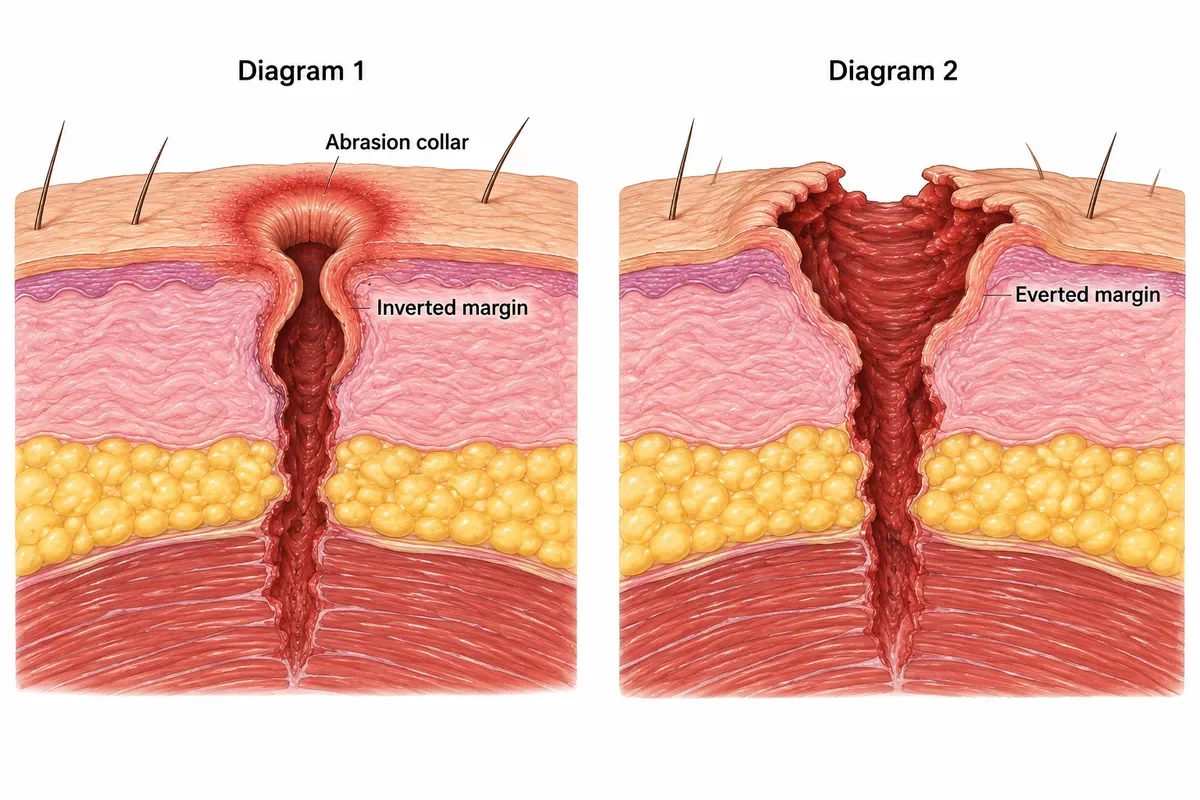
Two gunshot wound cross sections from a distant shot are drawn in the figure. What about the margin of diagram 1 marks it as the entry wound?
Look first: look at which way the skin edge is turned, and what rings it.
 View larger ↗⤢ Tap to enlarge
- ALarger and more ragged
- BBurnt and blackened
- CEverted with no abrasion collar
- DInverted with an abrasion collar
Show the answer and explanation
Answer: D. Inverted with an abrasion collar
Rule: an inverted margin with an abrasion collar marks an entry at any range. The bullet punches the skin inward and rubs its edge as it passes. Soot and powder marks depend on range, which is why a distant shot has neither.
Why the closest rival loses: everted with no collar (C) is diagram 2, the exit; nothing rubs the skin from inside. A larger, ragged hole (A) also points to an exit, and burning (B) needs a close shot.
Recallab question 56231 · Forensic Medicine › Injuries and ballistics · reference: Reddy, The Essentials of Forensic Medicine and Toxicology
Recallab example 5 · range of fire
Four gunshot wounds from four bodies are drawn in cross-section in the figure, lettered W to Z. Two of them show scattered punctate marks in the skin around the wound. Which of those two was fired from the greater range?
Look first: find the two with punctate marks first, then see which one also has soot.
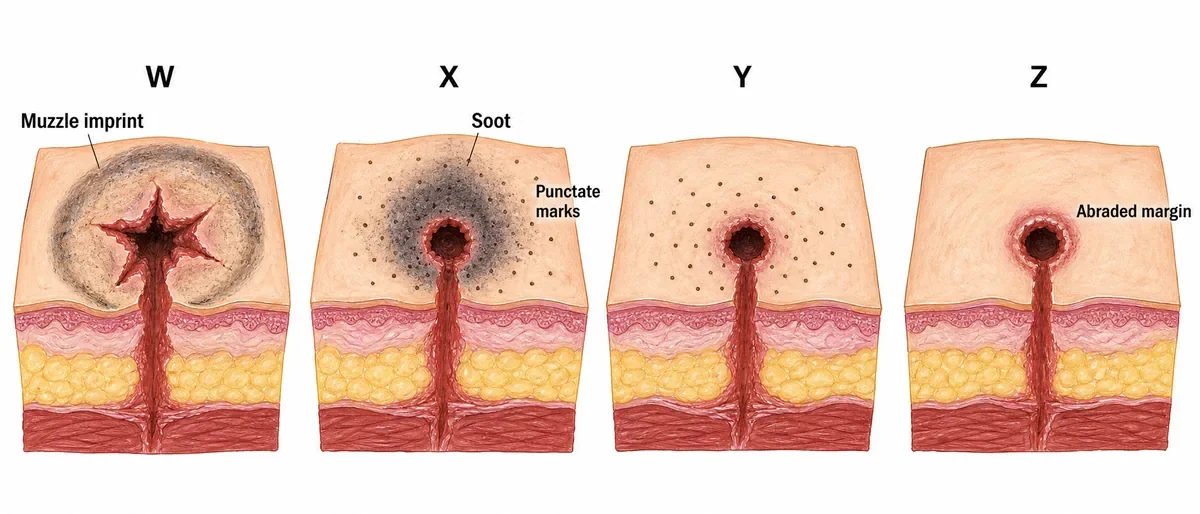 View larger ↗⤢ Tap to enlarge
- ASection X
- BSection W
- CSection Y
- DSection Z
Show the answer and explanation
Answer: C. Section Y
Rule: soot travels a shorter distance than the powder grains that tattoo the skin. X and Y both have punctate marks, but only X has soot, so Y was fired from further away.
Why the closest rival loses: X (A) has soot as well, so it is nearer. W (B) is a contact wound, with a muzzle imprint and a torn star-shaped margin, and Z (D) has no punctate marks at all: the most distant of the four, but not one of the two the question asks about.
Recallab question 56727 · Forensic Medicine › Injuries and ballistics · reference: Reddy, The Essentials of Forensic Medicine and Toxicology
Recallab example 6 · skull bevelling
Two bullet holes from one skull are drawn in the figure in cross section through the vault. Hole A is the entry wound. On what feature does that rest?
Look first: find which table carries the crater, then ask which way the bullet was going.
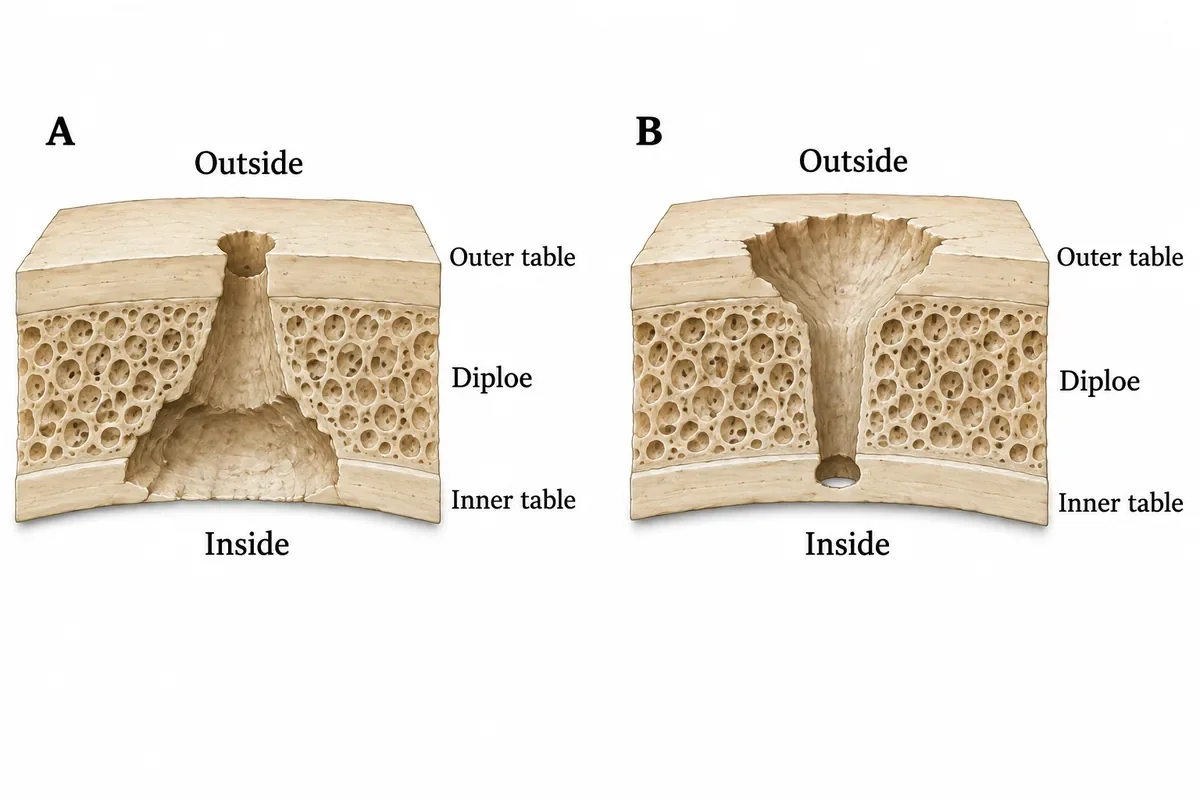 View larger ↗⤢ Tap to enlarge
- AThe crater is on the outer table
- BIts clean opening faces inwards
- CThe crater is on the inner table
- DIt is the larger opening
Show the answer and explanation
Answer: C. The crater is on the inner table
Rule: a bullet bevels the table it leaves. It punches a clean hole in the first plate of bone it strikes and chips out a cone as it leaves. Hole A is clean outside and cratered inside, so the bullet was travelling inwards: an entry.
Why the closest rival loses: a crater on the outer table (A) is hole B, an exit. A clean opening facing inwards (B) also describes an exit, and on the outer surface the entry is the smaller opening, not the larger (D).
Recallab question 55627 · Forensic Medicine › Injuries and ballistics · reference: Reddy, The Essentials of Forensic Medicine and Toxicology
Time since death
Recallab example 7 · rigor mortis
A body is drawn in the figure at four times after death, with the muscle groups that have stiffened shaded at each stage. What change inside the muscle fibre causes the stiffening?
Look first: follow the shading from drawing 1 to drawing 4 before you think about the cell.
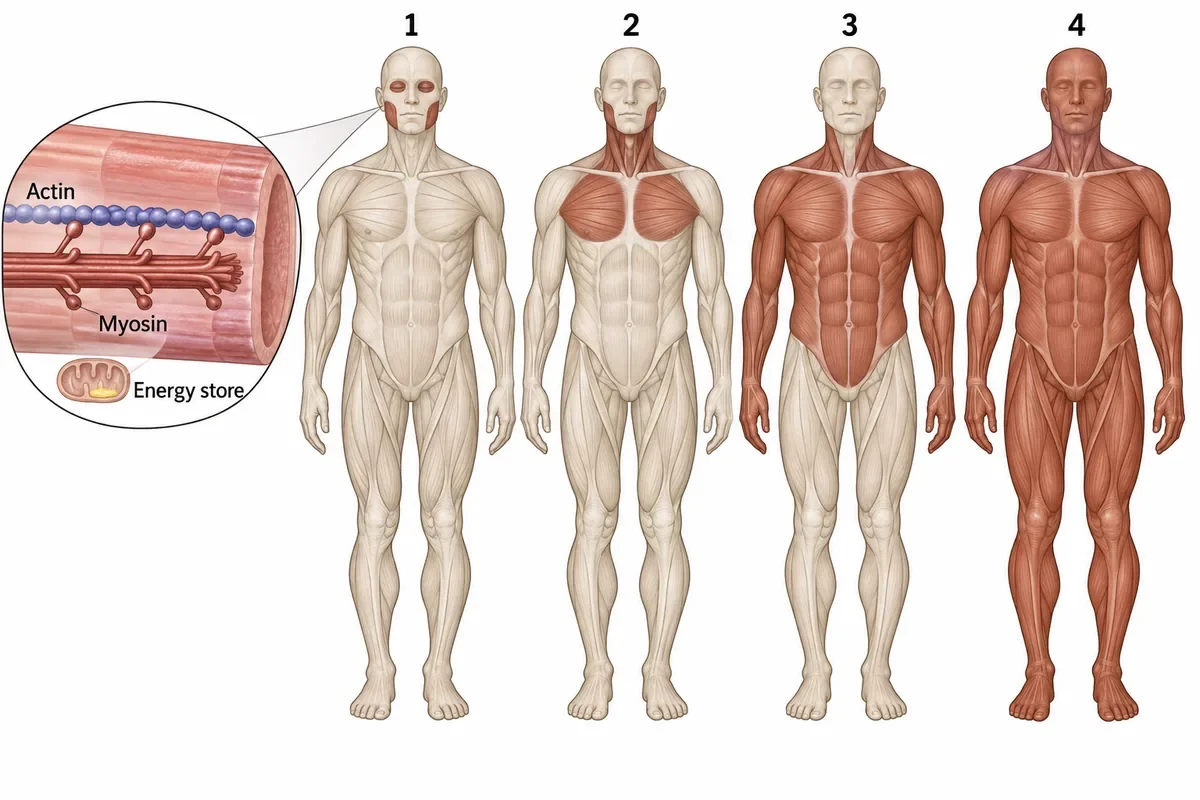 View larger ↗⤢ Tap to enlarge
- ALoss of acetylcholine at the end plate
- BCalcium leaving the fibre
- CDepletion of ATP
- DAccumulation of lactic acid
Show the answer and explanation
Answer: C. Depletion of ATP
Rule: ATP is needed to release actin from myosin, not to bind them. As ATP runs out after death the cross-bridges lock and cannot let go, which is rigidity. It spreads from the small muscles of the face to the limbs (Nysten's rule), and passes off in the same order.
Why the closest rival loses: lactic acid (D) does build up, but it is not what locks the filaments; the old acid theory gave way to the ATP explanation. Rigor needs no nerve signal (A), and calcium leaks into the fibre after death rather than leaving it (B).
Recallab question 55830 · Forensic Medicine › Postmortem changes · reference: Reddy, The Essentials of Forensic Medicine and Toxicology
Recallab example 8 · putrefaction
A body recovered after several days in a warm climate is drawn in the figure, with a cutaway of the abdominal cavity and a timeline of the changes beside it. Which postmortem change does this appearance belong to?
Look first: read the timeline under the body: what comes before this stage, and what after?
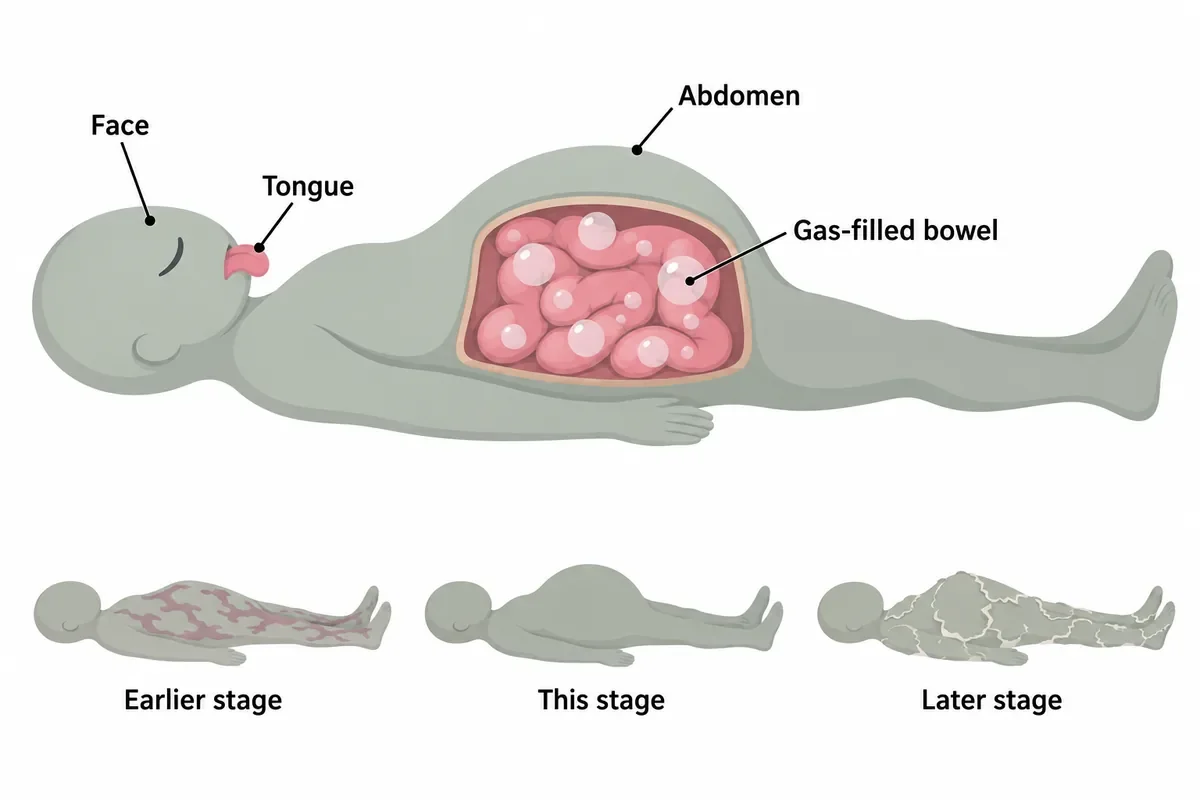 View larger ↗⤢ Tap to enlarge
- AAlgor mortis
- BRigor mortis
- CPutrefaction
- DCadaveric spasm
Show the answer and explanation
Answer: C. Putrefaction
Rule: gas from putrefaction is trapped in closed spaces, and it is that gas that bloats the body. It distends the bowel and the abdomen, pushes the tongue out between the lips and swells the face. Bloating comes after the green discolouration and marbling, and before the skin blisters and slips.
Why the closest rival loses: rigor mortis (B) stiffens muscle but makes no gas. Algor mortis (A) is cooling, and cadaveric spasm (D) is an instant stiffening at the moment of death.
Recallab question 56931 · Forensic Medicine › Postmortem changes · reference: Reddy, The Essentials of Forensic Medicine and Toxicology
The spotter routine
| If you see | Look first at | It usually settles |
|---|---|---|
| Cuts on a living person | Where they are | Defence or not |
| A wound in section | Margin bruising, the floor, the bone | Incised, chop, laceration or stab |
| A healing wound | The crust, then the base | Its age, as a range |
| A gunshot wound | Margin turned in or out; collar; soot; powder marks | Entry or exit, and the range |
| A bullet hole in bone | Which table is cratered | The direction of fire |
| A body after death | How far stiffening or decomposition has gone | The time since death |
More worked figures: six ECG strips, six biostatistics charts, six pharmacology graphs, six microbiology and pathology spotters, six eye and ENT spotters, six anatomy cross-sections and ten NEET PG image questions. For a fuller reading of any question you get wrong, ask for a Professor’s take: see Meet MentorQs.
Why candidates use Recallab
- Built towards 22,000 — a batch at a time
- Illustrations drawn for the question
- Every option explained, not just the right one
- AI study tools that are live today
- Start free, today
Or see the plans, or try a timed mock section.
Register to practise NEET PG forensic medicine questionsFree account, no card needed. Practise with every option explained and a reference on every question.Drawn from questions #56430, #58030, #55128, #56231, #56727, #55627, #55830, #56931 in the Recallab bank, each with its own verified answer and current-edition reference. Last reviewed 26 September 2026.